Pemayangtse Monastery
Pemayangtse Monastery
Founded in the 17th century at 2,085 m altitude, Pemayangtse is the royal monastery of the former Sikkim kingdom. Kangchenjunga views, a unique sacred model, and the Cham festival make it a major stop in western Sikkim.
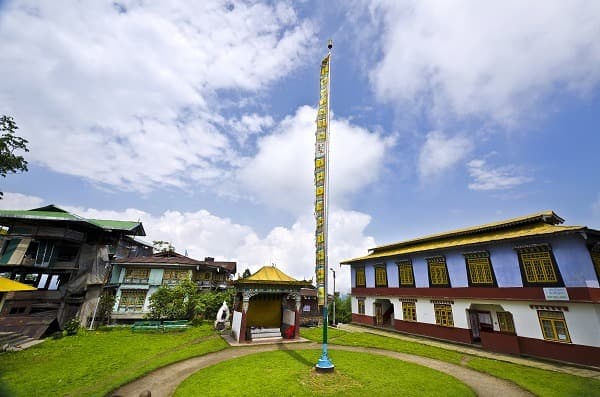
Perched at approximately 2,085 meters altitude in western Sikkim, Pemayangtse Monastery is one of the oldest and most venerated monasteries of Nyingma Buddhism in India. Founded in the 17th century, it overlooks the Rabdentse valley and offers clear views of Kangchenjunga in fair weather. It remains an active center of monastic life, not merely a tourist site.
Practical Information at a Glance
- Entry: paid (modest fee, confirm locally)
- Dress code: shoulders and knees covered; shoes removed at prayer hall entrances
- Recommended duration: 1 to 2 hours for the monastery alone; half-day when combining Rabdentse ruins
- Access: approximately 8 km from Pelling, reachable by shared taxi or private vehicle from Pelling or Geyzing
- Accessibility: limited — sloped terrain, non-adapted stairs
What to See
The complex comprises three levels. The ground floor houses the main prayer hall, adorned with thangkas, Buddha statues, and vibrant murals. The second floor preserves ancient sacred texts. On the third floor stands Zangdog Palri, a hand-carved wooden model representing Guru Rinpoché's paradise — a unique work, crafted by a monk over several years.
History and Context
The name Pemayangtse means "sublime and perfect lotus" in Tibetan. The monastery was founded around 1705 by Lhatsun Chempo, one of three saintly lamas who consecrated Sikkim's first king. It belongs to the Nyingma order, the oldest school of Tibetan Buddhism. Long the royal monastery of the Sikkim kingdom, it retains paramount status in the region's religious hierarchy.
Highlights of Your Visit
The Zangdog Palri Model
On the third floor, this polychrome wooden sculpture depicts across multiple levels Guru Rinpoché's celestial paradise. Every detail — deities, mythical animals, palaces — is hand-carved. It is the most photographed and discussed piece in the monastery.
The Main Prayer Hall
Walls are covered with murals illustrating the Nyingma Buddhist pantheon. Golden statues, prayer flags, and incense scent create an atmosphere of genuine reverence, especially during morning services.
The Kangchenjunga View
In clear weather — especially October-November and March-April — the monastery's terrace offers direct views of Kangchenjunga (8,586 m), the world's third-highest peak. Dawn is the best time for this vista.
The Cham Festival
Each year, typically in December or January according to the Tibetan lunar calendar, the monastery hosts the Cham dance: masked monks perform ritual dances in the courtyard. It ranks among western Sikkim's most important religious events.
Etiquette and Visiting Rules
- Remove your shoes before entering any prayer hall.
- Dress modestly: cover shoulders and knees.
- Circumambulate stupas and prayer wheels clockwise.
- Speak softly; monks may be meditating or at service.
- Ask permission before photographing monks or ceremonies.
Photography Tips
Morning light (between 7 and 9 a.m.) is ideal for photographing the façade and Kangchenjunga view. Indoors, light is dim: a fast lens or high ISO is necessary. The Zangdog Palri model is generally permitted for photography, but check with the attendant. Avoid flash in prayer halls.
Location and Access
Pemayangtse sits in Geyzing district (western Sikkim), about 8 km from Pelling, the nearest tourist hub. From Gangtok, allow approximately 4 to 5 hours' drive. The nearest airport is Bagdogra (Siliguri, West Bengal), about 3 hours away. Shared taxis regularly connect Pelling to Geyzing and surrounding sites. No direct rail access.
Nearby
- Rabdentse Ruins — less than a kilometer walk away, ancient royal capital of Sikkim with panoramic mountain views.
- Pelling — transit town 8 km away, launching point for hikes and excursions in western Sikkim.
- Sanga Choeling Monastery — one of Sikkim's oldest monasteries, reachable on foot from Pelling via a forest trail.
- Kanchenjunga Falls — waterfall accessible from the Pelling-Geyzing road, an easy stop en route.
Frequently asked questions
October-November and March-April offer the clearest skies for Kangchenjunga views. The monsoon (June-September) makes roads difficult and views rare. In December-January, the Cham festival is an added attraction despite the cold.
Foreign nationals must obtain an Inner Line Permit (ILP) to enter Sikkim. It is obtained upon arrival at Bagdogra, Siliguri, or Gangtok. Pemayangtse is accessible with this standard permit; some border areas require additional permits.
Yes. Both sites are less than a kilometer apart. Allow 1.5 to 2 hours for the monastery, then 45 minutes to 1 hour for the Rabdentse ruins. A taxi from Pelling can drop you off and wait.
Photography is generally tolerated in halls, including of the Zangdog Palri model. Flash should be avoided out of respect and to preserve murals. Confirm with the monk at the entrance.
The monastery operates a simple guesthouse run by monks, open to visitors wishing to stay. Pelling, 8 km away, offers a wider choice of hotels and guesthouses for all budgets.
The Cham festival typically occurs in December or January, according to the Tibetan lunar calendar. Dates vary yearly; consult your local agency or Sikkim's tourism department before planning your visit.
Photos
Want to discover this destination?
Our local advisors design your tailor-made trip.