Sas-Bahu Temples, Gwalior
Perched on the Gwalior Fort plateau, the 11th-century Sas-Bahu temples display carved friezes of exceptional density, testament to the refinement of medieval Vaishnavite art.
Perched on the Gwalior Fort plateau, the Sas-Bahu temples (literally "mother-in-law and daughter-in-law") form an 11th-century architectural pair dedicated to Vishnu. Built under the Kachchhapaghata dynasty, they exemplify the refinement of medieval sculpture in Madhya Pradesh. Their red sandstone decoration, of remarkable density, contrasts with the austerity of the ramparts that surround them.
Practical Information at a Glance
- Access: within the Gwalior Fort enclosure, accessible via the northern road (Urvahi Gate) or the eastern road (Gwalior Gate).
- Admission: included in the Gwalior Fort entrance ticket (differentiated pricing for Indian residents / foreign visitors).
- Suggested duration: 30 to 45 minutes for both temples.
- Dress code: modest dress recommended; the temples remain partially active.
What to See
The main temple (Sas) is the more imposing: its multi-tiered shikhara rises above a sculpted base adorned with friezes of deities, gandharvas, and geometric motifs. The smaller temple (Bahu), more modest in scale, preserves a finely worked columned portico. Both structures share the same orientation and ornamental vocabulary, suggesting a planned construction.
History and Context
The temples date from the reign of Mahipala (circa 1093–1105), a Kachchhapaghata ruler and vassal of the Chandelas. Dedicated to Vishnu in his Padmanabha and Sas-Bahu forms, they bear witness to the vitality of Vaishnavite worship in the region before the Delhi Sultanate's invasions. Though some sculptures have suffered degradation over the centuries, the ensemble remains remarkably legible.
Highlights of the Visit
The Main Temple's Carved Friezes
The Sas temple's base unfolds multiple registers of sculpture: processions of elephants, figures of dancers, deities in medallions. The density and precision of the carving make it one of the finest examples of the central Madhya Pradesh sculptural school.
The Smaller Temple's Portico
The Bahu temple preserves a portico with fluted columns whose capitals, adorned with foliage and figures, remain well preserved. The more intimate scale allows for close observation of details at eye level.
The Panorama from the Plateau
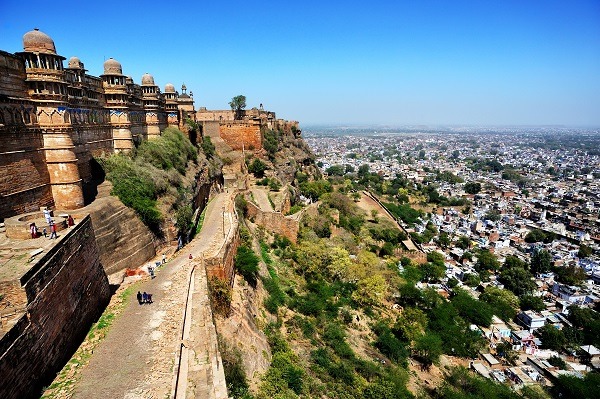
From the esplanade facing the temples, views across the lower city of Gwalior and the Chambal plains are expansive, especially in late afternoon.
Etiquette and Visiting Rules
- Remove your shoes before entering any active worship hall.
- Avoid short or transparent clothing.
- Photography is generally permitted outside; check restrictions inside with the caretaker.
Photography Tips
Early morning light (before 9 a.m.) skimming across the red sandstone brings out the relief of the sculptures beautifully. In late afternoon, the main temple's western façade is well-lit. Avoid midday: overhead light flattens the friezes. A macro lens or short-range zoom helps frame frieze details without touching the stone.
Location and Access
The Sas-Bahu temples lie in the northeastern section of the Gwalior Fort plateau, a short walk from the Man Singh Palace. Gwalior railway station, well served from Delhi, Agra, and Bhopal, is located in the lower city. Auto-rickshaws and taxis reach the fort entrance. Wheelchair access to the plateau is challenging due to slopes and uneven paving.
Nearby Attractions
- Man Singh Palace — a masterpiece of 15th-century Rajput architecture, a short walk away.
- Gwalior Fort — the enclosure housing the entire site, with its ramparts and monuments.
- Teli ka Mandir — an 8th-century temple with atypical profile, also on the fort plateau.
- Jai Vilas Palace — the Scindia residence in the lower city, with its museum and monumental chandeliers.
Frequently asked questions
No. Entry is included in the general Gwalior Fort ticket, which covers all monuments on the plateau.
October through March offers comfortable temperatures and favorable light. Avoid the monsoon season (July–September) if you wish to photograph the sculptures: humidity and vegetation can hinder access.
Yes. Man Singh Palace, Teli ka Mandir, and the Jain caves are all within walking distance on the same plateau. Plan a half-day for the entire complex.
It is allowed outside the temples. Inside active worship spaces, seek permission from the caretaker before using your camera.
Access to the fort plateau is difficult for wheelchair users: approach roads are steep and the temple surroundings are unevenly paved.
Interested in this visit?
We can include it in your personalised itinerary.