Borra Caves
Borra Caves
Karstic network perched in the Eastern Ghats, 90 km from Visakhapatnam: stunning stalactite formations, Shivaite temple and access by Araku train.
The Borra Caves form a karstic network carved into the Ananthagiri hill, perched at over 700 metres altitude in the Eastern Ghats range. Located some 90 km from Visakhapatnam, in Andhra Pradesh state, they extend beneath dense vegetation and shelter stalactites, stalagmites and a small Shivaite temple. It is one of the most renowned cavities in south-east India, accessible by a picturesque train that winds through the Araku Valley.
Why visit the Borra Caves
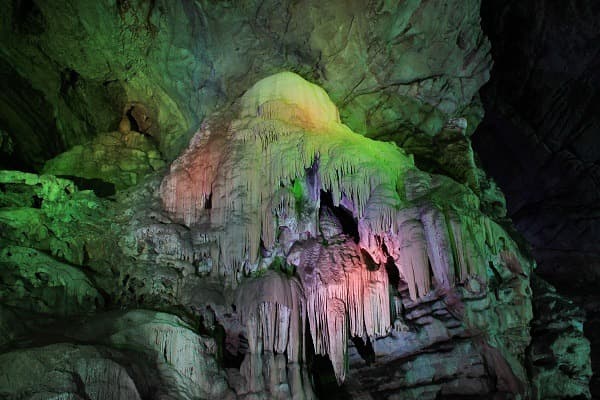
The site combines several rarely matched interests: remarkable geology, traces of prehistoric occupation, living religious dimension and an access route that is itself a tourist attraction. The limestone formations, sculpted by the underground river Gosthani, have taken on silhouettes over the millennia that local guides designate with evocative nicknames ("human brain", "mother with her child", "crocodile").
The visit remains accessible: a fitted-out course of walkways, stone stairs and observation platforms allows you to explore the cavity without any special equipment. The site suits families and travellers with a few hours to spare in the Araku region.
History and legend
The caves were described in 1807 by British geologist William King, while he was studying the region's geology. Excavations conducted on site revealed prehistoric occupation: chipped stone tools, bones and fire traces attest that human groups already frequented these cavities well before their entry into colonial mapping.
A local legend tells of a shepherd, searching for a lost cow, who is said to have discovered the cave entrance and found within it a natural lingam formed by a stalagmite, interpreted as a manifestation of Shiva. Since then, villagers have considered the site sacred. A small temple dedicated to Shiva has been erected at the entrance and regularly receives pilgrims.
What to see on site
The section open to the public extends over some 200 metres of marked galleries. Artificial lighting highlights the concretions and limestone rock contrasts; in certain places, water seeps from the walls or forms small cascades, a sign that the Gosthani river continues to shape the network.
Among the elements to spot during the visit:
- The concretions nicknamed "human brain", "mother with her child" and "crocodile"
- The natural lingam and inner Shivaite sanctuary
- The passages where the Gosthani river becomes visible or audible
- The small temple and entrance esplanade, lively at weekends
The acoustic atmosphere – the resonance of drops, the echo of footsteps – forms part of the experience. For photography, bring a fast lens: lighting remains limited, even with the fixtures in place.
Practical information
The site is open daily during daylight hours. It is best to arrive in the morning to avoid weekend crowds and Indian school holidays. Allow around 1 to 2 hours for a visit, longer if you take a local guide for geological and religious explanations.
Entry is charged, with a moderate rate for adults and a reduced rate for children. Additional fees apply for photo and video camera use. Wear good shoes (the ground is damp and slippery in places) and bring a light layer: the temperature drops noticeably inside.
When to go
The best period runs from October to February, during the dry season: pleasant temperatures on the Ananthagiri heights and optimal visibility in the Araku Valley. The monsoon (June to September) makes the landscapes spectacular and surrounding waterfalls very active, but access may be disrupted by rainfall and occasional rockfalls. The months of March to May remain accessible, with supportable heat at altitude.
How to get there
From Visakhapatnam, several options exist:
- By train: the Araku Valley tourist line crosses the valley and stops at Borraguhalu station, close to the site. The journey, marked by tunnels and viaducts, takes several hours and constitutes an attraction in itself.
- By car or taxi: around 90 km via the Araku road, allow 3 to 4 hours depending on traffic conditions and stops along the way.
- By tourist bus: day excursions generally combine the caves and several sites in the valley.
Around the area
The Araku Valley concentrates several complementary sites if you extend your stay:
- Katiki Falls: cascade fed by the Gosthani, accessible after a short forest walk.
- Chaparai Waterfalls: smooth rocks forming natural slides, popular for swimming.
- Tadimada Falls: more secluded, reached by a path through dense vegetation.
- Araku Tribal Museum: introduction to the region's indigenous cultures (objects, costumes, ways of life).
- Padmapuram Botanical Garden: botanical walk with a few tree-top cottages.
Frequently asked questions
Frequently asked questions
Allow 1 to 2 hours on site to walk the 200 metres of fitted-out path. With the journey from Visakhapatnam, plan rather for a full day, especially if you combine the visit with other sites in the Araku Valley.
Yes, the line crosses the Araku Valley via a succession of tunnels and viaducts, with views over the Eastern Ghats. Many travellers choose this option for the outbound journey and return by road.
The fitted-out course (walkways, stairs, platforms) remains accessible. The ground can be damp: bring closed and non-slip shoes. The visit particularly interests children thanks to the imaginatively nicknamed formations.
Yes, but additional fees apply for cameras and video equipment. As lighting is limited, a fast lens or recent smartphone gives better results than flash.
October to February for dry weather and pleasant temperatures. The monsoon (June-September) makes neighbouring waterfalls impressive but sometimes complicates road and rail access.
Plan your trip
The Borra Caves fit naturally into an itinerary in south-east India, around Visakhapatnam and the Araku Valley. To build a bespoke journey blending nature, heritage and encounters, explore our India travel ideas.
Interested in this visit?
We can include it in your personalised itinerary.