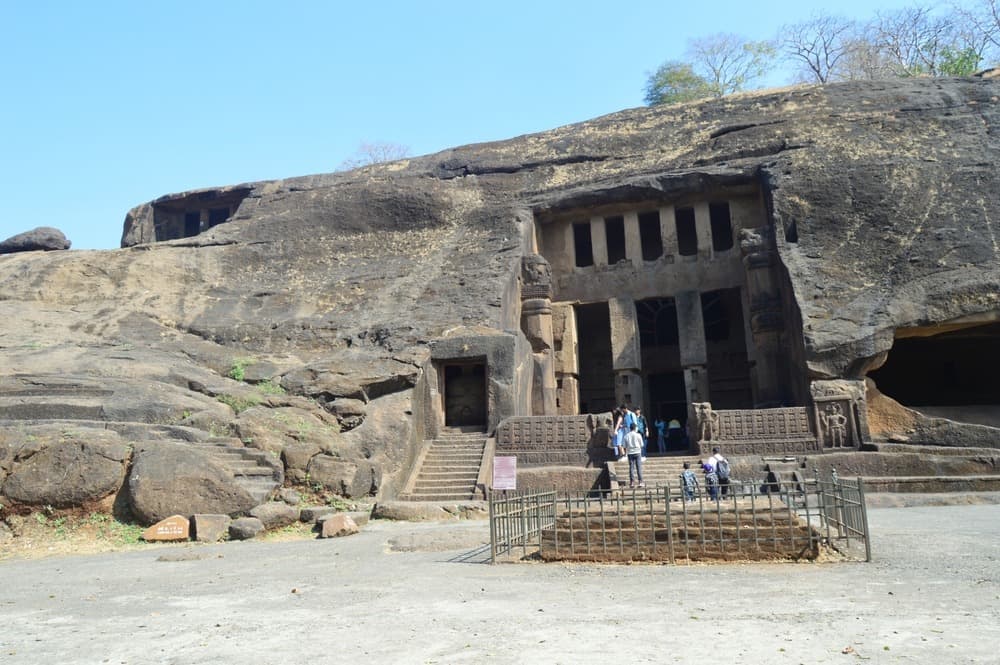
Kanheri Caves
Kanheri Caves
More than a hundred Buddhist caves carved into the basalt hills of Borivali, 40 km from Mumbai. An active monastic site from the 1st century BCE to the 9th century.
Sculpted into the basalt rock of the Borivali hills, the Kanheri Caves form one of Western India's largest Buddhist monastic complexes. More than a hundred cavities, carved over nearly a millennium, bear witness to the presence of an active religious community at the gates of present-day Mumbai.
Why visit the Kanheri Caves
The site combines several interests rarely found together. It offers a comprehensive overview of Buddhist rock art, from ancient Buddhism to the Mahayana tradition, readable in the evolution of sculptures and architectural layouts. It also preserves a stone hydraulic system still visible today, illustrating the technical autonomy of the monastic community. Finally, its location within the Sanjay Gandhi National Park allows visitors to combine cultural exploration with a walk through a forest setting, approximately 40 km from downtown Mumbai.
History
The name Kanheri derives from the Sanskrit Krishnagiri, meaning "black mountain," referring to the dark color of local basalt. The first cavities date back to the 1st century BCE, when Buddhist monks settled on the Borivali hills to pursue a life of study and meditation.
The complex gradually expanded over time. From the 2nd to 9th century, Kanheri became a major center of Buddhist learning in the Konkan region. Its proximity to trade routes connecting the west coast to the interior of the subcontinent also made it a stopping point for merchants and pilgrims, which explains the abundance of donor inscriptions carved into the walls.
What to see
The visit follows an upward sloping path, punctuated by viharas (dwellings) and chaityas (prayer halls) carved at different levels of the hillside.
Cave 3 and the stupas
Cave 3 represents the architectural highlight of the site. Its vast prayer hall is organized around a large central stupa, framed by a columned facade and covered with a vaulted ceiling. The side walls retain reliefs of protective figures. Several neighboring cavities house more modest stupas and altars dedicated to meditation.
Monastic cells
Higher up on the hillside, the viharas give a concrete sense of daily monastic life. Each cell, devoid of ornamentation, features a stone bed and sometimes a niche for a lamp. Inscriptions in Brahmi covering certain walls mention the names of donors and merchants, attesting to the links between the monastery and the commercial networks of the period.
Sculptures and traces of painting
Several cavities display statues of Buddha and bodhisattvas, standing or in meditation. Their treatment varies by period and allows you to follow the transition from ancient Buddhism to Mahayana. On certain walls, traces of pigment indicate that surfaces were once painted, though the colors have largely disappeared today.
The hydraulic system
The site preserves a network of channels, basins, and cisterns carved into the rock, designed to collect and store rainwater. This system allowed the community to sustain itself during the dry season and remains one of the most revealing elements for understanding the monastery's material organization.
Practical information
Entry to the Sanjay Gandhi National Park requires an entrance ticket, plus an additional fee for the caves themselves, higher for foreign visitors. Rates remain modest but change regularly: it is advisable to verify current prices before departure.
The site is open all day Tuesday through Sunday and closed Mondays. A morning visit is recommended to take advantage of favorable light in the caves and limit heat exposure. Plan for 2 to 3 hours on site, or a half-day if you wish to extend with a walk through the park. Bring sturdy shoes, water, and sun protection, as the route alternates between shaded areas and exposed passages.
When to visit
The best period extends from October to March, during the dry season, when temperatures are more manageable and the sky is clear. Between June and September, the monsoon makes trails slippery and visibility reduced, but vegetation becomes particularly lush and the park gains in atmosphere. April and May are hot and dry; a visit remains possible but requires an early morning start.
How to get there
The caves are located in northern Mumbai, approximately 40 km from downtown and about twenty kilometers from the international airport.
- By commuter train: the Western Line serves Borivali station, about ten minutes by rickshaw or taxi from the park entrance.
- By taxi or private car: allow approximately 45 minutes to 1 hour from southern Mumbai, depending on traffic. Parking is available at the entrance.
Once in the park, the caves are located about 6 km from the entrance. You can cover this distance on foot, by bike, or by taking the shuttle service provided by the park.
Nearby attractions
The Sanjay Gandhi National Park itself deserves time: forest trails, Tulsi Lake, and possible local wildlife viewing. Mumbai also concentrates numerous complementary sites, from the colonial Fort district to Elephanta Island and its own rock-cut caves, accessible by boat from the Gateway of India. To further explore India's Buddhist and cultural heritage, sites such as the Alchi Monastery in Ladakh or the Bhopal State Museum offer other perspectives on Indian religious art.
Frequently asked questions
Frequently asked questions
Plan for 2 to 3 hours to explore the main caves. Combined with a walk through the national park, budget for a half-day.
Yes, the site is open Tuesday through Sunday and closed Mondays. The dry season, from October to March, offers the best visiting conditions. During the monsoon, trails may be slippery.
The easiest way is to take the Western Line to Borivali station, then a rickshaw or taxi to the Sanjay Gandhi National Park entrance. By car, allow approximately 45 minutes to 1 hour.
Yes. National park entry is charged separately, with an additional ticket for cave access, higher for foreign visitors. Rates remain moderate but change: verify current prices before your visit.
Yes, provided they are comfortable with some walking and elevation gain. The site is explored via stairs and trails, which can be demanding in high heat.
Plan your journey
The Kanheri Caves integrate easily into a Mumbai stay and can open a broader itinerary around India's Buddhist and cultural heritage. To prepare a tailor-made circuit, consult our travel suggestions in India.

Interested in this visit?
We can include it in your personalised itinerary.