Rajasthan
Rajasthan is a destination that calls to the imagination, a journey to the heart of an exceptional heritage where majestic palaces, sacred temples and golden dunes tell the story of the maharajas. Whether during
Rajasthan is a destination that calls to the imagination, a journey to the heart of an exceptional heritage where majestic palaces, sacred temples and golden dunes tell the story of the maharajas. Whether watching the sunset over the Thar Desert, exploring a palace with a guide or wandering through a vibrant spice market, each moment promises a unique experience. Everything you need to know about the land of kings in this guide.
Rajasthan, an exceptional destination in India
Rajasthan is a state in north-western India, neighbouring the Indian states of Punjab, Haryana and Uttar Pradesh, and bordering Pakistan. It is a region of many facets, where each city reveals a unique piece of history and culture.
Jaipur, "the pink city"; Jodhpur, "the beautiful blue"; Udaipur "the city of lakes"; Jaisalmer "the land of sand dunes"; Pushkar "the sacred city of a thousand temples"… Rajasthan plays on its diversity and natural setting to attract tourists. A former dependency of the Mughal Empire from the 13th century and the former capital of Rajputana in the 17th century, it abounds in historical monuments, such as the Amber Fort, listed as UNESCO World Heritage.
In this region, India stopped at the time of the maharajas, elephant-riding cavaliers and women dressed in choli dancing in honour of the goddess Saraswati. Travelling to Rajasthan means stepping into a fantastic world, where the sweeping views of colourful palaces, delicious cuisine, crystal-clear lakes and charming accommodations herald eternal India.
History
The settlement of Rajasthan dates back more than 2,000 years before our era. However, political organization only emerged around the year 700 AD, when the region was divided between several Rajput clans. The Pratiharas were the first powerful dynasty to control Rajasthan. From the 6th to the 11th century, the Pratihara kings seized Kannauj, and, obtaining the submission of the Pala and Rashtrakuta (rival clans), they extended their rule over much of northern India.
The majority of the palaces, fortresses and other architectural complexes visible today date from the Muslim empire. Rajput kingdoms attempted to resist Islamic powers between the 12th and 15th centuries. The rebellion achieved notable successes with Rana Khumba, who, having defeated the forces of Malwa and Gujarat, founded the largest Rajput domain at Mewar. However, after the fall of Chittorgarh, the capital of Mewar, in 1568, the Rajputs finally fell into the hands of the Mughals.
Under the reign of Akbar, the principalities united to form Rajputana. This was a stable and prosperous period, when Rajasthani architecture experienced a golden age. The influence of Mughal art is evident in the extensive use of sandstone and white marble, in jharokas (stone windows supported by corbelled structures where court ladies could observe without being seen) and in chhatris (domed pavilions) which serve as royal cenotaphs. The Palace of Winds in Jaipur is a perfect example of this Indian architecture.
After 500 years of Mughal occupation, Rajasthan was ravaged by the Marathas before falling under British colonial rule from 1858 to 1947. Today, the region's historical wealth continues to attract many visitors, particularly those following an itinerary through Jaipur, Udaipur and Jodhpur.
What to see and do during a trip to Rajasthan?
Here are the best tourist destinations in Rajasthan and their attractions:
1. Jaipur
Jaipur, the capital of Rajasthan, located in the north-east of the state, is filled with fascinating monuments that bear witness to its rich royal past:
- Amber Fort
The former residence of the maharajas, this fort will impress you with its massive ramparts, richly decorated palaces and spectacular views of the surrounding hills and Maota Lake.
- The City Palace of Jaipur
The City Palace is a vast complex that blends Rajput architecture with Mughal influences. You will discover a superb exhibition of royal costumes, ancient weapons and precious objects illustrating the splendour of the maharajas.
- The Hawa Mahal or Palace of Winds
Built in 1799, this pink sandstone palace features more than 900 ornate windows. They allowed the women of the royal harem to discreetly observe the urban life of Jaipur while remaining sheltered from the heat.
- The Jantar Mantar
The Jantar Mantar is an 18th-century astronomical observatory. It houses instruments designed to observe celestial bodies with remarkable precision, testifying to the scientific ingenuity of the era.
- The Chand Baori
Located at Abhaneri, this spectacular step well features more than 3,500 symmetrically arranged steps. They lead down to fresh water once essential to local life.
- Ranthambore National Park
The Ranthambore National Park, approximately 180 km from Jaipur, is the state's most famous natural site. It is one of the rare places in India where you can observe Bengal tigers in their natural habitat.
2. Udaipur
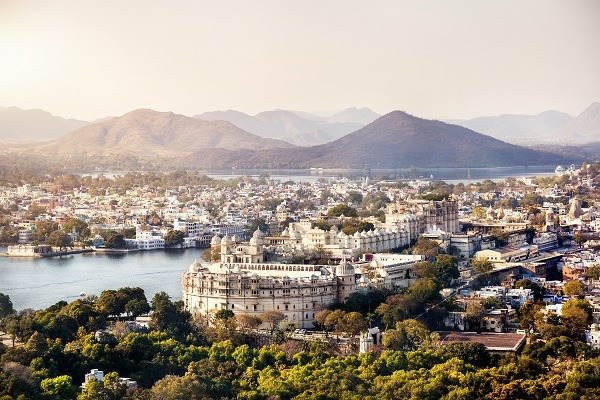
Udaipur, in the south, will seduce you with its romanticism and elegance. Among its jewels, don't miss:
- The Jag Mandir Palace
Built on an island in Lake Pichola, this 17th-century palace is renowned for its refined architecture, peaceful gardens and romantic views over the city.
- Lake Pichola
A boat ride on this lake promises magnificent views of the city's ghats, its palace (now converted into luxury hotels) and the Jag Mandir palace.
- The Jagdish Temple
Built in 1651, the Jagdish Temple stands out for its detailed sculptures, ornate sanctuaries and monumental steps leading to its main sanctuary.
3. Jodhpur
Jodhpur is located in the west-central region. Here are the must-see places:
- Mehrangarh Fort
Mehrangarh Fort is an imposing 15th-century fortress-palace dominating Jodhpur from a hilltop. From its ramparts, you will enjoy spectacular panoramas of the blue city.
- The Chamunda Mata Temple
Established within the grounds of Mehrangarh Fort, this sacred temple honours the goddess protector of Jodhpur. Many devotees gather here during religious celebrations.
- Mandore Garden
The former capital of Marwar, Mandore will enchant you with its lush gardens, royal cenotaphs and beautifully sculpted temples, nestled in the heart of a vast historic park.
- The Ummed Garden and Nehru Park
With their shaded pathways, fountains and areas perfect for relaxation, these two green spaces offer a breath of cool air in Jodhpur.
4. Jaisalmer
Nicknamed the "golden city" for the ochre hue of its sandstone, Jaisalmer stands in the heart of the Thar Desert. Its medieval heritage and picturesque streets also offer a journey out of time.
- Jaisalmer Fort
Dating from the 12th century, Jaisalmer Fort is listed as UNESCO World Heritage. It is one of the world's largest still-inhabited citadels. You will discover Jain temples, palaces and bustling streets. The ramparts offer exceptional panoramas of the lower city and the desert.
- The Havelis
Jaisalmer is also renowned for its havelis, richly decorated merchant mansions. These buildings will impress you with their intricately carved sandstone facades, testifying to the past opulence of the city's merchants in the age of caravan routes.
- The Dunes of Sam (Thar Desert)
Some forty kilometres from Jaisalmer, the spectacular dunes of Sam offer unforgettable sunsets. Camel rides allow you to experience the unique atmosphere of the Thar Desert.
5. Pushkar
A sacred city nestled on the shores of a lake, in the centre-east, Pushkar is a major Hindu pilgrimage site.
- The Sacred Lake
Surrounded by 52 ghats, this lake is at the heart of Hindu rituals. Pilgrims come here to purify themselves.
- The Temple of Brahma
Built in the 14th century, it is one of the world's rare sanctuaries dedicated to Brahma. It attracts many devotees and visitors.
- The Pushkar Market
Colourful and lively, this market is filled with textiles, jewellery, musical instruments and spices. It's the ideal place to discover local crafts and the vibrant atmosphere of the town.
Other destinations to explore in Rajasthan
Bikaner
Bikaner, also located at the edge of the Thar Desert, attracts tourists with its imposing Junagarh Fort, bustling streets and culinary specialities. It is also a renowned stop for its camel breeding and an annual festival dedicated to this animal.
Chittorgarh
The former capital of the Mewar kingdom, Chittorgarh is home to one of India's largest forts. Its towers, temples and palaces tell centuries of history, battles and Rajput legends.
Bundi
Nestled between hills and lakes, Bundi charms with its palace adorned with frescoes, its baoris (step wells) and its ramparts. The atmosphere here remains authentic and unspoilt by mass tourism.
Ajmer
A spiritual city, Ajmer is famous for the Sufi shrine of Khwaja Moinuddin Chishti, a major pilgrimage site in India. It also attracts visitors with its bustling markets and proximity to Ana Sagar Lake.
What is the best time to visit Rajasthan?
The best time to visit Rajasthan is from November to February, during winter, with pleasant temperatures ranging from 10°C to 27°C. November is particularly recommended. Several sporting and cultural events take place in Rajasthan during this peak tourism season.
Rajasthan can be explored easily thanks to its well-developed transport network. Major cities such as Jaipur, Udaipur and Jodhpur have national airports and, in the case of Jaipur, international ones. Trains efficiently connect the state to the rest of India. Public and private buses serve most destinations.
How long does it take to visit Rajasthan?
A stay of 10 to 15 days allows you to discover the main cities while enjoying iconic sites such as Amber Fort, Lake Pichola or the Thar Desert. For a more complete immersion, plan three weeks to include less touristy stops such as Bundi or Chittorgarh.
What language is spoken in Rajasthan?
Hindi is the official language, but English is widely spoken in tourist areas. Several regional dialects, including Marwari, are also widely used by the local population.
What is the religion in Rajasthan?
Hinduism is the predominant religion in Rajasthan, followed by Islam and Jainism. Numerous temples, mosques and sanctuaries dot the region.
What are the culinary specialities of Rajasthan?
Rajasthani gastronomy is distinguished by spice-rich dishes such as dal baati churma, gatte ki sabzi and laal maas, often accompanied by traditional breads and sweets such as ghevar.