Fatehpur Sikri
Fatehpur Sikri
An ancient Mughal capital abandoned in the 16th century, Fatehpur Sikri reveals red sandstone palaces, a monumental mosque, and a Sufi saint's tomb 40 km from Agra.
At the gateway to the Rajasthan desert, the city of Fatehpur Sikri awaits you for an extraordinary discovery. This forgotten gem, often dubbed a "ghost city," captivates as much through its mystical silence as through the richness of its history. Founded in the 16th century by Emperor Akbar, this imperial city was once the stage for unparalleled Mughal splendor. Today, it draws heritage enthusiasts and seekers of authenticity, coming to admire its magnificent monuments.
History
Shortly after ascending the throne of the Mughal empire, Akbar made Agra his new capital. He then married the Hindu princess of Amber in 1562 to form an alliance with the Rajputs. However, the emperor struggled to produce a male heir.
In 1568, Akbar traveled to Sikri to consult the Sufi saint Sheikh Salim Chisti. The encounter resulted in a prophecy: according to the sage, the emperor would soon have three sons, and his prediction proved remarkably swift. Indeed, in 1569, Akbar witnessed the birth of his first son Salim, who later became Emperor Jahangir. His second son was born in 1571. To show his gratitude, he had a city erected on the hill where the Sufi saint resided.
Akbar enlisted the finest architects of his kingdom to build the city. Thousands of craftsmen were also engaged to construct the buildings in accordance with the imperial vision. From pavilions to palaces, from mosques to all manner of structures, the edifices benefited from the best Mughal and Rajput architectural techniques and reflected the empire's success. Upon returning to Sikri in 1573 after a military campaign that began in 1572, Akbar decided to rename the city Fatehpur (City of Victory).
Nevertheless, the emperor resided here for only about fifteen years before departing in 1585. While some believed Fatehpur was abandoned by the king due to water scarcity, others considered Akbar's decision to settle in Lahore a strategic choice to consolidate his empire. Despite its magnificence, the city was never permanently inhabited again.
For its history and architectural wealth, Fatehpur Sikri is today inscribed on UNESCO's World Heritage List. The former Mughal capital is recognized as a remarkable testimony to Indo-Islamic architectural genius. The Archaeological Survey of India now ensures its preservation, showcasing the red sandstone used in the majority of its buildings.
What Can You Visit at Fatehpur Sikri?
Fatehpur Sikri is absolutely worth visiting during a trip to India. The city will captivate you with its multitude of historical sites such as the former fortress of the Mughal emperor and the prestigious Jama Masjid. Immerse yourself in the atmosphere of India's countryside by visiting its bazaar.
The Jama Masjid and the Buland Darwaza
The first place to visit during your stay in Fatehpur Sikri is undoubtedly the grand Jama Masjid, constructed between 1571 and 1572. Its architectural beauty, a blend of Indian and Persian cultures, earned it a place on UNESCO's World Heritage List. Beyond discovery, your visit also offers a chance for some exercise. You must climb around a hundred steps before reaching the Buland Darwaza, a sublime gateway serving the mosque.
Constructed in 1576, this gateway is also the main entrance to Fatehpur Sikri. It rises 54 meters in height and contains 15 stories. The monument is adorned with red and buff sandstone, as well as black and white marble. The Quranic inscriptions and Persian inscriptions on its pillars and arch captivate visitors' attention.
Once through the portal, you find yourself in a vast courtyard. At the heart of this pleasantly landscaped space stands a white marble structure—the tomb of the Sufi saint Sheikh Salim Chisti. Continue your path and admire the artistry present beneath the mosque's arcades. At the far end, you will spot several cenotaphs. These are the tombs of deceased members of Akbar's immediate and extended family.
Akbar's Palace
Like any capital, Fatehpur Sikri possesses its palace. Perfectly reflecting the heights of Mughal artistry, Akbar's Palace houses an authentic pavilion dedicated to public audiences where the emperor dispensed his decisions with four advisors, called the Diwan-i-Am. The courtyard has been beautifully converted into a garden, surely among the finest in the country! Do not miss the private audience hall, punctuated by imposing pillars.
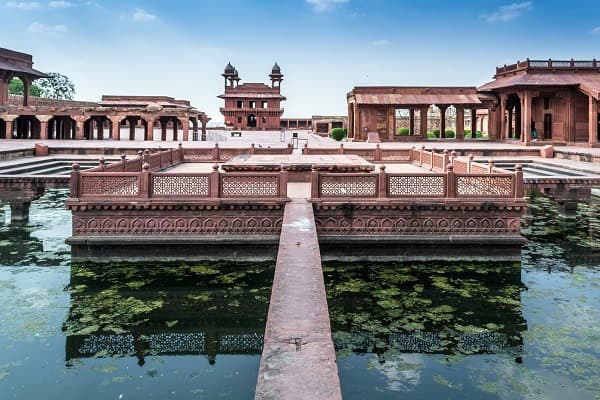
Beyond this, Akbar's palace also features an astrology kiosk. Visitors can also discover Jodha Bai's Palace, the favorite residence of the Hindu queen; the Sultan's Pavilion, whose delicate decorations reveal unique refinement; or the elegant Anup Talao, the central ornamental basin of the complex.
The Panch Mahal
The Panch Mahal, or "Palace of Five Stories," is one of Fatehpur Sikri's most remarkable structures. This red sandstone columned pavilion served as a pleasure palace. Its unique pyramidal structure features 176 columns distributed across five levels. It was once equipped with perforated screens between the pillars, allowing court ladies to enjoy the breeze while preserving their privacy.
Other Fort Monuments
Beyond those already mentioned, other architectural gems are also worth discovering in the city. The Birbal Bhavan, residence of Akbar's minister and trusted advisor, will impress you with its refined decorations and carved details. You can also discover the Hiran Minar, a tower erected in memory of the emperor's favorite elephant, as well as the Karawan Serai, an ancient caravanserai that once welcomed merchants and travelers.
The Market and Museum
After exploring the monuments, venture to the small market near the main entrance. A few shops offer costume jewelry, fabrics, traditional clothing and souvenirs, as well as some fruit and snacks. The spot is modest but pleasant for strolling, especially during the cooler hours. Nearby, the Fatehpur Sikri Archaeological Museum, housed in the former Treasury Building, offers you the chance to discover its sculptures, pottery, and Mughal objects discovered on the site.
Practical Information
Location and Access
Fatehpur Sikri is located 40 km west of Agra. Several options are available to reach it. Regular buses depart from Agra's Idgah bus station (1.5 hours travel time), trains connect Agra Fort station to Fatehpur Sikri (45 minutes), and taxis can take you there in approximately 35 minutes. The road is well-maintained and the journey is relatively straightforward.
Best Time to Visit the City
The best period to visit Fatehpur Sikri extends from October to March. During these months, the climate is mild and dry, ideal for exploring this ghost city on foot. Temperatures range between 8 and 25°C, making visits more pleasant, far from the oppressive summer heat.
Hours and Admission Fees
Fatehpur Sikri is open daily from 6:00 AM to 6:00 PM, except Friday, when access to the Jama Masjid may be restricted during prayer times.
Admission for foreign visitors is approximately 610 INR, including access to the main monuments of the complex. Indian nationals pay a reduced rate. Entry is free for children under 15 years old. The archaeological museum, located nearby, charges a small additional fee.
Want to discover this destination?
Our local advisors design your tailor-made trip.