Bodhgaya
Bodhgaya
The place of Buddha's enlightenment, Bodhgaya brings together the UNESCO-listed Mahabodhi Temple, monasteries from around the world, and an atmosphere conducive to meditation.
Recognized as the place where Siddhartha Gautama achieved enlightenment, Bodhgaya, or Bodh Gaya, is one of the four holiest sites in Buddhism. This city is located 115 kilometers south of Patna, the capital of Bihar, a state in northeastern India. A pilgrimage destination of major importance, it attracts believers and travelers alike.
The History of Bodh Gaya
Intrinsically linked to the life of Siddhartha Gautama, the future Buddha, Bodh Gaya ranks among Buddhism's most sacred sites. It was here, beneath a Bodhi tree, that the prince, then aged 35, is believed to have attained spiritual enlightenment after years of meditation and asceticism. This founding event of Buddhism occurred around the 6th century B.C.
Over the centuries, various sovereigns and dynasties contributed to the development of the site. Emperor Ashoka, a great promoter of Buddhism, is said to have commissioned a temple here in honor of Buddha in the 3rd century B.C. This sanctuary was reconstructed and enlarged over time, eventually becoming the Mahabodhi Temple that visitors can explore today.
Following Buddhism's decline in India, Bodh Gaya fell into obscurity for centuries, only to be rediscovered and restored in the 19th century. In 1922, the city received high-profile visitors including Gandhi and Nehru during a congress. Since 1956, it has housed an archaeological museum open to the public.
In 2002, the Mahabodhi Temple was inscribed on the UNESCO World Heritage List. On July 7, 2013, nine explosions occurred within the complex, resulting in the deaths of two monks. However, this terrorist attack caused no damage to the monuments or the Bodhi tree.
Today, Bodh Gaya is both a spiritual and cosmopolitan city where pilgrims, monks, and travelers from around the world converge. The population stood at 30,883 in 2001. Numerous monasteries have been built by countries including Thailand, Japan, Bhutan, and Vietnam, each reflecting their respective architectural traditions.
Bodh Gaya regularly hosts ceremonies, retreats, and spiritual teachings, notably the Kalachakra, a worldwide event presided over by the Dalai Lama. Despite its modest size, the city now boasts solid tourist infrastructure while maintaining a peaceful atmosphere conducive to meditation.
What to See and Do in Bodh Gaya?
1. The Mahabodhi Temple
This majestic temple is the spiritual heart of Bodh Gaya. It draws hundreds of pilgrims daily to meditate around the Bodhi tree. Its ancient architecture and intricate reliefs make it a place of reverence and wonder, steeped in history and spiritual significance.
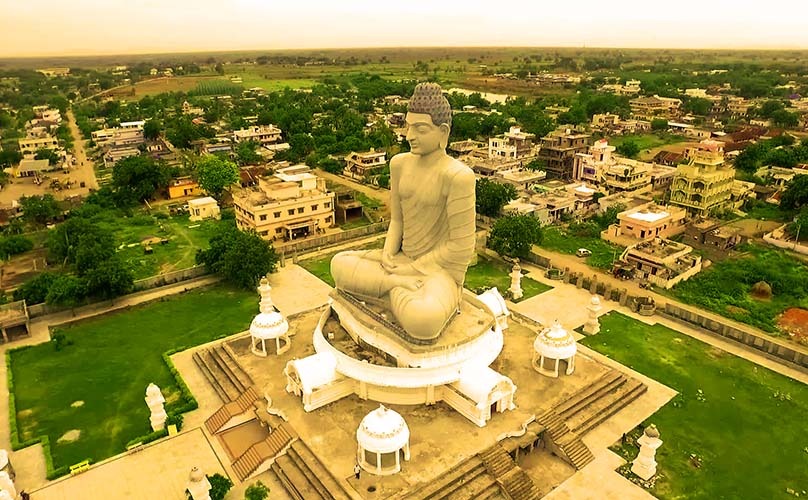
2. The Great Buddha Statue
Just steps from the Mahabodhi Temple stands this impressive 25-meter-tall statue depicting Buddha in meditation posture atop a lotus flower. Inaugurated in 1989 by the Dalai Lama, it was the first statue of such scale constructed in India.
3. Muchalinda Lake
This serene body of water, located just beside the Mahabodhi Temple, houses a statue of Buddha protected by a hooded serpent. It evokes the legend of Muchalinda, the serpent king, who sheltered Buddha during a storm while he meditated.
4. The Thai Monastery
This monastery was built by the Thai king at the request of Jawaharlal Nehru. Unmissable, it impresses with its distinctive architecture featuring golden roofs.
5. The Royal Bhutanese Monastery
Constructed in honor of Buddha by Bhutan's king, this monastery stands out for its 2-meter-tall statue and magnificent murals depicting Buddha's life. Monks here regularly organize prayers and Buddhism education programs.
6. The Japanese Indosan Nippon Temple
Built by a Japanese organization, this temple features a pagoda-style structure reflecting the aesthetics and traditions of Japanese Buddhism.
7. The Daijokyo Buddhist Temple
Constructed in 1983 by the Daijokyo organization, its main building, the Shakado, houses sacred relics of Buddha as well as a bust of the movement's founder. Nearby stands another large Buddha statue maintained by the same organization.
8. The Karma Temple
The Karma Temple will also delight you. Located just beside the Daijokyo Temple, this Tibetan structure is distinguished by its murals depicting scenes from Buddha's life, blending Indian, Tibetan, and Western influences.
9. The Burmese Monastery
This monastery's building displays traditional Burmese architectural style. You'll find a library rich in Buddhist texts and a meditation center, perfect for those seeking inner peace.
10. The Dungeshwari Caves
Located 12 km from Gaya, near Bodhgaya, the Dungeshwari Caves are famous for sheltering Buddha before his enlightenment. He practiced rigorous meditation and severe asceticism here before realizing that neither excess nor deprivation leads to enlightenment, but rather balance through the middle way. The peaceful site, surrounded by nature, offers an ideal setting for contemplation.
11. The Sujata Stupa
This stupa honors Sujata, the young woman who offered rice milk to Buddha, ending his years of asceticism. This episode marked a decisive turning point in his spiritual quest. To be discovered in the village of Bakraur, near the city.
12. The Vishnupad Temple
A visit to Bodhgaya extends beyond its Buddhist monuments. Hindu sacred sites also await here, including the Vishnupad Temple. This temple relates to the legend of Gayasur, a demon whom Vishnu is said to have pressed into the earth with his foot. The divine footprint is believed visible in the temple's rock. It is also important for funeral rites.
13. The Mangla Gauri Temple
Perched on a hilltop, this temple is one of India's 18 shaktipiths. Dedicated to the goddess Sati, a breast of hers is said to have fallen here according to legend. This site is considered highly powerful for making wishes and praying for prosperity.
14. The Barabar Caves
Located in Jehanabad district, these caves dating to the 3rd century B.C. are among the oldest rock-cut caves in India. They bear inscriptions by Emperor Ashoka and offer a unique glimpse into Mauryan-era architecture.
Practical Information
When to Visit Bodh Gaya?
Bodh Gaya enjoys a warm, dry climate. For worry-free travel, visit the city in April. Avoid August, as it marks the rainy season.
Bodh Gaya is situated around 15 kilometers from the city of Gaya, which has a well-connected railway station to major Indian cities like Delhi, Varanasi, and Kolkata. Gaya International Airport also receives some domestic and seasonal international flights, notably from Thailand and Sri Lanka. On site, you can get around on foot, by auto-rickshaw, or cycle-rickshaw. For longer journeys, opt for a taxi or car with driver.
How Long Should You Spend in Bodh Gaya?
Plan 2 to 3 days to explore the region's highlights. This allows you to visit major sites like the Mahabodhi Temple, the Great Buddha Statue, international monasteries, and the Dungeshwari Caves. If you wish to participate in a retreat, meditation sessions, or explore the surrounding area more thoroughly, a stay of 4 to 5 days may be more suitable.
Hotels
Bodhgaya offers varied and accessible accommodation. You'll find budget guesthouses, comfortable mid-range hotels, and a few upscale establishments with air conditioning and on-site restaurants. Some monasteries also provide simple lodging for pilgrims and travelers. It's recommended to book in advance during high season (November to February).
Restaurants
For dining, Bodhgaya offers simple, local, and vegetarian cuisine, often influenced by Buddhist traditions. You'll find small Indian restaurants, street food stalls, and cafés run by foreigners serving international dishes (Italian, Korean, Tibetan, etc.). Many establishments cluster around the Mahabodhi Temple.
Safety and Precautions
Bodhgaya is generally safe for travelers, even those traveling solo. It's advisable to keep your belongings secure, particularly in crowded areas.
Dress Code and Respect for Customs
In temples and monasteries, it's customary to remove your shoes at the entrance and wear clothing that covers your shoulders and legs. Choose modest, comfortable, and respectful attire. Avoid public displays of affection, especially in places of worship. Discretion and respect for silence are equally important.
Want to discover this destination?
Our local advisors design your tailor-made trip.