The Temples of Baroli
The Temples of Baroli
Nestled near Rawatbhata, the Baroli complex houses nine 10th-century temples among the oldest in Rajasthan. A hidden treasure of Gurjara-Pratihara art.
The Baroli temples form a Hindu temple complex located in the eponymous village, not far from Rawatbhata, in the Chittorgarh district of Rajasthan. Bordered by the Chambal River and cloaked in lush vegetation, this sacred site encompasses nine Hindu temples dating from the 10th century. It is one of the oldest temple complexes in Rajasthan, a fascinating testament to Gurjara-Pratihara architecture and medieval sculptural art.
History
The exact origins of the Baroli temples remain partially obscure, but most historians agree in dating them to the 10th century, during the era of the Gurjara-Pratihara Empire. This powerful kingdom, which dominated much of northern India between the 8th and 11th centuries, is renowned for its active patronage of religious architecture and Hinduism.
The Baroli complex thus represents one of Rajasthan's oldest religious establishments. The temples were erected to honor the great Hindu deities: Shiva, Vishnu, Ganesha, Durga, and others.
The site's modern history has been marked by a degree of neglect and several acts of vandalism. In 1998, a precious statue of Nataraja (Shiva as the lord of dance) was stolen and later recovered in London, in a private collection.
This incident drew public attention to the richness of India's heritage and strengthened conservation measures. Today, the entire complex is protected by the Archaeological Survey of India, which ensures its gradual restoration.
Visiting the Baroli Temples
A visit to the site offers a striking immersion into the architectural genius of medieval India. You will discover nine temples, spread throughout a wooded enclosure, each displaying different styles, functions and states of preservation.
The Ghateshwara Mahadeva Temple
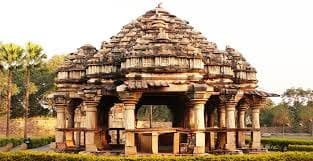
This is the jewel of the complex. Dedicated to Shiva, it stands out for its five lingas, one of which recalls the shape of a pot (ghata), from which its name derives. This near-intact sanctuary offers an unforgettable visual experience: a ceiling adorned with an open lotus, a finely sculpted shikhara and an entrance hall with carved columns. The dance pavilion (rangamandapa), a more recent addition, displays a profusion of details, including dancing apsaras, the divine rivers Ganga and Yamuna as entrance guardians, as well as multiple representations of the god Shiva in various forms.
The Ganesha Temple
Facing east, this sanctuary dedicated to the elephant-headed god is a blend of stone and brick. Though mutilated, the Ganesha statue retains an impressive presence. He embodies wisdom, success and the removal of obstacles—qualities that visitors often come here to invoke.
The Vamanavatar Temple
This small sanctuary is dedicated to Vamana, the fifth avatar of Vishnu, often depicted as a wise and divine dwarf. Dating from the 10th century, it houses a four-armed statue characteristic of this incarnation, symbolizing humility and cunning in service of goodness. Though modest, the edifice impresses through its restrained sobriety: a sanctuary covered by a simple flat slab, a narrow vestibule, and a sparse but well-proportioned entrance. Though its shikhara has vanished with time, the spirit of the place remains intact, faithful to the discrete yet powerful image of the divinity it honors.
The Trimurti Temple
Located at the southeastern end of the complex, this partially ruined temple is one of the few in India dedicated to the Trimurti, the union of Hinduism's three major gods (Brahma, Vishnu and Shiva). The architecture follows the pancharatha style, typical of the Gurjara-Pratihara period, with a sanctuary adorned with an elegant nagara-style shikhara.
The entrance, though deteriorated, retains a carved lintel depicting Nataraja (dancing Shiva), placed as a protective motif above the doorway. Inside, a three-headed Shiva statue (Mahesha-murti) presides at the center.
The Ashtamata Temple (or Mahishamardini)
South of the Ghateshwara Mahadeva stands the Ashtamata temple, dedicated to Durga in her warrior form as Mahishamardini, slayer of the buffalo demon Mahisha. It is a typical 10th-century sanctuary, facing east, with a stone structure comprising a sanctum, a secondary vestibule (antarala) and a mukhamandapa (entrance porch).
The pancharatha architecture is enriched here with a ten-tiered shikhara separated by bhumi-amalaks, forming an impressive vertical silhouette. Among the sculpted details, one notes a lintel adorned with a dancing Maheshvari, as well as an image of Parvati placed in the sukanasa (the roof's forward projection).
This temple, both martial and graceful, stands as an ode to divine feminine power.
The Sheshashyan Temple
This sanctuary, today heavily damaged, was once dedicated to Vishnu in his posture known as Sheshashayi, reclined upon the cosmic serpent Shesha. Of rectangular plan, the temple still retains a projecting vestibule and a sober sanctum, though it has lost its vault-shaped roof (valabhi), typical of construction from this era.
The austerity of the architecture, heightened by the absence of sculpted decorations at the entrance, creates an almost mystical atmosphere. It emanates an impression of cosmic silence, faithful to the theme of Vishnu in creative slumber between two cosmic cycles.
Harmony with Nature
Baroli's charm lies not solely in its stones. Surrounded by dense vegetation (peepal, mango and jamun trees) and cradled by the murmur of the Chambal, the site exudes rare serenity. You will walk among a millennium-old heritage, among peaceful ruins, forgotten sculptures and birdsong.
Living Heritage
Even though some temples lie in ruins, Baroli remains an active place of worship. Nandi the bull still stands watch before Shiva's sanctuary. Devotees come to meditate, light incense sticks and touch the sacred stones. This continuity gives the place a soul, beyond its historical value.
Practical Information
Access
The architectural complex is located approximately 45 kilometers southeast of Kota. Visitors can reach it by taxi or private car from major cities across Rajasthan. Parking is available on-site.
Hours
The site is open from 9 a.m. to 6 p.m. every day of the year. Entrance is free.
Want to discover this destination?
Our local advisors design your tailor-made trip.