Adalaj
Adalaj
Adalaj, a quiet village in Gujarat, shelters a remarkable 1499 stepwell whose architecture and the legend of Queen Rudabai captivate travelers.
The village of Adalaj, situated in Gandhinagar district in the state of Gujarat, owes its renown to a remarkable monument: its stepwell. This edifice stands out not only for its spectacular architecture but also for the intricate sculptures that adorn its facades.
History
The village of Adalaj holds a singular memory where history merges with legend. It is here that the destiny of Queen Rudabai, an emblematic figure from a still-living past, was written.
In the 15th century, King Rana Veer Singh, a Hindu ruler, orders the construction of a stepwell to meet his kingdom's water needs. But war interrupts the work: the king is killed by Sultan Mahmud Begada, a Muslim leader who covets not only his territory but also the queen. The queen sets a condition for her forced marriage: that the stepwell be completed in memory of her husband. The sultan agrees, but once the work is finished, Rudabai chooses death over humiliation and takes her own life by throwing herself into the waters.
This tale, passed down through generations, still profoundly marks the village's daily life. The memory of the queen and the stepwell continues to inhabit local stories, the gestures of its inhabitants, and even the religious ceremonies that punctuate the year.
Adalaj Stepwell (Adalaj ni Vav or Adalaj Baoli)
While Adalaj attracts visitors from around the world each year, it is above all to admire the stepwell, also called Adalaj Baoli or Adalaj ni Vav, but more commonly known by its tourist name, Adalaj Stepwell. This masterpiece, both practical and symbolic, ranks among the finest expressions of medieval hydraulic engineering in India.
A complex and symbolic arrangement
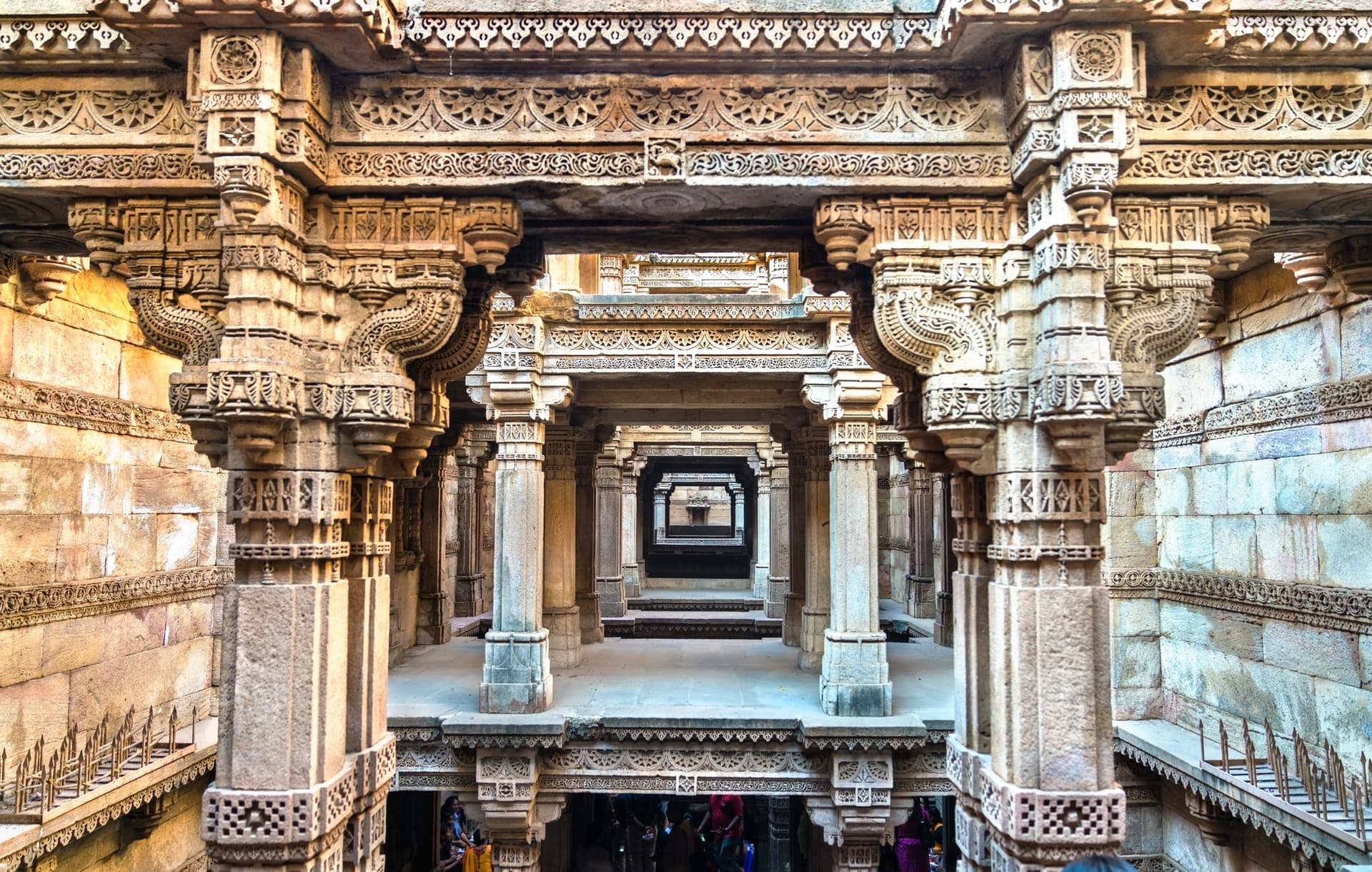
Designed in 1499, the Adalaj Stepwell descends through five levels, linked by symmetrical entrance staircases and framed by sculpted balustrades. These passages guide visitors to the heart of the well in an architectural progression both physical and symbolic. At each level, the temperature drops, humidity increases, and silence settles in, offering welcome relief from the heat outside.
Structures built to endure
One of the monument's great strengths lies in the robustness of its structures. Columns, galleries, domes, and platforms articulate with elegance and precision in a perfectly mastered balance. The edifice combines Hindu and Muslim construction techniques, thus bearing witness to the political and religious complexity of its era.
A blend of art, faith, and ingenuity
The well's walls are adorned with geometric patterns, floral representations, deities, and sacred animals. These details tell not only of the builders' faith but also of their aesthetic concern. One can glimpse scenes of religious ceremonies that once punctuated the site's life: prayers, offerings, blessings, and more.
At every turn of the gallery, the play of shadow and light draws the eye. If you love photography, remember to bring your camera: the perspectives, reliefs, and reflections in the water make this a captivating visual canvas.
A living place at the village's heart
Even today, the Adalaj Stepwell is frequented by residents seeking calm, meditation, or simply shelter from the sun. For attentive visitors, the monument reveals a piece of local daily life: a group of women drawing water, an elderly man sitting in the shade, a child running along the steps. Heritage here is not frozen in time—it is lived.
Practical Information
The village of Adalaj is located approximately 18 km north of the city of Ahmedabad, where you will find airport and railway services.
Due to its small size, the village of Adalaj can easily be explored on foot. Alternatively, you can hire a rental car for excursions to the surrounding area.
Nearby Attractions
If your visit to Adalaj leaves you with some spare time, you can explore a few interesting sites in the vicinity.
Less than 5 kilometers away, don't miss the Swaminarayan Temple in Adalaj, a modern and peaceful complex where you'll discover immaculate architecture and well-maintained gardens. The atmosphere is conducive to meditation and contemplation, particularly during major religious celebrations.
The city of Ahmedabad also awaits you with its UNESCO-listed monuments, museums, lively markets, and historic neighborhoods such as the old city.
Finally, if you're traveling with family, a detour to the Akshardham Temple in Gandhinagar, approximately 10 km away, may well be worthwhile. It is a highly visited site, rich in sculptures and cultural activities, particularly for children.
Want to discover this destination?
Our local advisors design your tailor-made trip.