Meghalaya
Meghalaya
Living root bridges, crystal-clear rivers and matriarchal societies: Meghalaya, the verdant jewel of Northeast India, reveals a rare and unspoiled India.
Meghalaya is a small state in Northeast India. Sharing its borders with Assam and Bangladesh, it forms part of the seven sister states. Let us draw back the curtain on the diverse attractions of Meghalaya, the Abode of Clouds.
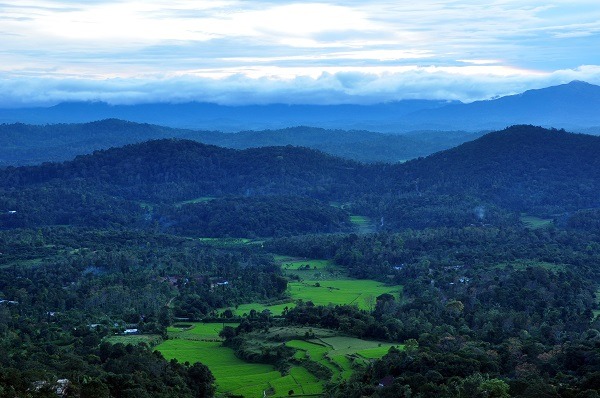
A forgotten corner of Scotland set down on the Indian subcontinent, Meghalaya's agricultural and rolling landscape is a coveted destination. At the eastern tip of India, Meghalaya reveals a landscape of high plateaus, rivers, waterfalls and pristine primary forests. From Cherrapunji to the Garo Hills, from the Balpakram national park to the Nokrek biosphere reserve, with a detour to the flowering town of Mawlynnong, you will come to understand how tribal groups have upheld a civilization deeply united with nature. That said, a word of warning is in order: Meghalaya is more a trekking and adventure destination than a family holiday resort! If wilderness speaks to you, do not waste a moment in booking your Meghalaya circuit.
History
Scholarship on the origins of Meghalaya's settlement divides archaeologists. Excavation work undertaken at Natiang shows evidence of stone tool use, suggesting human occupation from the Neolithic period onwards.
Meghalaya is considered the cradle of rice cultivation. With abundant rainfall and fertile hills, the region was among the first to practice shifting agriculture in Asia. Even today, this primitive agricultural practice persists in rural areas, supplemented by game hunting and gathering.
While the Ahom dynasty controlled Assam and neighbouring Bengal, Meghalaya had its own chieftains among the Jaintia, Garo and Khasi peoples. The 19th century saw the British army seize Indian territory; the region was administratively attached to Assam, which itself was one of the principal provinces of the British Raj. Between 1905 and 1912, it was incorporated into the province of Eastern Bengal and Assam.
British occupation was marked by development works that beautified the region. Officers were impressed by Meghalaya's cool and pleasant climate and transformed Shillong into a pretty Scottish-style town complete with a sanatorium.
Today
The Indian state of Meghalaya was officially formed on 21 January 1972. Following the fall of the British colonial empire in 1950, it initially remained under the control of Assam, along with Nagaland, Mizoram and Arunachal Pradesh. In 1970, Parliament passed legislation in favour of administrative redistribution of the northeast zones. Assam had to cede the districts of Khasi Hills, Garo Hills and Jaintia Hills to the new hill state, which took the name Meghalaya or "Abode of Clouds".
With a population of 216,606 (as of 2018), Shillong is the capital and largest city of Meghalaya. Nicknamed "the Scotland of the East", it appeals through its exotic character, which its significant colonial heritage only reinforces.
As soon as you leave Shillong, it is rural India in all its splendour that unfolds for visitors: the India of lakes and rolling hills, known for its agricultural wealth.
Tourism is a sector full of promise for development and income improvement. In this tribal state where forest cover represents more than 77% of the territory, opportunities for picnicking, trekking, bathing and hiking are virtually limitless. A child of nature, tourism activity also has a sporting dimension, with mountain tourism, golf tourism and natural cave exploration.
Places of Interest to Visit
Little visited by tourists, Meghalaya deserves an exploratory trip for its outstanding natural beauty. Tribal heritage, craftsmanship and human encounters constitute an attraction in themselves. You will return enchanted by your journey.
Religious Heritage
Lovers of sculpture and ancient stone will readily find their way to Shillong. A procession of magnificent buildings gathers at the heart of the capital, in the locality of Laitumkhrah.
Linger before the Cathedral of Mary Help of Christians, the seat of the Shillong episcopal see, which was inaugurated in 1936. A fine example of Gothic art, the church stands out for its soaring arches and luminous stained glass windows imported from Grenoble that embody divine majesty. Inside, do not miss the series of artworks conceived by the Munich Institute of the Arts in Germany that depict the 14 Stations of the Passion of Christ. Near the altar rests the body of the city's first archbishop, Hubert D'Rosario.
Not far from the Cathedral of Mary Help of Christians, you will find the Grotto Church, a place of prayer carved into the hillside.
On Kacheri Road, opposite the State Library, stands the wooden facade of All Saints Church. It is nestled in a rural setting, among verdure, hills and cascades. Ravaged by an earthquake in 1897 before being rebuilt in 1902, the colonial-style building truly deserves a visit.
Outside Shillong, Meghalaya is rather sparse in churches and museums. Tourists come here primarily to appreciate its wild side.
Natural Heritage
Meghalaya's extensive network of waterways explains the abundance of lakes, rivers and spectacular waterfalls.
- Cherrapunji Waterfall: with a height of 340 metres, it is India's largest waterfall. Better known as Nohkalilai Falls, the cascade is Meghalaya's most emblematic site.
- Mawlynnong Waterfall: surrounded by verdure and colourful orchids, Mawlynnong waterfall is a popular tourist attraction.
- Elephant Falls: set aside a stop on your journey to visit the waterfall. Access to Elephant Falls passes through verdure and steep rocks and leads to a small lake. You have no excuse, the falls being only a stone's throw from Shillong peak, 12 km from the town itself. It is a cascade falling in 2 levels: Wei Laplam Falls and Wir Phang Falls. An ideal excursion destination for magical moments with your loved ones.
- Umiam Lake: south of Shillong, Umiam Lake is, thanks to its enchanting setting surrounded by coniferous forests, a particularly sought-after hiking destination. Couples come here to enjoy a romantic sunset cruise, aboard a pedalo or sailing boat. As for sports enthusiasts, they can expend energy and test their skills in disciplines as varied as kayaking, rafting, water cycling, jet skiing or water skiing. The more leisurely will content themselves with opening their eyes wide and appreciating the beauty of the site, to which the tall hills of East Khasi and surrounding islands give special character. Umiam Lake, otherwise known as Barapani Lake, hosts accommodation facilities meeting international standards.
- Balphakram National Park: covering an area of 220 km², the park supports a rich population of felines, hoofed herbivores and birds. Although it only appears on UNESCO's waiting list, it will not disappoint climbers and lovers of wide open spaces. You will walk through deciduous forest, with thick vines overhead. Your eyes will feast on orchids and multicoloured flowering trees. You will wonder which deserves more photo stops: the barking deer, the golden cat or the red panda. A green escape 167 km from Tura, the capital of Garo Hills district.
- Nokrek Biosphere Reserve: teeming with wild fauna and flora, Nokrek Park is a choice refuge for tourists and researcher biologists. Scale the Nokrek peak, make your way through pristine canopy to the Rongbang Dare waterfall, admire the limestone formations of Siju Cave, take a boat ride on the Simsang river… These are just some of the pleasures that await you during a day of trekking at Nokrek National Park.
Balphakram National Park and Nokrek Biosphere Reserve are Meghalaya's two most biodiverse sites. For holiday-makers who wish simply to share happy family moments without exploring nature in depth, Lady Hydari Park in Shillong is a recommended stop. The nearby waterfall, called Crinoline Falls, is an attraction not to be missed.
Cultural Heritage
The Indian state of Meghalaya is inhabited by tribal communities which, far from the modern world, have preserved their cultural identity to this day. They are known for their matriarchal tradition which recognises women as the sole heirs to land titles and grants the youngest daughter all inherited property.
Looking for cultural immersion in Meghalaya? Head to the village of Mawlynnong, the stronghold of the Khasi, located just 80 km from Shillong. You will not be disappointed by the friendly and warm welcome from villagers. But that is not all. A top-tier green city, Mawlynnong has earned praise from the international community for its environmentally conscious practices.
The Don Bosco Centre for Indigenous Culture (DBCIC) is a renowned museum in Asia that received a visit in 2016 from the Princess of Thailand and members of the Indian Parliament. Of ethnographic purpose, the museum presents a captivating slice of the lifestyle of indigenous peoples in Northeast India. By visiting the 15 themed galleries of the DBCIC, you will learn how Indians practise wet rice cultivation, you will observe ancient hunting, fishing and gathering instruments, and the traditional attire of Khasis, Garos or Jaintias will hold no more secrets for you. The "Basketry" gallery and the "Art" gallery are perhaps the most interesting in the museum. In the room dedicated to basketry, your gaze is struck by a unique variety of bamboo products: from dining pieces to umbrellas and headwear, passing through magnificent bamboo baskets.
When to Visit?
To plan your trip to Meghalaya, you must account for the weather. The state experiences three types of seasons:
- a hot and rainy summer: March to May
- a monsoon season during which the majority of rainfall occurs: mid-May to mid-October
- a cold and dry winter: November to February
Humidity is a constant in the Meghalaya region, even in the driest months. With 12,000 mm of rainfall per year, Meghalaya holds the world record for humidity. Cherrapunji and Mawsynram are the two most humid places on the planet. Do not forget an umbrella and suitable clothing.
To avoid facing heavy storms, consider leaving in summer or winter. Unlike other Indian states, pleasant warmth prevails in summer without reaching scorching temperatures. The thermometer stays below 28°C.
The majority of tourists travel in winter, from November to February, when the climate is milder (between 4°C and 16°C) and does not spoil fine sporting days. However, summer is more preferable if you are planning a culturally motivated trip to Meghalaya. This period offers the opportunity to witness famous regional festivals.
The success of tourism is still hampered by weak air and rail connections. There are no direct flights to Shillong from European capitals; moreover, Shillong airport is not connected to major destinations in the country.
To get to Meghalaya, the simplest option is to book a flight to Guwahati, the capital of Assam, which is 15 hours by air from Paris. In doing so, you hire a taxi to transport you to your accommodation in Meghalaya.
You Will Love…
- taking a dream cruise on Umiam Lake;
- wandering through Bara Bazar, a loud and colourful market;
- pursuing an outdoor activity: white-water rafting, kayaking, zip-lining, fishing, pleasure cruising…;
- playing golf in an exceptional setting at Shillong Golf Course;
- experiencing a memorable trek at Balphakram National Park;
- encountering wildlife in the heart of the Nokrek Reserve;
- savouring local cuisine;
- exploring souvenir shops.
Want to discover this destination?
Our local advisors design your tailor-made trip.