Kailasanathar Temple
Kailasanathar Temple
Built in the 8th century by the Pallavas in Kanchipuram, the Kailasanathar Temple preserves 58 sub-shrines and rare mural paintings in South India.
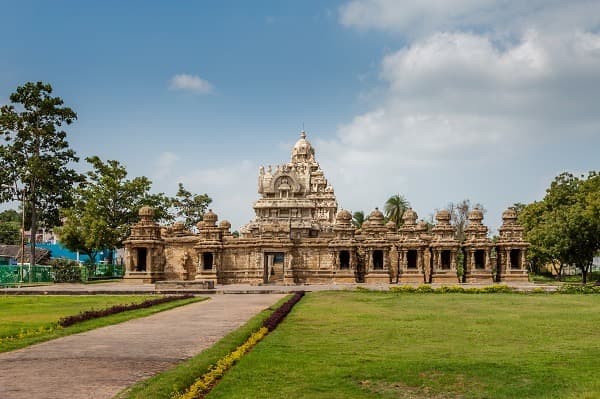
On the western bank of Kanchipuram, the Kailasanathar Temple ranks among Tamil Nadu's oldest stone sanctuaries. Constructed under the Pallava dynasty in the early 8th century, it is dedicated to Shiva and preserves, in its niches, fragments of mural paintings contemporary with its construction. Its Dravidian silhouette, its 58 sub-shrines, and its relatively serene atmosphere — Kanchipuram, a temple city, boasts dozens of others far more frequented — make it an essential stop for those interested in Pallava art.
Why visit Kailasanathar Temple
The Kailasanathar is an open-air manual of architecture. Its appeal rests on three elements:
- A sufficient state of preservation to read the Pallava ornamental grammar: niches, rampant lions (yali), narrative panels.
- Fragments of 8th-century mural paintings in several niches, rare pictorial vestiges from this period in South India.
- Moderate visitor numbers compared to the large neighbouring temples, allowing you to observe details without crowds.
The site remains a living place of worship: ritual practices unfold here daily, without theatrical staging for visitors.
Temple history
Construction was initiated by Rajasimha (Narasimhavarman II) of the Pallava dynasty in 685 CE and completed by his son Mahendra Varma III in 705 CE. The temple inaugurates, in Kanchipuram, the large-scale use of dressed stone for a Shaivite sanctuary — a turning point after earlier rock-cut structures.
The plan adopts a primitive Dravidian architectural style: main sanctuary crowned with a pyramidal vimana, mandapa, and rectangular enclosure punctuated with small cells. According to local tradition, a tunnel constructed under royal command served as an escape route in case of siege; its entrance remains visible on the site.
The monument is today protected by the Archaeological Survey of India (ASI), which conducts consolidation campaigns to slow stone erosion.
What to see on site
The main sanctuary
The temple is built of sandstone, a material that allowed Pallava sculptors fine work but weathered easily in sea air and pollution. The sanctum houses a linga; the outer walls display forms of Shiva (Tripurantaka, Nataraja, Ardhanarishvara) in high relief.
The 58 sub-shrines
58 small shrines surround the main sanctuary, forming a continuous enclosure. Each cell houses a different representation of Shiva or associated deities. Walk around them clockwise (pradakshina), as tradition requires.
The mural paintings
Several niches preserve fragments of 8th-century paintings, among South India's oldest. The pigments, fragile, are visible in soft light — no flash photography.
The iconographic panels
On the enclosure, panels illustrate dance competitions between Shiva and Parvati, a classical theme in Shaivite iconography. Other scenes feature Durga, Ganesha, and divine processions.
Practical information
- Admission: generally free.
- Photography: permitted within the enclosure, forbidden inside the main sanctum.
- Dress code: shoulders and knees covered; shoes removed before entering sacred areas.
- Duration: allow 1 to 1.5 hours to tour the sub-shrines and observe the sculptures.
- Opening hours: open mornings and late afternoons, with closure at midday — check on site before making the trip.
When to visit
Kanchipuram has a tropical hot climate, with scorching summers (April–June) and a north-east monsoon in October–November. The most comfortable period extends from November to February, when daytime temperatures remain manageable.
For a particular experience, the Maha Shivaratri festival, celebrated on the 13th night and 14th day of the month of Magha (February–March according to the Hindu calendar), features nights of prayer and significant temple attendance. Expect queues and a much denser atmosphere.
How to get there
Kanchipuram is located southwest of Chennai, the main regional entry point.
- By air: Chennai International Airport is the nearest, roughly 70 km away. Allow 2 to 2.5 hours by road depending on traffic.
- By train: Kanchipuram railway station connects to Chennai and several Tamil Nadu towns.
- By bus: regular services from Chennai, Pondicherry, and Tiruchirappalli.
- On site: the temple stands at the western edge of Kanchipuram, on the banks of the Vegavathi River (sometimes called Vedavathi locally). A rickshaw from the centre will suffice.
Kanchipuram is also renowned for its hand-woven Kanjeevaram silk sarees; town-centre workshops complement the temple circuit.
Nearby attractions
- Brihadeeswarar Temple in Thanjavur — Chola masterpiece, UNESCO-listed.
- St. Thomas Basilica in Chennai, marking South Indian Christian tradition.
- Daria Daulat Bagh, Tipu Sultan's summer palace in Karnataka, to extend your itinerary westward.
Frequently asked questions
Frequently asked questions
Plan your trip
Kailasanathar Temple fits into a broader itinerary across the major Pallava and Chola sites of Tamil Nadu. To build a customized stay incorporating Kanchipuram, Mahabalipuram, and the temple capitals of the south, explore our travel experiences in India.
Interested in this visit?
We can include it in your personalised itinerary.