Brahma Temple
Brahma Temple
A sanctuary with a striking red spire rising near Pushkar Lake, Brahma Temple is one of the world's few major shrines dedicated to Brahma, the creator god of the Hindu trinity.
The Brahma Temple, also known as Jagatpita Brahma Mandir, stands near Pushkar Lake in Ajmer district, Rajasthan. Recognizable by its striking red spire rising to 21 meters, it ranks among the world's rare major shrines dedicated to Brahma, the creator god of the Hindu trinity. A visit here is an essential stop on any journey to Pushkar.
Why visit Brahma Temple
The sanctuary is one of five sacred pilgrimage sites in India and one of the world's very few temples dedicated to the creator god. This uniqueness stems from a mythological legend still alive in local tradition, lending the site an atmosphere of particular devotion, especially during major religious events such as Kartik Poornima.
Beyond its spiritual dimension, the temple holds notable architectural interest: its distinctive red spire, black and white marble floor, walls inlaid with hundreds of silver coins engraved with donors' names, and the rich iconography surrounding Brahma's four-faced idol.
History and legends
According to the Padma Purana, Brahma sought a place to perform the Yajna ritual when the lotus he held in his hand fell and transformed into a lake. He chose this site for the sacrifice and named the city Pushkar, from the Sanskrit push (flower) and kar (hand).
The same tradition recounts that his wife Saraswati, unable to reach him in time for the ritual, angered him into union with Gayatri. Furious, Saraswati cursed him, declaring that Brahma would only be worshipped at Pushkar. This legend explains the rarity of temples dedicated to the creator god across India.
Pushkar once counted up to 500 temples, most of which were desecrated under Mughal emperor Aurangzeb before being restored. The current building dates from the 14th century, though tradition traces its foundation to over 2,000 years ago, attributed to sage Vishwamitri following the Yajna for Brahma. A renovation is believed to have occurred in the 8th century, with major recent rehabilitations undertaken by Maharaja Jawat Raj of Ratlam. Tradition also credits Adi Shankara with installing the main statue around 718.
What to see
Exterior architecture
The temple stands on a raised platform accessed by marble steps. Its red spire of 21 meters and the hamsa (swan, Brahma's mount) adorning the main entrance make it immediately recognizable. The structure combines stone slabs and blocks assembled with molten lead, characteristic of North Indian sanctuaries.
Interior and iconography
Inside, the black and white marble floor and walls inlaid with hundreds of silver coins engraved with the names of devotee donors immediately strike the eye. The inner sanctum (garbhagriha) houses Brahma's marble statue, called the chaumurti or "four-faced idol." The god is depicted seated cross-legged with four faces pointing toward the cardinal directions and four arms holding:
- the akshamala, the prayer beads;
- the pustaka, the sacred book;
- the kusha, ritual grass;
- the kamandalu, a water vessel.
To the left of the main statue stands Gayatri, to the right Saraswati. One also recognizes representations of Vishnu, dvarapalas (door guardians), and a golden Garuda.
Practical information
Entry to the temple is free. The sanctuary opens to devotees very early in the morning and closes in the evening, with a midday closure: it is advisable to check local opening hours before visiting, as they vary by season.
A few rules apply inside:
- married men cannot enter the inner sanctum, access being reserved for monks;
- pilgrims' offerings (puja) are received in the outer hall by priests, predominantly from the Parashar Gotra lineage;
- photography inside is forbidden;
- shoes must be removed at the entrance and dress should cover shoulders and legs.
When to visit
The temple can be visited year-round, but two periods stand out. The cool season, October to March, offers the most comfortable visiting conditions. It is also during this period, on the full moon of the month of Kartik (October-November), that the Kartik Poornima festival takes place, dedicated to Brahma. Pilgrims then bathe in the sacred waters of Pushkar Lake before coming to leave their offerings at the temple.
Coinciding with Kartik Poornima, the Pushkar Fair is held over five days near the sanctuary. Considered India's largest cattle fair, it attracts traders, pilgrims, and travelers. Crowds are then substantial and accommodations should be booked well in advance.
How to get there
The temple stands in the heart of Pushkar, about ten kilometers from Ajmer, which has the nearest railway station and good connections to Jaipur, Delhi, and the rest of Rajasthan. From Ajmer, local buses and shared taxis reach Pushkar in less than an hour. Once there, the temple is walkable from most central accommodations, following bazaar alleyways down to the ghats.
Nearby attractions
A visit to Brahma Temple combines easily with other points of interest:
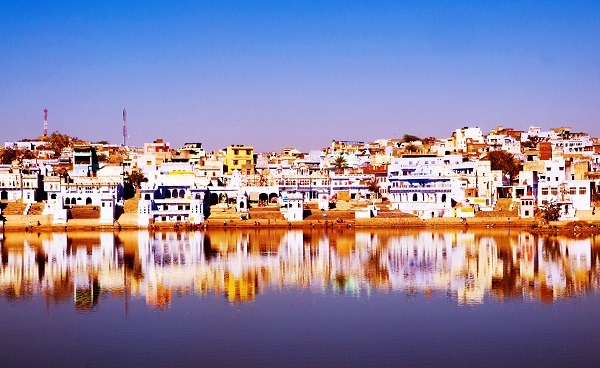
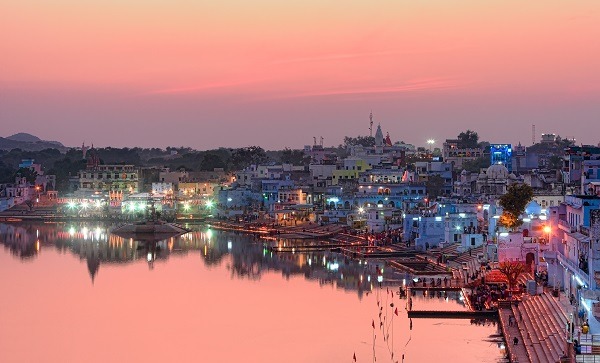
- Pushkar Lake and its 52 ghats, just steps from the temple;
- other sanctuaries in the city, notably the Savitri temple perched on the hillside;
- Ajmer and the Sufi shrine of Khwaja Moinuddin Chishti;
- further south, the Jagdish Temple in Udaipur, another major Vishnavite sanctuary in Rajasthan;
- in Jaipur, the forts Nahargarh and Jaigarh, which complete a Rajasthani circuit.
Frequently asked questions
Frequently asked questions
Plan your journey
Brahma Temple fits naturally into a Rajasthan circuit, between Jaipur, Ajmer, Pushkar, and Udaipur. To build a custom itinerary including Pushkar and its surroundings, explore our trips to India.
Interested in this visit?
We can include it in your personalised itinerary.