Sansad Bhavan (Parliament of India)
Sansad Bhavan (Parliament of India)
Sansad Bhavan, the seat of India's Parliament in New Delhi, is a masterpiece of colonial architecture designed by Herbert Baker. Its circular colonnade of 144 sandstone columns dominates the monumental Lutyens' Delhi district.
Sansad Bhavan, the seat of India's Parliament, rises at the heart of New Delhi in the Raisina Hill district, designed by British architects Edwin Lutyens and Herbert Baker. Inaugurated in 1927 during the British Raj, this circular colonnaded building houses both the Lok Sabha (lower house) and the Rajya Sabha (upper house). Its distinctive silhouette—a cylinder of red sandstone surrounded by 144 columns—makes it one of the most photographed symbols of India's capital.
Quick Practical Information
- Public access: the interior is not open to casual tourist visits; organized tours are possible upon official request through the Parliament office.
- Exterior: freely visible from Sansad Marg and the surrounding gardens.
- Dress code: formal attire required for any official business inside.
- Recommended duration (exterior): 20 to 30 minutes to photograph and observe the architectural ensemble.
- Wheelchair access: the surroundings are accessible; interior access depends on official authorization.
What You'll See
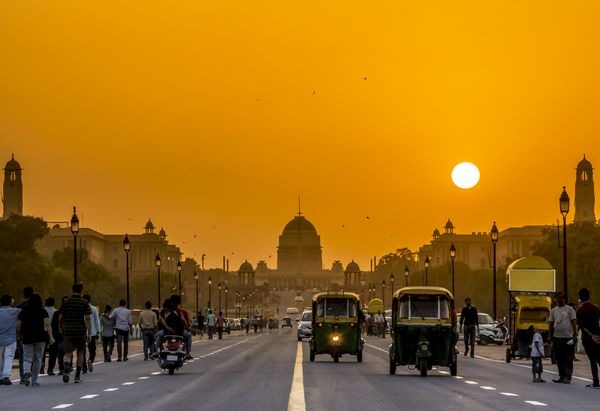
The exterior façade strikes with its rigorous symmetry: a continuous colonnade of Dholpur sandstone runs around the entire perimeter of the building. The central dome, subtle when viewed from outside, crowns the central circular chamber. In the immediate vicinity lie the Rashtrapati Bhavan (presidential palace) and the two Secretariat Buildings flanking Rajpath.
History and Context
Construction began in 1921 and was completed in 1927 as part of the vast urban planning project for New Delhi commissioned by the British. Lutyens designed the overall master plan; Baker designed the Parliament building. Upon India's independence in 1947, the edifice became the legislative heart of the world's largest democracy. In 2023, an adjacent new Parliament building, designed by architect Bimal Patel, was inaugurated to accommodate the needs of an expanded assembly.
Highlights of Your Visit
The Exterior Colonnade
The 144 red-beige sandstone columns form a continuous peristyle. Their regular rhythm and the patina of the material create a striking contrast with Delhi's sky, especially in raking light.
The New Parliament (2023)
The adjoining triangular building incorporates motifs inspired by classical Indian architecture. Its inauguration reignited the debate on preserving the colonial heritage of Lutyens' Delhi.
The Rajpath / Kartavya Path Axis
From Sansad Marg, the monumental axis now renamed Kartavya Path connects the Parliament to India Gate. This is where India's Republic Day parade takes place each year on January 26th.
Photography Tips
Morning light (before 9 a.m.) is ideal: the sun illuminates the main façade without backlighting. Position yourself on Sansad Marg to frame the colonnade in perspective. Winter haze days (December–January) create a particularly atmospheric quality. Interior photography requires official authorization.
Location and Access
Sansad Bhavan sits in the Lutyens' Delhi district, within walking distance of the Rashtrapati Bhavan and India Gate. The nearest Metro station is Udyog Bhawan (Yellow Line). Taxis and auto-rickshaws easily serve the area. Parking is very limited in this secure zone.
Nearby Attractions
- Rashtrapati Bhavan — The official residence of India's President, a Lutyens masterpiece whose Mughal gardens are open to the public during certain periods.
- India Gate — A triumphal arch commemorating Indian soldiers who fell in World War I, a popular gathering point in the evenings.
- Jantar Mantar — An 18th-century astronomical observation site, a few minutes' walk away, UNESCO World Heritage listed.
- National Museum — One of India's largest museums, with collections spanning 5,000 years of history, located on Janpath.
Frequently asked questions
Interior access is not open to casual public visits. Official tours can be arranged upon written request to the Parliament office, generally reserved for school groups or institutional delegations.
October through March offers pleasant weather in Delhi (cool to mild temperatures). Avoid summer (April–June) when temperatures regularly exceed 40°C. On January 26th, the Republic Day parade enlivens the entire Kartavya Path axis.
Yes, photography from public roads and surrounding gardens is permitted. Photography within the secure perimeter or of the building interior requires official authorization.
Rashtrapati Bhavan, India Gate, and Jantar Mantar are all within walking distance or a short ride from the Parliament. Half a day is sufficient to explore this monumental axis.
It is a triangular structure adjacent to the original Sansad Bhavan, designed by architect Bimal Patel. It now hosts sessions of the Lok Sabha and Rajya Sabha, while the original building is preserved.
Interested in this visit?
We can include it in your personalised itinerary.