Kumbhalgarh Fort
Kumbhalgarh Fort
India's second-largest fort, UNESCO-listed, Kumbhalgarh Fort rises with its 36 km of ramparts in the Aravalli range, 84 km from Udaipur.
Kumbhalgarh Fort, sentinel of the Aravalli
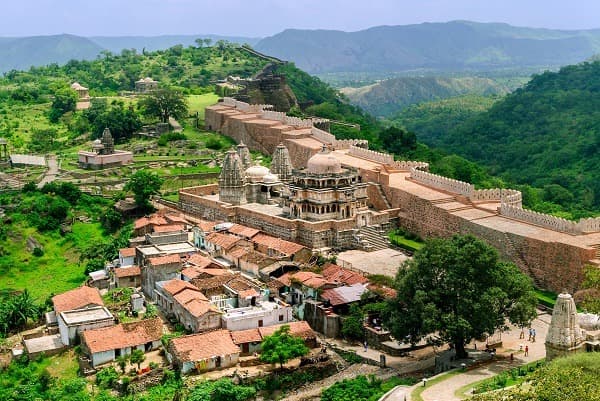
Perched at 1,914 meters altitude on a ridge of the Aravalli mountains, Kumbhalgarh Fort stands 84 km north of Udaipur, in southern Rajasthan. With ramparts that wind across 36 km through the mountains, it is India's second-largest fort after Chittorgarh. Inscribed as a UNESCO World Heritage site in 2013 as part of the "Hill Forts of Rajasthan," it combines military might, refined architecture, and the dynastic legacy of the Mewar kingdom.
Why visit Kumbhalgarh Fort
The site brings together three rarely combined assets. First, its fortifications: a continuous 36 km wall, sometimes called the "Great Wall of India," punctuated by curved bastions and watchtowers. Next, its heritage density: over 360 Hindu and Jain temples, multicolored palaces, and water reservoirs cascade across successive terraces within the fort. Finally, its setting: from the high ramparts, views sweep across the plains, reaching the distant dunes of the Thar desert on clear days.
The place remains less crowded than Amber or Jaisalmer forts, allowing for a more contemplative visit.
History: from Rana Kumbha's grand project to the birth of Maharana Pratap
The fort was built between 1445 and 1458 by Rana Kumbha, sovereign of Mewar, under the supervision of architect Mandan. The location was chosen for its defensive value: a rocky spur of the Aravalli, difficult to access, serving as a refuge for Mewar's rulers during invasions.
Legend tells that the construction of the enclosing wall repeatedly failed. A spiritual guide consulted by Rana Kumbha reportedly recommended a human sacrifice. A pilgrim volunteered and was decapitated according to ritual. The main gate, Hanuman Pol, today houses a sanctuary and temple commemorating this sacrifice.
Kumbhalgarh is also the birthplace of Maharana Pratap, a heroic figure of Rajasthan who resisted Mughal armies in the 16th century. In the late 19th century, Rana Fateh Singh undertook extensive renovations that gave the complex its present appearance.
What to see within the ramparts
The ramparts and seven gates
The enclosure is entered through seven monumental gates. The walls fold back on themselves in seven successive lines of fortifications, reinforced by curved bastions and broad watchtowers. Walking along the high ramparts is one of the site's most striking experiences.
Kumbha Mahal and Badal Mahal
At the fort's summit, the Badal Mahal ("palace of the clouds") impresses with its interiors in green, turquoise, and white tones, contrasting sharply with the dark stone of the fortifications. The older Kumbha Mahal preserves the austere atmosphere of 15th-century royal residences.
The temples
Over 360 temples are scattered throughout the enclosure, bearing witness to the coexistence of Hindu and Jain traditions within the Mewar kingdom. The Shiva Temple, or Neelkanth Mahadev, houses a monumental Shivalinga still in worship today.
When to visit
The best period runs from October to March, when Rajasthan's temperatures remain manageable during the day. The monsoon (July-September) verdures the Aravalli but can make some paths slippery. Summer (April-June) is punishing due to heat at this moderate altitude.
The Kumbhalgarh Festival, held annually around early December, celebrates Maharana Kumbha over three days: sound and light spectacle, Heritage Fort Walk, turban contests, mehendi-mandana, and traditional music concerts. This is a recommended period to combine your visit with cultural programming.
Practical information
- Visit duration: allow 2 to 3 hours for the fort's main buildings, a half-day if you walk sections of the high ramparts.
- Opening hours: daily daytime access. Sound and light shows take place in early evening.
- Admission: modest entry fee, with separate rates for Indian residents and foreign visitors, following standard ASI practice.
- Tips: bring sturdy walking shoes, water, and a hat. The elevation gain between the lower gates and Badal Mahal is considerable.
How to get there
The nearest airport is Udaipur (Maharana Pratap Airport), about 100 km away, with connections to Delhi, Mumbai, and Jaipur. From Udaipur, the drive in a private car or taxi takes 2.5 to 3 hours depending on road conditions.
RSRTC buses serve the region from Udaipur and Jodhpur; the nearest bus terminus is several kilometers from the fort, with the final leg by taxi or auto-rickshaw. Most travelers combine Kumbhalgarh with the Jain temples at Ranakpur on a day trip from Udaipur.
Combine with
Kumbhalgarh fits naturally into a southern Rajasthan circuit. Udaipur, its lakes, and palaces form the logical departure base. The temples at Ranakpur, about 50 km away, often complement the same day. To extend your discovery of India's UNESCO heritage, other cultural stops can be planned before or after Udaipur.
- Also see the State Museum of Bhopal to understand the context of central Indian dynasties.
- For another lesser-known fort on the subcontinent, Anjengo Fort in Kerala offers a colonial counterpoint.
- Heritage and spirituality enthusiasts will appreciate the Alchi Monastery in Ladakh.
Frequently asked questions
Frequently asked questions
Plan your trip
Kumbhalgarh naturally fits into a Rajasthan itinerary combining Udaipur, Ranakpur, and Jodhpur. To build a custom journey including this fort and the subcontinent's major sites, consult our India trips.
Interested in this visit?
We can include it in your personalised itinerary.