Ellora Caves
Ellora Caves
Carved into the basalt cliff of the Deccan between the 5th and 11th centuries, the 34 Ellora caves unite across two kilometers Buddhist, Hindu and Jain sanctuaries — including the colossal Kailasa temple, a unique monolith in the world.
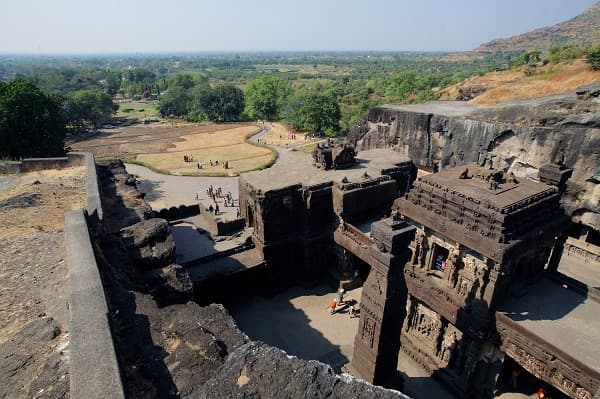
About thirty kilometers northwest of Aurangabad, the Ellora caves form one of the most ambitious rock-cut ensembles ever carved into the basalt cliffs of the Deccan. Thirty-four sanctuaries — Buddhist, Hindu and Jain — hewn between the 5th and 11th centuries coexist across two kilometers of cliff face. This interreligious proximity, unique in the world, earned Ellora its UNESCO World Heritage listing in 1983.
Practical information at a glance
- Entrance: Paid for foreign visitors; free for Indian nationals (official ASI rates, verify on-site).
- Weekly closure: Tuesdays.
- Recommended duration: 3 to 5 hours for a complete tour; a full day if you wish to explore each cave.
- Dress code: Respectful attire recommended; some active caves require removing shoes.
- Access: Regular buses from Aurangabad central bus station; taxis and auto-rickshaws available.
- Accessibility: Terrain is partially uneven; the Kailasa cave (No. 16) is accessible on foot via a flat path, but many caves feature steps.
What you'll see
The thirty-four caves are divided into three distinct groups. Caves 1 to 12, to the south, are Buddhist: multi-story monasteries and prayer halls adorned with colossal Buddhas. Caves 13 to 29, in the center, are Hindu and culminate with the Kailasa temple. Caves 30 to 34, to the north, belong to the Jain tradition and stand out for the fineness of their sculptures.
History and context
The carving of the caves began under the Vakataka and Chalukya dynasties, around the 5th century, and continued under the Rashtrakutas until the 11th century. Ellora is not an abandoned site: several sanctuaries remain active places of worship. The coexistence of three religions on the same site testifies to a period of relative tolerance and intense royal patronage in the medieval Deccan.
Highlights of the visit
The Kailasa temple (cave 16)
Carved from a single block of rock in the cliff face under the Rashtrakutas in the 8th century, Kailasa is the world's largest monolithic temple. Two hundred thousand tons of rock were excavated from top to bottom to reveal this sanctuary dedicated to Shiva. The friezes depicting Ravana lifting Mount Kailash rank among the most expressive reliefs in classical Indian art.
The Buddhist monasteries (caves 1-12)
Cave 10, known as the "Carpenter's Cave," is a chaitya (prayer hall) whose vault imitates carved wood. Cave 12 (Teen Tal) rises across three levels and houses rows of meditating Buddhas of remarkable serenity.
The Jain sanctuaries (caves 30-34)
Cave 32 (Indra Sabha) reproduces the Kailasa structure in miniature. Its lotus-decorated ceilings and finely carved tirthankaras illustrate the extreme care Jain artisans lavished on ornamental detail.
Etiquette and visiting rules
- Remove your shoes before entering active sanctuaries.
- Speak in low voices in spaces of active worship.
- Do not touch the sculptures; some are fragile and protected.
- Photography is generally permitted, but check the signs at the entrance to each cave.
Photography tips
Morning light (before 10 a.m.) ideally illuminates the western facade of the Kailasa temple. Mid-day, the interior of the Buddhist caves benefits from diffuse light favorable to sculpture portraits. A lightweight tripod is useful in dark caves; verify permission before setting it up. Avoid using flash on ancient paintings and reliefs.
Location and access
Ellora is located about 30 km from Aurangabad, connected by a national highway. MSRTC buses depart regularly from the central bus station. By taxi or rental car, expect 40 to 50 minutes depending on traffic. The site is often combined with the Ajanta caves (approximately 100 km to the northeast) as a day excursion from Aurangabad.
Nearby attractions
- Ajanta Caves — Buddhist paintings from the 2nd century BCE to the 5th century, UNESCO-listed, approximately 100 km away.
- Bibi Ka Maqbara — 17th-century Mughal mausoleum nicknamed "the Taj of the Deccan," in Aurangabad.
- Daulatabad Fort — Medieval fortress perched on a volcanic peak, midway between Aurangabad and Ellora.
- Aurangabad — Main base for accommodation, with its own rock-cut caves and lively bazaar.
Frequently asked questions
The dry season, from October to March, offers pleasant temperatures. Avoid May and June when heat regularly exceeds 40°C. The monsoon (July-September) makes paths slippery but vegetation is lush.
It's possible but exhausting: the two sites are about 100 km apart. It's better to dedicate a day to each site to fully appreciate them.
An accredited guide greatly enriches the visit: the iconography of the sculptures is complex and explanatory panels remain limited. Guides are available at the site entrance.
Photography without flash is generally permitted. Some active caves may have specific restrictions; respect the signs posted at the entrance to each cave.
Allow at least 3 hours for the highlights (Kailasa, Buddhist caves, Jain caves). A full day allows you to explore all 34 caves without rushing.
No, the Ellora caves are closed on Tuesdays. Plan your visit accordingly, especially if you're combining it with other excursions from Aurangabad.
Photos
Want to discover this destination?
Our local advisors design your tailor-made trip.