Datia Palace
Datia Palace
A seven-storey Bundela structure built in 1614 by Bir Singh Deo, Datia Palace merges Mughal and Rajput architecture. Uninhabited since its inception.
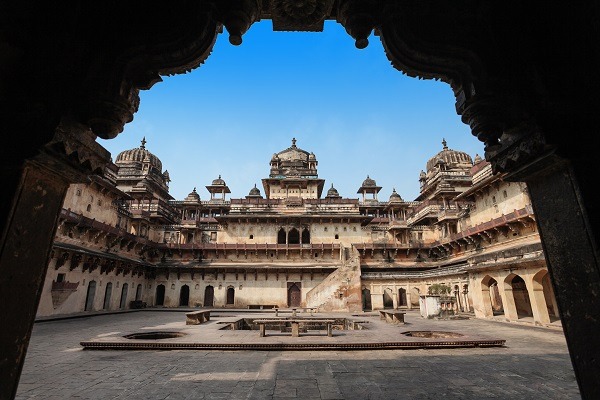
The Datia Palace, also known as the Bir Singh Palace or Satkhanda Palace, rises its seven storeys of stone and brick in the heart of the town of Datia, in Madhya Pradesh. Built in 1614, it combines Mughal and Rajput architecture within a massive structure of roughly 80 metres on each side, never inhabited by the royal family that commissioned it.
Why visit Datia Palace
Three elements make this site unique in the landscape of central India's palaces:
- A construction without wood or iron, entirely in stone and brick, which partly explains its longevity over more than four centuries.
- A palace uninhabited from the start: no maharaja ever resided here, which earned it the local nickname of "haunted palace".
- A rare internal religious complex, where Hindu temples and a small mosque coexist within the same walls.
For those interested in Bundela architecture or wishing to venture off the beaten path in northern India, Datia makes a coherent detour from Gwalior, Jhansi or Orchha.
History of the palace
The palace was commissioned in 1614 by the maharaja Bir Singh Deo, an ally of the Mughal emperor Jahangir. Its construction took nine years and required an investment of 35 lakhs of rupees, a considerable sum for the time. It is the largest of the 52 palaces attributed to this Bundela sovereign, who developed a coherent architectural programme throughout the region.
In 1635, the Mughal emperor Shah Jahan visited the site accompanied by historian Abdul Hamid Lahori, who recorded the event. Despite these prestigious visits and the quality of construction, no member of the royal family ever established a residence here. This continued absence of occupation, uncommon for a palace of this scale, fuels local accounts of its alleged invisible presences.
What to see on site
Exterior architecture
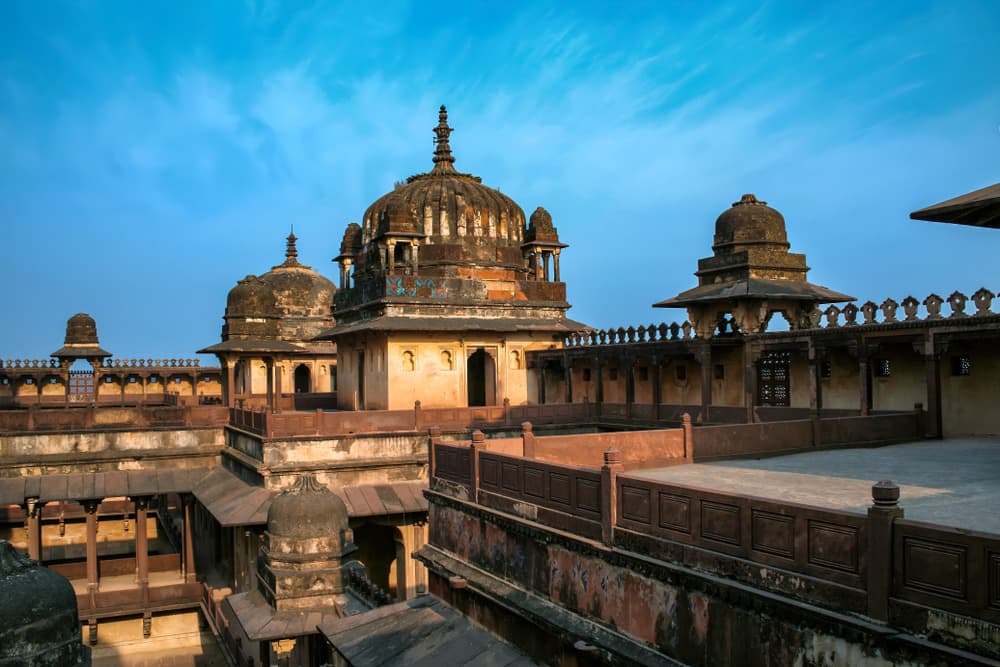
The building is organised across seven storeys around a central courtyard, hence the name Satkhanda ("seven levels"). The main entrance faces east and overlooks the Karna Sagar lake, located to the south of the site. The façades combine arched domes and vaulted doorways of Mughal inspiration with typically Rajput and Bundela elements: chhatris (domed pavilions), finely carved latticed windows, corbelled balconies. The summit is crowned with a ribbed dome topped with a Shikhar in the shape of a lotus petal.
Interiors and frescoes
The palace contains over 400 rooms, connected by a network of corridors and staircases. Several underground chambers served as refuge from the summer heat, a common climate-conscious architectural principle in the region. Many rooms preserve mural frescoes depicting horses, Hindu deities, court figures and floral motifs. These paintings were created with natural plant-based dyes, which sheds light on the pictorial techniques in use in medieval India.
The religious complex
Within the palace exist temples dedicated to Ganesha and Durga and a small mosque (dargah). This juxtaposition, intended from the design stage, illustrates the climate of religious coexistence characteristic of the Bundela court allied with the Mughals.
Practical information
- Hours: open daily during daylight hours, generally from morning until late afternoon. Verify opening times locally before travelling.
- Admission: free entry announced for all visitors. An accredited local guide (Hindi/English) can be hired on-site for a modest fee; this significantly enhances your understanding of the frescoes and spaces.
- Duration of visit: allow 1 to 2 hours to explore the main levels and terraces.
- Access: parking is available nearby; from Datia station, shared autos drop visitors at the entrance for a few rupees.
When to visit
Madhya Pradesh experiences very hot summers, with temperatures frequently exceeding 40°C from April to June. The most comfortable period runs from October to March, with dry weather and mild days. The monsoon (July-September) greens the region but can complicate travel and viewing of the façades. A morning or late afternoon visit remains preferable, as the low-angled light highlights the stone carvings.
How to get there
Datia is located approximately 75 km from Gwalior, accessible by car or train. From Jhansi, allow about an hour by bus or train. The town is a logical stopping point between Gwalior to the north and Orchha to the south, on the Delhi–Bhopal railway line. Once in Datia, the palace can be reached in minutes by auto-rickshaw from the station or town centre.
What to see in the region
- Gwalior Fort and its Tomar palaces, 75 km to the north.
- Orchha, former Bundela capital with spectacular temples and cenotaphs, approximately 60 km away.
- The State Museum of Bhopal to deepen your understanding of Madhya Pradesh's history.
- The Ajit Singh Memorial, another site honouring Indian princely heritage.
Frequently asked questions
Frequently asked questions
No member of the royal family ever resided there after its completion in 1623. This absence of occupation, unusual for a palace of this size, has nurtured a local oral tradition centred around invisible presences, hence the nickname.
It is not compulsory but recommended. The frescoes, underground chambers and symbolism of the religious complex gain much from expert commentary. Hindi/English-speaking guides are present at the entrance for a modest fee.
One to two hours is sufficient to explore the accessible levels, terraces and internal religious complex. Allow more time if you wish to photograph the frescoes in detail.
Yes. From Jhansi, approximately one hour by bus or train. From Orchha, allow just over an hour by car. Datia fits well into a Gwalior–Orchha–Khajuraho circuit.
Plan your journey
Datia Palace forms part of a coherent circuit through central India, between Bundela architecture, Mughal heritage and lesser-known stopover towns. To build a custom itinerary incorporating Datia, Orchha and the sites of Madhya Pradesh, explore our journeys through India.
Interested in this visit?
We can include it in your personalised itinerary.