Chapora Fort
Chapora Fort
Portuguese and Maratha ruin perched above the Chapora River and the Arabian Sea, in northern Goa. Free access, sweeping views, a site made famous by Dil Chahta Hai.
Chapora Fort stands on a laterite hill in Bardez, northern Goa, overlooking the mouth of the Chapora River and the Arabian Sea. Its ruined walls, remnants of more than four centuries of struggle between the Bijapur sultans, Portuguese and Marathas, draw both history enthusiasts and travellers eager to see the site made famous by Indian cinema.
Why visit Chapora Fort
The fort combines three compelling reasons to make the detour from the nearby beaches of Vagator and Anjuna:
- A layered historical site: its stones have witnessed the Bijapur sultanate, the Portuguese colonial empire and the Maratha confederation. The chronology is readable directly in the bastions and gun emplacements.
- A panoramic vantage point over the Chapora River, the ocean and the coconut groves of northern Goa, particularly appreciated in late afternoon.
- A pop-culture landmark: its appearance in Dil Chahta Hai (2001) made it a pilgrimage site for fans of Hindi cinema, who come to identify the filming angles.
Admission is free and a visit takes no more than one or two hours, making it easy to fit into a day on the northern coast.
History of the fort
The site was first occupied by a military outpost whose ruins served as the foundation for a fort built by Sultan Adil Shah of Bijapur. Its name derives from Shahpura, "city of Shah", a trace of this Muslim origin.
The Portuguese conquered Bardez in 1543 and rebuilt the structure in 1612 to secure the northern boundary of their possessions, then threatened by incursions from the Maharaja of Sawantwadi. Yet Chapora changed hands several times.
In 1683, the Maratha army led by Sambhaji seized the fortress. Local legend has it that the attackers used large monitor lizards, with their sharp claws, as "living ropes" to scale the walls; the tale belongs to folklore and has no historical verification, yet it continues to be recounted on site.
The Portuguese recovered the fort in 1717 and undertook major works, including the excavation of underground tunnels intended for emergency evacuation to the river. In 1739, the Marathas retook Chapora. Rather than launch another siege, the Portuguese preferred to annex the province of Pernem in 1741, during the "New Conquests". The fort, now in the rear, lost its military purpose and was abandoned in 1892.
What you see today
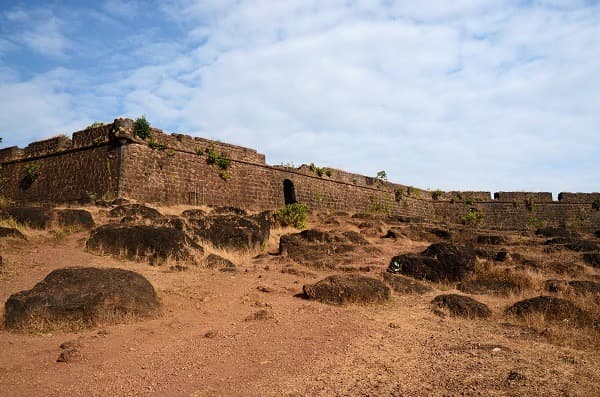
The fortification follows the natural relief of the peninsula. The laterite walls, the reddish sandstone typical of Goa, hug steep slopes rather than relying on ditches. The massive bastions, equipped with gun emplacements and topped with cylindrical turrets, remain the best-preserved elements.
The main entrance, austere, is reached via a path climbing from the road. Inside, the esplanade is clear: the barracks, officers' quarters and church dedicated to Saint Anthony have vanished. The openings of the underground tunnels dug in 1717 are still visible in places, but inaccessible.
Walking the ramparts allows you to traverse nearly the entire perimeter and offers, at each corner, a different orientation: the river to the north, the ocean to the west, Vagator beach to the south.
Practical information
- Access: free, with no strict gatekeeping or ticketing. The site remains accessible for most of the day.
- Duration of visit: allow 1 to 2 hours including the climb and rampart walk.
- Equipment: closed-toe shoes recommended, the ground is uneven and the walls lack railings. Water essential, no food or drink vendors on site.
- Shade: very limited. Avoid midday.
When to go
Goa has a tropical climate marked by summer monsoon. For Chapora, two factors matter: rain and heat in full sun on the ramparts.
- November to February: the most pleasant period. Moderate temperatures, clear skies, and the peak tourist season for Goa.
- March to May: sustained heat, especially in April–May. The climb and walk on the ramparts become taxing in the middle of the day; favour early morning or late afternoon.
- June to September: monsoon. The ramparts become slippery and showers frequent; the landscape is nonetheless very green.
Sunset remains the busiest time, due to the clear view towards the west.
How to get there
The fort is located in the taluka of Bardez, roughly 10 km from Mapusa and 21 km from Panaji (Panjim).
- From Panaji: taxi or rented scooter, allow approximately 45 minutes depending on traffic.
- From Goa International Airport (Dabolim): taxi, roughly 1.5 hours by road.
- From Mapusa: local buses heading to Anjuna and Vagator, stop near the access path.
- From Vagator beach: possible to hike via a trail climbing the south flank of the hill. A direct and more immersive approach.
Nearby
The fort sits in a region dense with coastal sites and villages:
- Vagator beach: just at the south foot of the hill, divided into Big and Small Vagator.
- Anjuna beach and market: a few kilometres to the south, the Wednesday flea market is known for its crafts and souvenir stalls.
- Chapora village: to the north, fishing port and river mouth, more authentic than neighbouring tourist zones.
- Morjim and Ashvem: quieter beaches beyond the river, accessible via the Siolim bridge.
To extend your discovery of Indian fortified heritage, you can consult our guide to Anjengo Fort in Kerala, or explore other aspects of the country via Alchi Monastery in Ladakh and the State Museum of Bhopal.
Frequently asked questions
Frequently asked questions
Yes, admission is free. The site is not managed as a ticketed monument: it is an open ruin on the hillside, without strict gatekeeping.
Allow 1 to 2 hours, including the climb from the car park or from Vagator beach, and a walk around the ramparts.
Yes, but with caution: between June and September, the stones become slippery and showers are frequent. The dry season, from November to February, remains more comfortable.
Several scenes from the film Dil Chahta Hai (2001), regarded as a classic of contemporary Hindi cinema, were filmed here. The site has become a landmark for fans of the film.
It is a local legend attached to the Maratha capture of the fort in 1683. It is not confirmed by reliable historical sources, but it is part of the folklore associated with the site.
Plan your trip
Chapora Fort fits naturally into an itinerary across northern Goa, between beaches, markets and fishing villages. To build a wider trip across the subcontinent, consult our travel ideas for India.
Interested in this visit?
We can include it in your personalised itinerary.