Bhanwar Niwas
Bhanwar Niwas
A 1927 haveli designated as a heritage monument by the ASI, Bhanwar Niwas retains its original Indo-European architecture and Usta art in Bikaner's old walled city.
Bhanwar Niwas occupies a 1927 haveli in Bikaner's walled old city, Rajasthan. Built for Bhanwarlal Ji Rampuria, heir to a Marwari merchant family, it is today listed as a heritage monument by the Archaeological Survey of India. The hotel preserves its original Indo-European architecture, Art Deco ornamentation, and remains managed by the founding Rampuria family.
Why stay here
- An authentic 1927 haveli listed by the Archaeological Survey of India, still owned by the founding Rampuria family.
- Rare Indo-European architecture: pink sandstone façades from Dulmera carved with floral and geometric motifs, Italian marble, furnishings inspired by Lazarus & Co creations from Calcutta.
- The Blue Salon and its gold leaf ornaments executed in the ancestral Usta art—a decorative technique distinctive to Bikaner.
- The High Tea tradition perpetuated by the family, served each afternoon in the courtyard.
- Central location in the old city, within walking distance of Rampuria havelis and historic bazaars.
Atmosphere
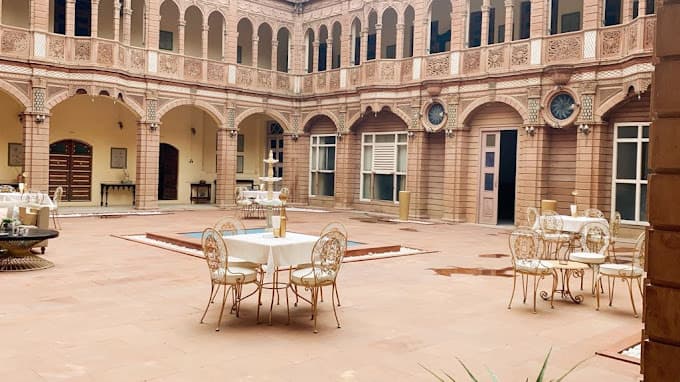
The building is organized around a central courtyard, the typical haveli layout in Rajasthan that ensures natural ventilation and tempers summer heat. Carved balconies filter light and impart a hushed atmosphere, hovering between an Indian patrician residence and a European villa of the 1920s.
On the ground floor, two salons set the tone. The intimate salon lends itself to quiet moments at day's end. The Blue Salon, more ceremonial in character, showcases the richness of Usta art: hand-applied gold leaf on a deep blue ground, gilt armchairs, antique objects. The ensemble speaks to the social standing of Marwari merchant families at the height of Bikaner's wool, spice, and jewelry trade—the wealth that made the city prosper.
The rooms
Around thirty rooms are divided into three categories: Standard, Deluxe, and Suites. Each blends period furnishings, carved woodwork, and worked textiles with the amenities expected of an establishment in this category (air-conditioning, private bathroom, Wi-Fi).
Suites feature four-poster beds and Egyptian cotton linens, with more generous volumes and ornate ceilings. The arrangement remains faithful to the haveli spirit: no hotel standardization—each room retains its own character.
Dining and services
The dining offering centers on two venues. The Courtyard, outdoors, offers Indian and international cuisine with a vegetarian emphasis, prepared from local products. Coffee & Co. serves masala teas, specialty coffees, and snacks throughout the day.
High Tea, served afternoons in the inner courtyard or on the terrace, perpetuates a Rampuria family tradition: kachoris, samosas, mini-sandwiches, homemade cookies, and Chena Toast, a local sweet specialty.
For services, the establishment provides 24-hour room service, laundry, valet parking, currency exchange, on-call physician, complimentary parking, and tourism advice. A meeting room is available for business travelers. The staff is multilingual.
On-site experiences
A multilingual audio tour allows you to explore the hotel at your own pace: history of the Rampuria family, architectural details, Usta technique, and displayed works. To delve deeper, the hotel organizes private heritage walks through the old city's alleyways, extending to other Rampuria havelis, ancient temples, and bazaars.
On weekends, the inner courtyard and Coffee & Co. host concerts of traditional Rajasthani music and Shehnaï recitals—the reed instrument emblematic of North India.
When to visit
The most comfortable window for Rajasthan spans October through March, with dry days and cool nights. February sees Bikaner's Camel Festival. From April to June, heat becomes intense (often above 40°C); the monsoon from July to September remains moderate in this semi-arid region but can disrupt travel.
Location and access
The hotel sits in Bikaner's walled old city. The train station is about 1.5 km away; Bikaner airport is 13 km distant. Vehicle access to the entrance may be limited by the narrowness of the lanes: it is often simpler to finish on foot or by rickshaw. Transfers can be arranged by the hotel on request. Jodhpur and Jaipur are several hours' drive away.
Nearby attractions
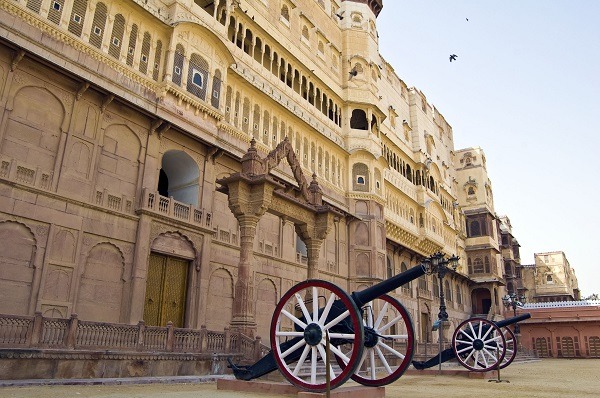
- Junagarh Fort: a 16th-century fortress, one of Rajasthan's few never conquered, rich in interior palaces.
- Rampuria Havelis: a cluster of red sandstone merchant houses, accessible on foot from the hotel.
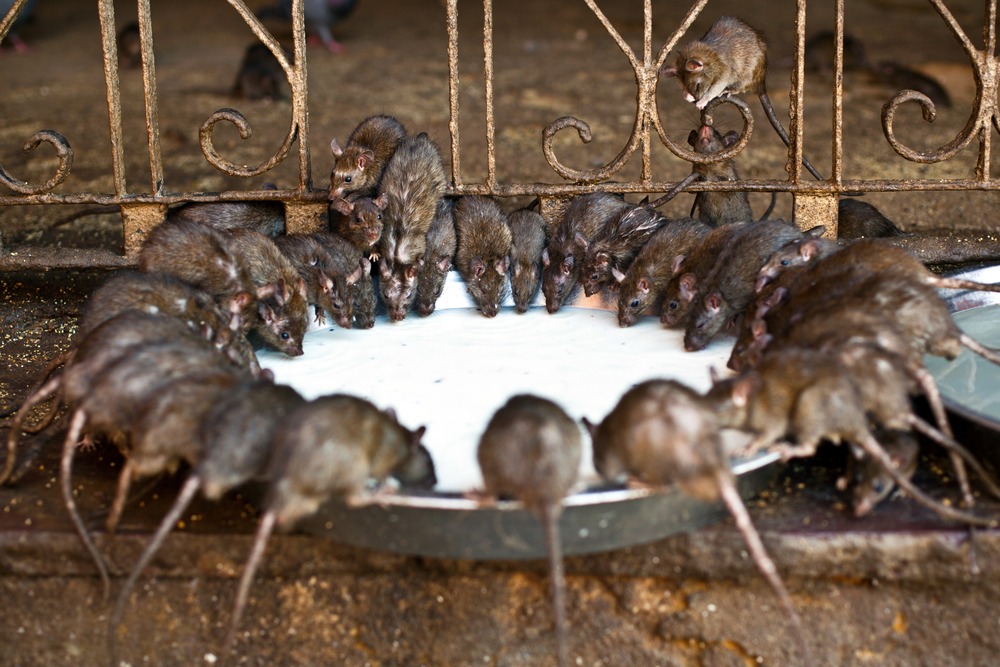
- Karni Mata Temple at Deshnoke, about thirty kilometers away, famous for its sacred rats.
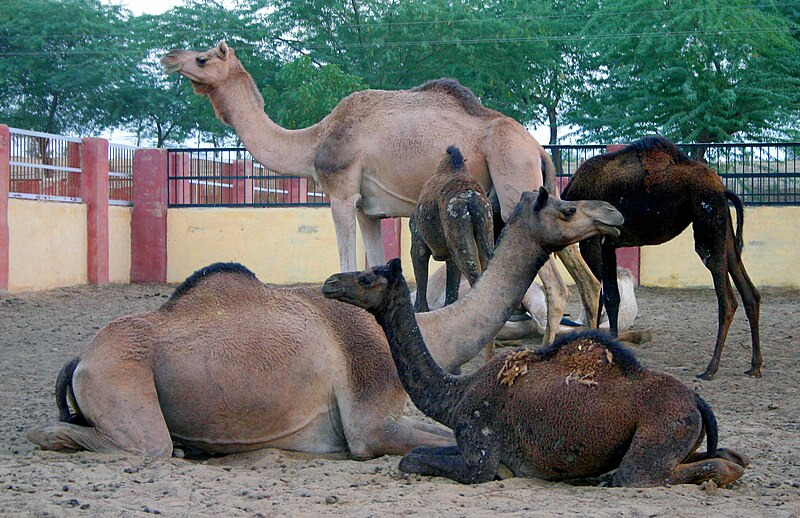
- National Research Centre on Camel, India's unique research station dedicated to Thar camels.
Frequently asked questions
Yes. The haveli remains the property of the Rampuria family, which perpetuates its traditions, including the High Tea ritual served each afternoon.
October through March, when temperatures are comfortable. The Camel Festival in January or February is a good reason to plan your visit around it.
Usta art is an ancestral decorative technique from Bikaner combining painting on a colored ground with hand-applied gold leaf. The Blue Salon presents a particularly refined example.
Bikaner airport is about 13 km away. Allow roughly thirty minutes by taxi. The hotel can arrange a transfer on request.
Planning your trip
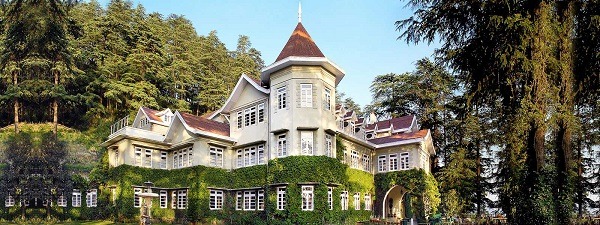
Bhanwar Niwas fits naturally into a Rajasthan circuit, complementing stays such as the Ranthambore Heritage Haveli for tiger spotting, or the Woodville Palace Hotel in Shimla for the Himalayan foothills. To build a custom itinerary, explore our India journeys.
Nearby
Fancy staying here?
We can book this accommodation for you.