Music of India
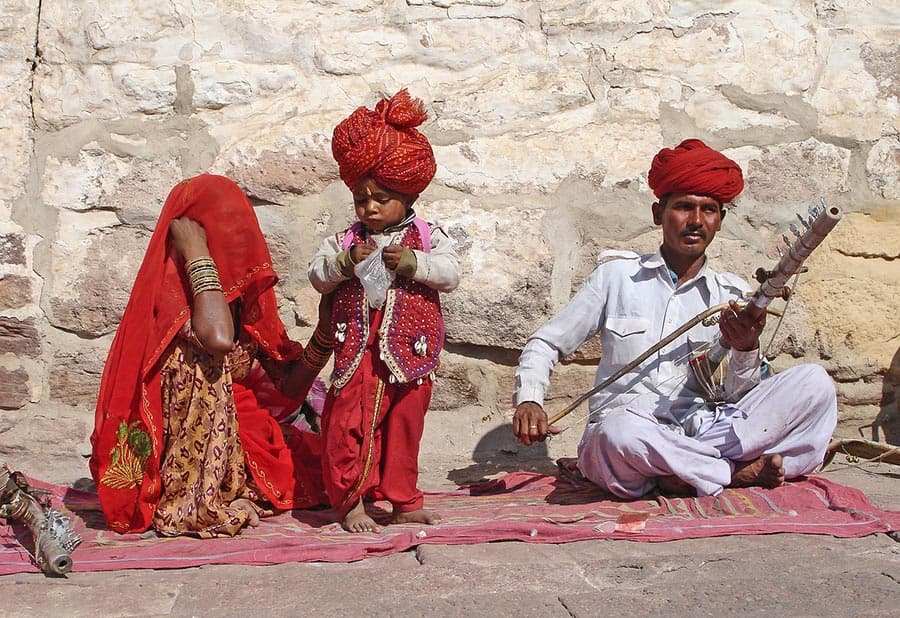
Upon arriving in India, your first encounter with the arts begins through music. Classical in the finest restaurants, contemporary in popular venues, omnipresent in every case.
Upon arriving in India, your first encounter with the arts begins through music. Classical in the finest restaurants, contemporary in popular venues, omnipresent in every case.
Northern India and Southern India each nurture two distinctly different musical genres:
Hindustani music in the north, as well as in Nepal, Pakistan, and Afghanistan. Carnatic music in the south. Both genres, deeply influenced by religion at their origins and remarkably similar until the 13th century, diverged with the arrival of the Mughals and their Persian-influenced music. Hindustani music evolved into court music, performed for the Maharajahs. More emotionally expressive, it tells human stories (one might say, in modern times, increasingly commercial!). Modern music, popularized by Bollywood, derives directly from this tradition.
By contrast, Carnatic music of Southern India preserves its spiritual essence, placing greater emphasis on musical structure and improvisation. It is based on the system of Ragas.
Three instruments symbolize musical India: the sitar, the tabla, and the harmonium.
The Sitar
A plucked string instrument from the lute family, its distinctive sonority captivated Western rock musicians in the 1960s and 1970s (George Harrison of the Beatles, Brian Jones of the Rolling Stones). Ravi Shankar's performance at the legendary Woodstock festival marked the beginning of Western enthusiasm for this strangely shaped instrument. Ravi Shankar's recordings then enjoyed considerable success. Today, the sitar continues to hold a prominent place in Hindustani music ensembles.
The Tabla
A percussion instrument composed of a pair of drums, one producing high-pitched sounds and the other lower tones. Its distinctive feature lies in the layering of two goat skins of different diameters, at the center of which a paste made of flour and iron is applied. This combination produces a unique resonance particular to this instrument.
Used both as a solo instrument and as an accompaniment in orchestras, it has established itself in the music of both Northern and Southern India. The king of the Raga, it gives musicians the opportunity to express their remarkable improvisational talents. Zakir Hussain, the most celebrated performer in Europe, has played with numerous Western artists.
The Harmonium
Imported by colonial settlers in the 19th century and profoundly adapted to suit Indian life, here is the indispensable wind instrument of every Hindustani music orchestra. Its distant European ancestor, a cousin of the organ originally dedicated to religious music, required the player to sit behind a keyboard. Yet in India, people sit on the floor or on cushions. The original pedal mechanism, replaced by a side bellows (similar to an accordion), allows the musician to sit on the ground. The left hand operates the bellows while the right hand plays the melody. Used as a solo instrument or accompanying a group, it sets the tone for singers. Its playing may not demand the virtuosity inherent in mastering the sitar and tabla, but its powerful and mesmerizing sound forms an essential component of classical Indian music.