Indian Currency
Inde is a fascinating and transformative destination, but before you take flight, it's essential to understand how its currency works. Between exchange rates, bills with unusual values, and different payment practices, it's best to be prepared.
Inde is a fascinating and transformative destination, but before you take flight, it's essential to understand how its currency works. Between exchange rates, bills with unusual values, and different payment practices, it's best to be prepared.
This comprehensive guide provides everything you need to know about the Indian rupee (INR): value, conversion, on-site usage, fraud prevention tips, payment methods… Nothing is left out so you can depart with peace of mind.
What is the official currency used in Inde?
The currency used in Inde is the Indian rupee, designated by the ISO code INR (Indian National Rupee). It is the sole legal tender throughout the country.
- Symbol: ₹ (Unicode U+20B9)
- Common abbreviations: Rs, ₹, or INR
The rupee is issued and regulated by the Reserve Bank of Inde (RBI), the country's central bank.
Note: "RS" or "Rs" is used in shorthand on receipts and menus, but it's the same currency represented by the ₹ symbol.
Banknotes and coins in circulation
Inde uses a monetary system based primarily on banknotes, though coins remain in circulation for everyday transactions.
Banknotes
The most common denominations are:
- 10 ₹
- 20 ₹
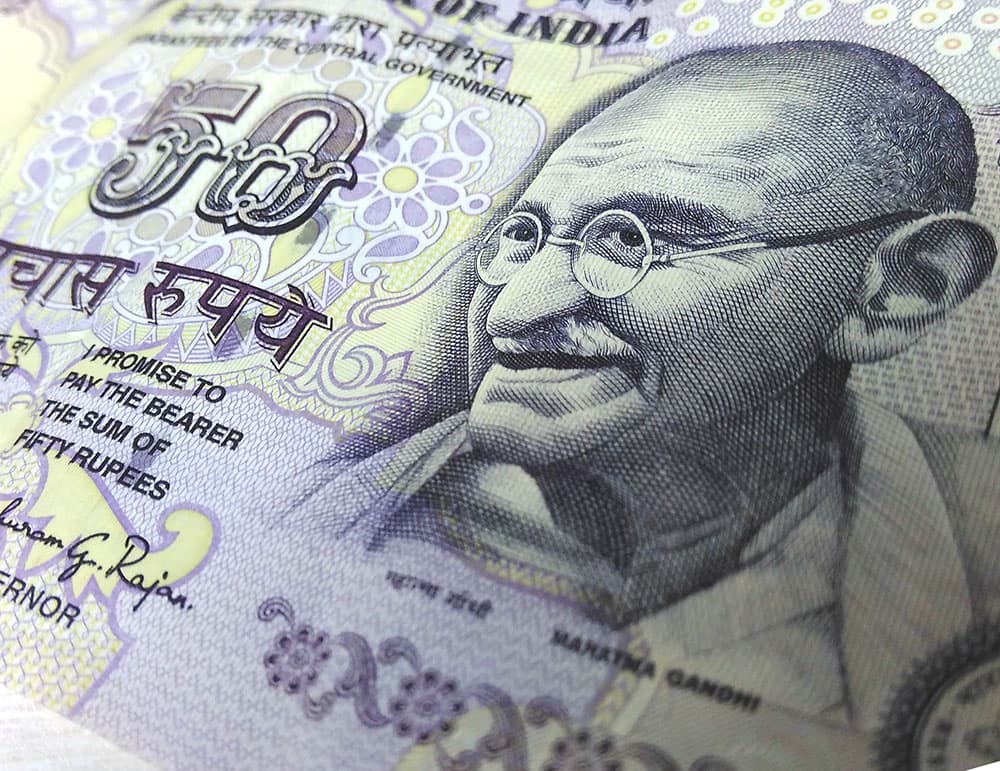
- 50 ₹
- 100 ₹
- 200 ₹
- 500 ₹
- 2000 ₹
Each note features a colorful design, often adorned with Mahatma Gandhi as the main portrait. The reverse displays famous monuments (e.g., Goa Fort, Sanchi Stupa, Mangalyaan…).
Note: 2,000 ₹ notes have been gradually withdrawn from circulation since 2023. They are becoming rare and are sometimes refused in shops. It is therefore preferable to request smaller denominations (₹100, ₹200, or ₹500) when withdrawing or exchanging money, to facilitate your daily payments.
Coins
Coins in circulation are:
- 1 ₹
- 2 ₹
- 5 ₹
- 20 ₹
- 10 ₹
They are widely used for small purchases (buses, snacks, tips). It's worth noting that some older coins are sometimes refused in small shops, particularly in rural areas. Favor recent coins, which are lighter and more modern.
Converting euros to Indian rupees
The value of the rupee against the euro fluctuates regularly. On average, 1 € is equivalent to approximately 88 to 101 ₹ (depending on the period).
Thus:
- 10 € ≈ 1,000 to 1,010 ₹
- 50 € ≈ 5,000 to 5,050 ₹
- 100 € ≈ 10,000 to 10,100 ₹
How to calculate quickly?
For a quick estimate of your euros in rupees, mentally multiply them by 100.
1 euro ≈ 100 rupees, so 10 euros ≈ 1,000 rupees.
Traveler's tip: to simplify your conversions even further in real-world situations, simply remember that 100 ₹ is worth approximately 1 €. This allows you to have a rough idea of the cost of goods and services displayed in the street, restaurants, or transport.
How to convert effectively?
The rupee is a relatively stable currency, but it can lose value during periods of inflation or economic tension. Using a converter is therefore essential to get an accurate value.
To convert your euros to rupees with precision:
- Check real-time rates on sites like XE.com or Wise.com.
- Use mobile applications such as Currency Converter Plus, Google Finance or similar.
Where to exchange euros for INR?
In your home country (before departure)
You can exchange your euros for rupees before leaving. Some major banks or exchange services (Travelex, Yes Change, CEN Change) offer this service.
By exchanging your euros for rupees before departure, you have the advantage of arriving in Inde with local currency in hand, which can be convenient right after landing.
However, exchange rates are generally less favorable than in Inde, and the availability of rupees is sometimes limited in local exchange agencies.
On-site
Once there, several options are available to convert your euros to rupees.
At the airport
- Advantage: accessible upon arrival
- Disadvantage: generally less favorable exchange rates, sometimes high fees
In banks
- Some Indese banks offer a reasonable rate, but the process can be lengthy (forms, passport copy, etc.)
In licensed exchange offices (Forex)
- Widespread in major cities and tourist areas
- Rates often more favorable than at the airport
- Ensure they are authorized by the Reserve Bank of Inde (RBI).
Through hotels
- Some upscale hotels offer exchange services.
- Convenient but often less competitive.
Through ATMs
ATMs allow you to withdraw rupees directly with your card. They are very numerous in Inde, including in secondary cities. Prefer ATMs from official banks (SBI, ICICI, HDFC) to avoid high fees or fraud.
- Limit per withdrawal: often 10,000 ₹
- Bank fees: approximately 200 ₹ per withdrawal + your French bank's commission
- Attention: some ATMs only accept chip cards or withdrawals under 5,000 ₹.
How to avoid fraud?
As in any tourist destination, there are some risks related to exchange and the use of cash in Inde. Here are some precautions to take:
Check the notes you receive
- Refuse torn or heavily worn notes.
- Learn to spot security features (watermarks, embossed printing, color-shifting).
Be wary of street exchange
- Some individuals will offer to change your euros "at the best rate".
- This type of black market exchange is illegal, risky, and often a source of fraud.
Count your money in front of the exchange agent
- Only put your notes away once you've finished counting.
- Refuse any pressure or interruption during the transaction.
Keep receipts
- In case you need to reconvert unused rupees to euros, exchange receipts are essential.
What is the cost of living in Inde?
Inde is a country where the cost of living is significantly lower than in your home country, making it a particularly economical destination for European travelers. Prices vary depending on cities and the level of comfort sought, but in general, the value for money is excellent.
Food
- Simple meal in a local restaurant: approximately 120 to 250 ₹, or about 1.20 to 2.50 €
- Tourist or air-conditioned restaurant: approximately 450 to 900 ₹, or about 4.50 to 9.00 €
- Bottle of water (1 liter): 20 to 30 ₹, or 0.20 to 0.30 €
Accommodation
- Budget hotel (guesthouse, hostel): 700 to 1,500 ₹, or 7 to 15 €
- Mid-range hotel: 2,500 to 5,000 ₹, or 25 to 50 €
- 3-4 star hotel: 7,500 to 12,000 ₹, or 75 to 120 €
Transportation
- Tuk-tuk ride in the city: 40 to 180 ₹, or 0.40 to 1.80 €
- Metro ticket (Delhi, Mumbai, etc.): 15 to 65 ₹, or 0.15 to 0.65 €
- Long-distance train (example Delhi – Agra):
- Standard class: 120 to 480 ₹, or 1.20 to 4.80 €
- Sleeper/AC class: 650 to 1,800 ₹, or 6.50 to 18 €
Generally speaking, a budget of 25 to 45 € per day is sufficient to travel comfortably in Inde.
How to pay in Inde?
In cash
The most common method of payment remains cash payment, especially for small transactions.
By card
- Visa and Mastercard are accepted in most hotels, shopping centers, tourist restaurants, and airports.
- American Express or Maestro cards are less widely accepted.
- Verify that your card is international (activated for use abroad) and free of withdrawal/payment fees outside the euro zone.
Contactless and mobile payment
Mobile payment (Paytm, Google Pay, PhonePe…) is common, but primarily used by locals via Indese bank accounts. It is rarely accessible to foreign travelers without a local bank account.
What to do with your remaining money?
Once your trip is over, you may have a few notes left in your pocket. Rather than leaving them to gather dust in a drawer, here are several useful or charitable options to consider before leaving Inde:
- Reconvert your rupees to euros, ideally at an authorized exchange office. Remember to keep your exchange receipts, they will be essential.
- Keep a small amount on hand if you plan to return to the country. It's always practical for your first expenses upon arrival.
- Make a charitable gesture: you can donate your remaining rupees to local NGOs, temples, or even newly arrived travelers.
Note: it is forbidden to leave Indese territory with more than 10,000 ₹ in cash for foreigners (and 25,000 ₹ for residents).
Frequently asked questions
What is the price of a meal in Inde?
As mentioned above, you can eat a local dish for as little as 120 ₹, and a tourist meal around 400 ₹. Street food is even more economical. However, ensure that what you eat is safe.
What is the symbol of the Indian rupee?
The symbol of the Indian rupee is ₹. It is a stylized fusion of the Latin letter "R" and the Devanagari character र. It was officially adopted in 2010.
In which country is the currency RS used?
The abbreviation "Rs" does not refer exclusively to the Indian rupee. It is also used in other countries whose currency is called rupee, such as:
- Pakistan (PKR – Pakistani rupee)
- Sri Lanka (LKR – Sri Lankan rupee)
- Mauritius (MUR – Mauritian rupee)
- Seychelles (SCR – Seychellois rupee)
However, only the Indian rupee (INR) is recognized and used as legal tender in Inde. No other foreign rupee is accepted for payments there.
Do you always need to carry cash?
Yes. Outside major cities and hotels, cash payment remains the norm, particularly in markets, temples, and local transport.
Is the credit card accepted everywhere?
No. It is mainly accepted in tourist destinations, hotels, and shopping centers. It is preferable to always have cash with you.
Final word
Indese currency, with its rupee system and cash culture, may seem confusing at first. But once the basics are understood, it becomes simple to manage. By following the advice in this guide, you'll know how to exchange your euros at the right rate, avoid fraud, pay with confidence, and manage your budget throughout your entire trip.