Sundarbans National Park
Sundarbans National Park
The world's largest mangrove delta, sanctuary of the Bengal tiger and UNESCO World Heritage site: the Sundarbans are best explored by boat from Kolkata, through silent waterways and dense forest.
Sundarbans National Park stretches across the world's largest mangrove delta, straddling India and Bangladesh. On the Indian side, it covers approximately 1,330 km² in West Bengal. This labyrinth of waterways, islands and dense forest is home to the Bengal tiger in one of its last truly wild sanctuaries. Listed as a UNESCO World Heritage site, the park is also a fragile ecosystem facing the mounting threat of rising waters.
Essential Information at a Glance
- Admission: paid entry — a permit is required, issued by the Forest Department (rates vary for Indian residents and foreign visitors).
- Access: from Kolkata, by bus or car to Godkhali or Canning, then by boat to the islands (Gosaba, Sajnekhali).
- Best season: November to February — moderate temperatures, lower vegetation density, optimal wildlife viewing conditions.
- Recommended duration: minimum 2 to 3 days to explore multiple waterways.
- Regulations: disembarking prohibited in core zones; visits only by licensed boat with a forest guide.
- Accessibility: severely limited — aquatic terrain and boats are not equipped for mobility needs.
What You'll See
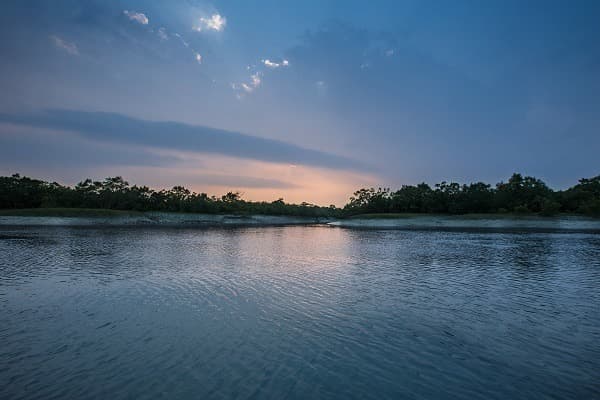
Mangrove dominates the landscape: mangrove trees with their signature tangled aerial roots, sundari (Heritiera fomes) trees that lend the forest its name. The waterways harbour Ganges dolphins, marsh crocodiles, monitor lizards and abundant birdlife — fish eagles, kingfishers, grey herons. The Bengal tiger, present but elusive, is often spotted only through paw prints left in the mud banks.
History and Context
The name "Sundarbans" likely derives from the sundari tree. The area has been inhabited for centuries by fishermen and honey collectors — the mawali — who brave both tiger encounters and cyclones. The national park was established in 1984; UNESCO inscribed it as a World Heritage site in 1987. The delta is formed by the Ganges, Brahmaputra and Meghna rivers, constantly reshaped by tides and cyclones.
Highlights of Your Visit
Boat safaris through the waterways
Slow navigation through narrow channels forms the heart of the Sundarbans experience. At dawn, mist hovering over the water and the profound silence offer a stark contrast to the outside world. Forest guides scan the mud banks at low tide for tiger tracks and signs of passage.
Sajnekhali Interpretation Centre
This forest station houses a small museum on local wildlife and an observation platform overlooking an inland water body. Crocodiles and monitor lizards are regularly spotted here. It also serves as the administrative gateway for core-zone permits.
Sudhanyakhali Island
An observation tower overlooks a watering hole frequented by axis deer and, more rarely, tigers. Late afternoon patience often yields rewarding sightings.
Fishing villages
Peripheral islands such as Gosaba offer glimpses into daily life among communities living alongside the forest — fishing nets, wooden boats, local temples.
Photography Tips
Golden light in the early hours illuminates the waterways beautifully. A telephoto lens (minimum 300 mm) is essential for wildlife. Mangrove reflections in still water work well toward evening. Tiger photography remains unpredictable and cannot be planned — keep your camera ready at all times.
Location and Access
The park lies approximately 100 km south of Kolkata. The typical route goes through Canning (accessible by train from Kolkata) or by road to Godkhali, then by boat. Local agencies organise multi-day boat-hotel stays (launch) that allow you to sleep on the water and maximise time exploring the waterways. There is no direct road access to the forest zones.
Nearby Attractions
- Kolkata — Bengal's sprawling metropolis, the main hub for logistical arrangements, approximately 2–3 hours away by road and boat.
- Dakshineswar Temple — iconic Hindu temple on the banks of the Hooghly river, in Kolkata.
Frequently asked questions
November to February: moderate temperatures, minimal cyclone risk, less dense vegetation and optimal conditions for wildlife observation.
The tiger population is present, but direct sightings remain rare. Paw prints in the mud banks and other signs of passage are more commonly encountered than actual tiger appearances. Patience and discretion improve your chances.
Yes. A permit issued by the West Bengal Forest Department is mandatory. Local agencies and licensed boat operators typically handle permit procurement for their clients.
Not in core zones — disembarking is strictly prohibited for safety reasons (tiger presence) and ecosystem protection. Some buffer zones permit guided stops under the forest guide's supervision.
The most practical option is to book through a local agency that provides transport, a licensed boat, a forest guide and handles permits. Multi-night stays aboard a boat-hotel allow you to explore multiple zones without logistical constraints.
Access is extremely challenging: boarding wooden boats, unstable banks and no adapted facilities. The park is not designed with accessibility in mind.
Photos
Want to discover this destination?
Our local advisors design your tailor-made trip.