Lalitgiri
Lalitgiri
Lalitgiri, nestled in Odisha's hills, is home to one of India's oldest Buddhist complexes: stupas, medieval monasteries, and golden relics, best combined with Ratnagiri and Udayagiri.
Lalitgiri is one of India's oldest Buddhist sites, nestled in the hills of Odisha, roughly 90 km north of Bhubaneswar. This monastic complex reveals stupas, sculptures, and relics spanning from the 2nd century BCE to the medieval period. Less frequented than major tourist circuits, it offers a serene immersion into Odisha's tantric Buddhism.
Practical Information at a Glance
- Entry: paid admission (archaeological site protected by the ASI — Archaeological Survey of India)
- Recommended duration: 2 to 3 hours to explore the entire site
- Dress code: modest attire recommended; easy-to-remove shoes for certain areas
- Access: by car or bus from Cuttack or Bhubaneswar; roads are passable but winding in the final stretch
What You'll See
The site spans several developed hills: Lalitgiri, Ratnagiri, and Udayagiri together form Odisha's "Buddhist triangle." At Lalitgiri itself, you'll discover a large partially restored central stupa, brick monasteries, meditation halls, and a site museum housing remarkable Buddhist sculptures, including representations of the Buddha in slate and sandstone.
History and Context
Excavations conducted by the ASI unearthed Buddhist relics within caskets of gold, silver, and crystal, confirming the site's religious significance. Lalitgiri is regarded as one of the region's earliest centers of Buddhist worship, active long before Nalanda's rise. Vajrayana Buddhism left a strong imprint here, visible in the tantric iconography of the sculptures.
Highlights of Your Visit
The Great Stupa
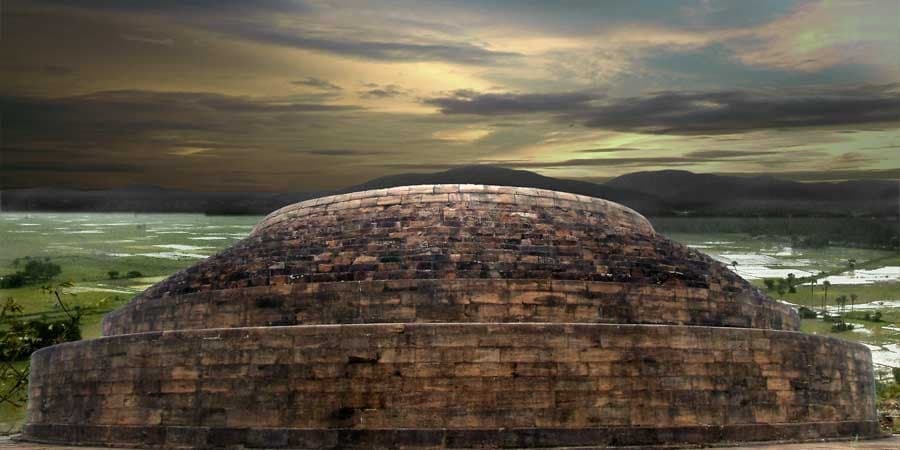
The main stupa, partially restored, dominates the hilltop. Its circular brick base and imposing proportions attest to ancient architectural mastery. The view of surrounding hills from this vantage point is expansive and serene.
The Site Museum
The museum houses pieces unearthed during excavations: Buddha sculptures, bodhisattvas, decorative panels, and the celebrated reliquary caskets. It's an essential stop for understanding the site's chronology.
The Brick Monasteries
Remains of the viharas (monasteries) reveal a quadrilateral layout typical of medieval Buddhist architecture. Several monks' cells remain discernible in the landscape.
Etiquette and Visitor Rules
- Respect silence in areas near stupas and worship halls.
- Do not touch sculptures exposed in the open air.
- Photography is generally permitted on the outdoor site; check restrictions at the museum entrance.
Photography Tips
Morning light is ideal for photographing the main stupa, which faces east. Museum sculptures benefit from artificial lighting; a tripod may be useful if permitted. Surrounding hills offer natural backdrops in late afternoon.
Location and Access
Lalitgiri is located in Cuttack district, Odisha. The site is accessible from Bhubaneswar (approximately 90 km) or Cuttack (approximately 65 km) via the national highway, then secondary roads. It's often visited in combination with Ratnagiri and Udayagiri, which form Odisha's Buddhist triangle. No direct public transport reaches the site; a rental car or taxi from Cuttack is recommended.
Nearby Attractions
- Ratnagiri — the best-preserved Buddhist site in the triangle, with monasteries and finely detailed sculptures.
- Udayagiri (Odisha) — the triangle's third summit, less excavated but atmospheric.
- Bhubaneswar — Odisha's capital, rich in medieval Hindu temples, approximately 90 km away.
Frequently asked questions
The dry season, October to March, is most pleasant. Monsoon rains (June-September) make secondary roads difficult to access.
Yes, all three sites can be visited in one long day from Bhubaneswar or Cuttack, provided you start early in the morning and have a private vehicle.
Local guides are sometimes available at the site entrance, but their presence is not guaranteed. It's advisable to contact the ASI or your local agency to arrange a guide in advance.
Rules may vary. Check at the museum entrance on the day of your visit; photography is generally unrestricted on the outdoor site.
The terrain is hilly and unpaved paths make access difficult for people with reduced mobility. The site museum is more accessible than the hills.
Photos
Want to discover this destination?
Our local advisors design your tailor-made trip.