High Camp – Annapurna Base Camp Trek
High Camp – Annapurna Base Camp Trek
At 5,520 meters altitude, High Camp on the Annapurna Base Camp Trek is the highest stop before ABC. Direct views of Annapurna I, starlit nights and sunrise over the Himalayan giants.
At 5,520 meters altitude, High Camp on the Annapurna Base Camp (ABC) trek is one of the most elevated bivouacs accessible on foot in the Himalayas. Perched on the massif's slopes, it offers a direct view of Annapurna I (8,091 m), Machapuchare and Hiunchuli. It is the final stop before base camp, often reached at night to arrive at ABC at sunrise.
Quick practical information
- Altitude: 5,520 m — prior acclimatization is essential.
- Access: on foot only, from Annapurna Base Camp (ABC) or Machhapuchhre Base Camp (MBC).
- Required permits: TIMS Card and Annapurna Conservation Area Permit (ACAP) are mandatory.
- Accommodation: basic tea houses; reservation recommended during peak season.
- Recommended duration: one night's stop as part of the ABC trek (8 to 12 days total).
- Accessibility for people with disabilities: none — demanding alpine terrain.
What you'll see there
The panorama from High Camp is dominated by the giants of the Annapurna Sanctuary: Annapurna I, Machapuchare ("fishtail"), Gangapurna and Hiunchuli form an amphitheater of ice and rock. At this altitude, vegetation disappears; the landscape becomes mineral, swept by the wind. On clear nights, an exceptional starry sky reveals itself, far from any light pollution.
History and context
The Annapurna Sanctuary is a closed glacial cirque, considered sacred by local Gurung communities. Annapurna I was the first 8,000-meter peak climbed by humans, in 1950, by Maurice Herzog's French expedition. The network of tea houses dotting the trek developed from the 1970s onward, transforming this route into one of Nepal's most frequented treks.
Highlights of the visit
Sunrise over Annapurna I
Departing High Camp before dawn allows you to reach ABC as the first pink light strikes Annapurna I's south face. This is the most photographed moment of the trek, and one of the most striking views in the Himalayas.
The glacial amphitheater at night
Spending a night at High Camp allows you to observe Machapuchare under moonlight. The silence, clarity of the air and complete isolation create a rare atmosphere, difficult to find elsewhere on a trek accessible without mountaineering equipment.
The altitude progression
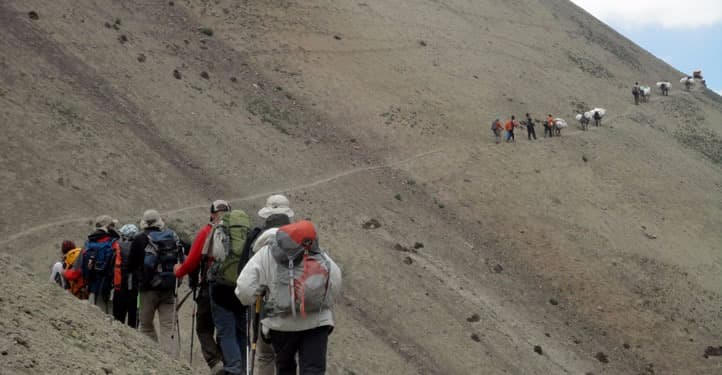
The ascent from MBC (Machhapuchhre Base Camp) to High Camp is short but physically demanding. The lack of oxygen is felt; walking slowly, staying hydrated and watching for signs of altitude sickness is essential.
Photography tips
The golden light of sunrise on Annapurna I is optimal between 6 a.m. and 7 a.m. Protect your camera from nighttime cold (batteries drain quickly below 0°C). A wide-angle lens captures the entire amphitheater; a telephoto lens isolates the seracs and ridges. No known photography restrictions on this site.
Location and access
High Camp is located in the Annapurna Conservation Area, in Nepal, in the Gandaki region. The usual starting point for the trek is Nayapul or Phedi, accessible from Pokhara. Most trekkers pass through Chhomrong, Dovan, Himalaya Hotel and MBC before reaching High Camp. No motorized access exists beyond Jhinu Danda.
Nearby attractions
- Annapurna Base Camp (4,130 m) — the main base camp, an iconic stage of the trek, a few hours' walk below.
- Machhapuchhre Base Camp (3,700 m) — an intermediate stop with direct views of the "Fishtail".
- Chhomrong — lively Gurung village, key supply point on the ABC trek.
- Pokhara — the trek's starting point, on the shores of Phewa Lake, with views of Annapurna on clear days.
Frequently asked questions
The most favorable windows are October–November (clear skies after the monsoon) and March–April (rhododendrons in bloom at lower altitudes). Winter often closes tea houses above MBC due to snow.
The ABC trek does not legally require a guide, but a porter or local guide is strongly recommended above MBC for safety in case of bad weather or altitude sickness.
Two documents are mandatory: the TIMS Card (Trekkers' Information Management System) and the Annapurna Conservation Area Permit (ACAP). They can be obtained in Kathmandu or Pokhara.
Yes. At this altitude, symptoms of acute mountain sickness (headaches, nausea, intense fatigue) are common. Progressive acclimatization over several days is essential. In case of severe symptoms, immediate descent is the only solution.
Nighttime temperatures drop well below freezing, even in season. A sleeping bag rated for −15°C minimum, down jacket, hat, gloves and thermal underwear are essential.
Pokhara is the natural base before and after the trek. Some trekkers continue on to Poon Hill (Ghorepani) for a more complete circuit in the Annapurna region.
Want to discover this destination?
Our local advisors design your tailor-made trip.