Dwarka
Dwarka
Dwarka, at the western tip of Gujarat, is one of the four sacred cities of Hinduism. The Dwarkadhish temple, ritual ghats and Bet Dwarka island make up a pilgrimage dense with devotion.
Dwarka occupies the western tip of Gujarat, on the Saurashtra peninsula, on the edge of the Arabian Sea. A sacred city among the four dhams of Hinduism, it is associated with Krishna, who is said to have made it his legendary capital. Pilgrims and travellers cross paths here year-round around the Dwarkadhish temple, the ghats and a wind-beaten coast. The city remains modest in size, but dense in devotion.
Practical information at a glance
- Access: Dwarka railway station, connected to Ahmedabad and Jamnagar; buses from Jamnagar and Porbandar.
- Dress code: clothing covering shoulders and knees required to enter temples.
- Shoes: must be removed before entering sacred enclosures.
- Recommended duration: one full day for the main temple, the ghats and Bet Dwarka.
- Cameras: prohibited inside the Dwarkadhish temple.
What to see
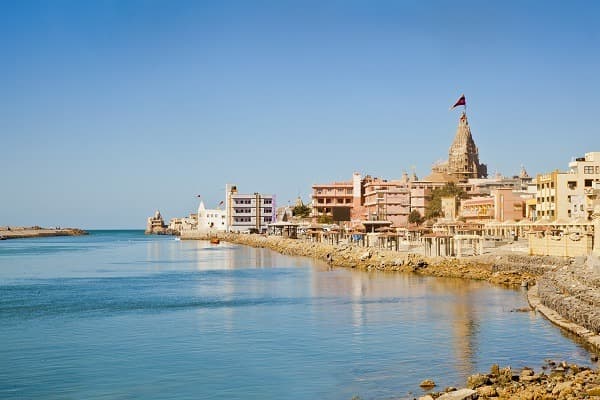
The Dwarkadhish temple dominates the city with its 51-metre spire, topped with a flag changed five times daily. The ghats descend towards the Gomti river before it meets the sea. A few kilometres offshore, Bet Dwarka island houses another Krishnaite sanctuary accessible by boat. Dwarka lighthouse offers a clear view of the coast and turquoise waters of the Gulf of Kutch.
History and context
Vedic texts and the Mahabharata describe Dwarka as Krishna's sunken city, founded after his departure from Mathura. Underwater excavations conducted since the 1980s by the Archaeological Survey of India have uncovered submerged structures dating back thousands of years, fuelling debate about the site's antiquity. The current Dwarkadhish temple dates back to the 16th century, built on far older foundations.
Highlights of the visit
Dwarkadhish Temple
Dedicated to Krishna under the name "Lord of Dwarka," this five-storey limestone temple is the spiritual heart of the city. Crowds are dense during aarti hours (ritual prayer with lamps), especially at dawn and sunset. Access to the inner sanctuaries is reserved for Hindus.
Gomti Ghats
The ghats allow ritual bathing in the Gomti river before visiting the temple. The atmosphere is particularly intense at dawn, when pilgrims arrive in large numbers. The Gomti Ghat is also the departure point for Bet Dwarka.
Bet Dwarka
This island, about twenty minutes by boat, is reputed to be Krishna's residence. Its main temple is more intimate than the one in the city. The crossing offers views of the coast and local fishing boats.
Rukmini Devi Temple
Located about two kilometres from the centre, this temple dedicated to Krishna's consort features finely carved medieval architecture, less crowded and quieter than Dwarkadhish.
Etiquette and visiting rules
- Covering clothing mandatory (shoulders and knees) for all temples.
- Shoes to be left at the entrance of sacred enclosures.
- The interior of Dwarkadhish's main sanctuary is reserved for Hindus; non-Hindus may access the outer courtyards.
- Photography prohibited inside the Dwarkadhish temple.
- Silent and respectful behaviour during aartis.
Photography tips
The golden light of dawn illuminates the temple spire from the ghats — this is the best time to photograph the exterior. Colourful fishing boats near Gomti Ghat make good subjects in late afternoon. On Bet Dwarka island, the alleyways around the temple are photogenic without particular restrictions.
Location and access
Dwarka is located at the western extremity of Gujarat, about 130 km from Jamnagar. The railway station is well connected to the Indian network. By car or bus, the road sometimes runs along the coast. The nearest airport is Jamnagar. The city centre is compact and can be explored on foot. Disabled access remains limited in ancient temples with numerous stairs.
Around the area
- Somnath — another major Shiva temple in Gujarat, about 230 km to the south-east, one of the twelve jyotirlingas of India.
- Porbandar — birthplace of Mahatma Gandhi, about 100 km to the south, with the Kirti Mandir museum house.
- Jamnagar — coastal city known for its Jain temples, its bazaar and Narara marine park, about 130 km to the east.
- Gir National Park — last refuge of the Asian lion, about 160 km to the south-east.
Frequently asked questions
From October to March, the climate is pleasant with moderate temperatures. Summer (April-June) is very hot. The monsoon (July-September) can make some access difficult, particularly the crossing to Bet Dwarka.
Non-Hindus can access the outer courtyards and observe the architecture. Access to the inner sanctuary is reserved for Hindus.
Boats leave regularly from Gomti Ghat. The crossing takes about twenty minutes. Frequency may vary depending on weather and season.
Cameras and phones are prohibited inside the Dwarkadhish temple. Outside and on the ghats, photography is free.
One full day is enough for the main temple, the ghats and the Bet Dwarka excursion. Two days allow you to include the Rukmini Devi temple and a more leisurely exploration of the city.
Yes. A classic itinerary connects Dwarka to Somnath, Porbandar and Gir National Park in three to five days, by rental car or bus.
Photos
Want to discover this destination?
Our local advisors design your tailor-made trip.