Diskit
Diskit
Diskit is the heart of Nubra Valley in Ladakh: a Buddhist monastery perched on a rocky outcrop, a 32-meter Maitreya statue, and just kilometers away, the sand dunes of Hunder with their Bactrian camels.
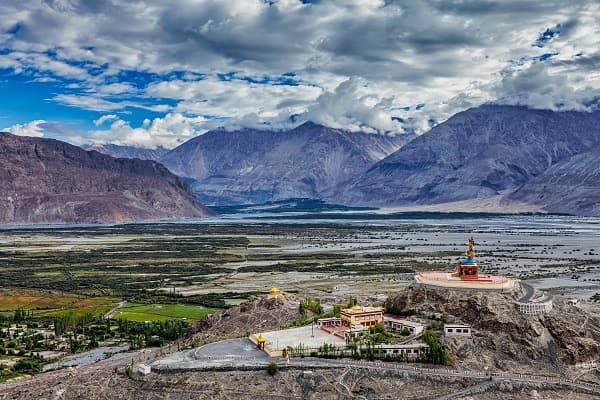
Diskit is the main town of Nubra Valley, north of Ladakh, approximately 120 km from Leh via the Khardung La pass. Perched on a rocky spur overlooking the confluence of the Shyok and Nubra rivers, the village is home to the oldest Buddhist monastery in the valley and a giant Maitreya statue visible from kilometers away. It's the natural entry point for exploring the sand dunes, remote villages, and high-altitude desert landscapes of Nubra.
Practical information at a glance
- Access: Road from Leh via Khardung La pass (approximately 3–4 hours depending on conditions); jeep or shared bus available.
- Permit: Inner Line Permit (ILP) required for Indian nationals; special permit needed for foreign visitors — obtain in Leh before departure.
- Altitude: Approximately 3,100 m — allow for acclimatization in Leh first.
- Monastery dress code: Shoulders and knees covered; remove shoes when entering prayer halls.
- Recommended duration: 1 to 2 nights to combine monastery, Hunder dunes, and neighboring villages.
- Season: May to September (road closed in winter).
What to see
Diskit Monastery (Diskit Gompa) dominates the village from a rocky promontory. Founded in the 14th century, it belongs to the Gelugpa order. Its halls contain thangkas, statues, and a mummified demon's head linked to a local legend. Just below, the 32-meter Maitreya statue, inaugurated in 2010 in the presence of the Dalai Lama, faces the valley and Pakistan.
History and context
Diskit has been mentioned as an administrative and religious center of Nubra for centuries. The valley was long a waypoint on the trade route connecting Ladakh to Turkestan via the Saser La pass. The monastery, one of the oldest in the region, underwent successive destruction and reconstruction. Nubra Valley remained a sensitive military zone until partial opening to tourism in the 1990s.
Highlights of a visit
Diskit Gompa
The monastery is reached on foot from the village via a winding path. The lower prayer halls preserve ancient frescoes and statues. The upper terrace offers a clear view of Nubra Valley and the snow-capped peaks of the Karakoram.
Maitreya statue
The statue of the Buddha of the future, oriented toward the Pakistani border, is visible from the main road. It is an active pilgrimage site: prayer flags permanently surround it and monks conduct ceremonies regularly.
Hunder dunes
A few kilometers north of Diskit, the sand dunes of Hunder create a striking contrast with snow-capped mountains. Two-humped Bactrian camels, a legacy of Central Asian caravans, are available for rides.
Etiquette and visiting rules
- Remove your shoes before entering prayer halls.
- Walk clockwise around stupas and prayer wheels.
- Ask permission before photographing monks or ceremonies.
- Speak softly inside the monastery.
Photography tips
Early morning light is ideal for photographing the monastery: the ochre facade is evenly lit and shadows remain soft. For the Maitreya statue, late afternoon backlighting creates a dramatic effect with the mountains in the background. The Hunder dunes photograph best in early morning or late afternoon, when sand textures are most defined.
Location and access
Diskit lies in Nubra Valley, north of Ladakh. The main road from Leh passes through Khardung La pass, one of the world's highest motorable passes. Shared jeeps and private taxis connect the town to Leh. The town has a few guesthouses and simple hotels. Public transport exists but remains irregular outside peak season.
Nearby
- Hunder — neighboring village with famous sand dunes and Bactrian camels.
- Panamik — village in the north of the valley, known for hot springs.
- Leh — Ladakh's capital, the essential starting point for any stay in the region.
- Khardung La Pass — high altitude pass on the Leh–Nubra route, with panoramic views of the Karakoram and Ladakh ranges.
Frequently asked questions
Yes. Nubra Valley is a protected zone. Indian nationals must obtain an Inner Line Permit; foreign visitors need a specific permit. Both can be obtained in Leh from the competent authorities or through a local agency.
May to September, when Khardung La pass is open. July–August is peak tourist season. June and September offer fewer crowds and generally stable weather.
Allow one to two hours for the monastery and Maitreya statue. Combined with Hunder dunes, plan for a full half-day.
It's possible but tiring: the round-trip drive takes about 6 to 8 hours. An overnight stay allows for a more relaxed visit and better light for the dunes.
Diskit sits at approximately 3,100 m. Khardung La pass on the access route exceeds 5,000 m. At least two days of acclimatization in Leh before heading to Nubra is strongly recommended.
Photography is generally allowed in courtyards and outside areas. Inside prayer halls, restrictions may apply depending on the space — check with monks on site.
Photos
Want to discover this destination?
Our local advisors design your tailor-made trip.