Alsisar
Alsisar
At the gates of the Thar Desert, Alsisar unveils its painted havelis and restored royal fort—a rare stop on a Shekhawati circuit through Rajasthan.
Once home to wealthy merchants, the small village of Alsisar harbours splendid residences known as "havelis." While traders gradually relocated to Delhi or Mumbai over the decades, these palatial mansions remain standing along picturesque alleyways, welcoming travellers into a timeless setting where you can truly disconnect. Should your journey through India take you to Alsisar, you'll discover an enchanting town brimming with character and hidden treasures.
The History of Alsisar
Former stopover on the Silk Road, Alsisar was founded in the 18th century. The town is part of the legacy of Pahad Singh, left by his father Samrath Singh upon his death. In 1783, Alsisar rose to prominence when it became the capital of Pahad Singh's kingdom, who built a fort there. Two centuries later, governance of the city passed to Thakur Gaj Singh of the Rajput Kachawa lineage. He set about transforming Alsisar's historical monuments into prestigious hotels.
Born in 1958, Thakur Gaj Singh served in the Indian Army. Upon returning to the Jaipur and Shekhawati region, he resolved to restore Alsisar to its former glory by rehabilitating the town's buildings. The work was undertaken with meticulous attention to detail and respect for the spirit of the sites and their original architecture. The project included the development of green spaces around a marble fountain that radiates a captivating atmosphere.
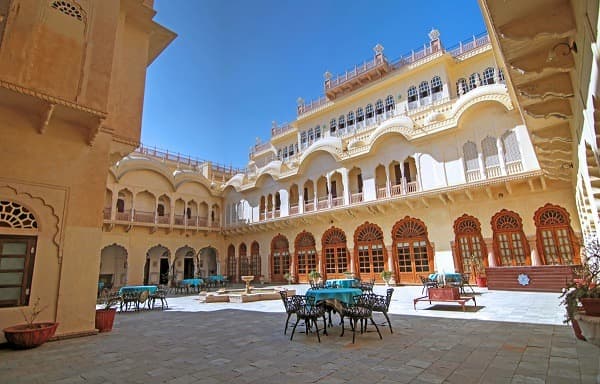
The restoration of the fort into a luxury hotel ranks among Thakur Gaj Singh's most significant undertakings in Alsisar. From its regal architectural style to its magnificently decorated interiors, this imposing structure has been beautifully rehabilitated while retaining its timeless charm. Adorning the hotel's walls, vibrant frescoes with lively motifs bear witness to the residence's glorious past. The establishment opens onto verdant spaces dominated by centuries-old trees, lending a touch of romance to the picturesque setting.
Since their restoration, Alsisar's buildings have become premier tourist attractions drawing increasing numbers of visitors from around the world. In response to growing visitor numbers, Thakur Gaj Singh has undertaken further renovation projects, including notably the rehabilitation of Lakshmi Niwas Palace in Bikaner.
What to Do in Alsisar?
1. Admire the Havelis
The havelis of Alsisar are true architectural jewels. Dating from the late 18th century, most are vast quadrangular residences. These dwellings stand out for their wall paintings, adorning both exterior and interior facades, from floor to ceiling. The frescoes depict mythological, historical, and everyday scenes.
While some havelis remain completely uninhabited, with owners visiting only a few days a year, others have been subdivided among resident families. Nevertheless, wealthy Indians are increasingly turning their attention to these time-worn palaces, with the aim of converting them into prestigious hotels.
Passing through the havelis' entrance, you'll find yourself in a vast interior courtyard surrounded by porticos, sometimes connected by corridors. The series of arcades featuring polylobed architecture and magnificent decoration will remind you that these patios are quintessentially Indian creations, though the style bears some resemblance to 15th-century Florentine residences.
Access to upper floors is via narrow staircases with steep steps. As you continue climbing, you'll reach the roof-terraces, from which the panorama over the village's rooftops is simply breathtaking. In the distance, the desert landscape reinforces the sense of otherworldly escape and complete disconnection.
2. Explore Alsisar Mahal Hotel (The Fort)
Dominating the village landscape, Fort Alsisar Mahal is far more than a royal relic; it embodies the region's heritage renaissance. Even if you don't stay here, a visit to this magnificently restored fort is essential. It offers a fascinating blend of past grandeur and contemporary comfort. Wandering through its colourful fresco-lined corridors and shaded gardens, you'll immerse yourself in the refined atmosphere of Rajput aristocracy. Visitors can also admire its characteristic architectural elements: carved balconies, airy courtyards, and marble fountains.
3. Stroll Through the Village
Wandering through Alsisar's alleyways is like stepping into a landscape frozen in time. Colourful houses, artisanal shops, and children playing in the streets compose an authentic scene. The inhabitants, often warm and curious, will welcome you with genuine smiles. Strike up a conversation, watch weaving in progress, or share a cup of masala tea: these simple moments are often the most memorable of a journey through rural Rajasthan.
4. Attend a Festival
Alsisar comes especially alive during seasonal festivals. The most emblematic is undoubtedly the Magnetic Fields Festival, a contemporary music event held at Fort Alsisar Mahal each December. Beyond this major celebration, other traditional festivities punctuate local life: Holi, Diwali, and religious processions. Participating in one of these events allows you to fully immerse yourself in the region's vibrant and colourful festival culture.
5. Savour Local Rajasthani Cuisine
Rajasthani gastronomy is an adventure in itself. In Alsisar, you can taste typical dishes such as dal baati churma, ker sangri (desert vegetables), or fragrant curries accompanied by wood-fired breads. Some havelis and guesthouses even offer traditional home-cooked meals. Don't miss the local sweets, such as ghevar or mawa kachori, emblematic treats of Shekhawati.
6. Observe Local Wildlife and Flora
At the edge of the Thar Desert, Alsisar harbours a discrete yet surprising biodiversity. Venturing slightly beyond the village, you may spot gazelles, peacocks, or mongooses, often visible at sunrise or sunset. Botany enthusiasts will appreciate the vegetation typical of semi-arid zones: acacias, desert figs, euphorbias, and other plants adapted to aridity. This sober yet resilient nature harmoniously complements Alsisar's architectural setting.
Practical Information
When to Visit?
Located in the heart of a semi-desert zone, Alsisar can experience extreme temperatures in summer, reaching 48°C, and in winter, dropping to 0°C. Throughout the year, the average temperature is estimated at 25.2°C. Classified as BSh according to Köppen-Geiger, the steppe climate affecting the town is characterised by minimal precipitation averaging 400 mm.
The best time to visit Alsisar extends from October to March, during the winter season, when temperatures are milder and more conducive to tourist activities.
Alsisar is located in the north-west of Jhunjhunu district, approximately 200 km from Jaipur and 270 km from Delhi. It sits on National Highway 41, which connects these two metropolises. The nearest railway station to the town is at Jhunjhunu, while the closest airport services are at Sanganer and New Delhi.
Car rental with a driver is the best way to discover Alsisar and its surroundings.
Accommodation in Alsisar
Want to discover this destination?
Our local advisors design your tailor-made trip.