Hoysaleswara Temple
Hoysaleswara Temple
At Halebidu, Hoysaleswara Temple unfolds sculpted friezes across multiple registers covering the entirety of its walls. A 12th-century Hoysala masterpiece and UNESCO World Heritage site as of 2023, it is ideally visited together with Belur in a single day.
Hoysaleswara Temple stands in Halebidu, the former capital of the Hoysala empire in Karnataka. Dedicated to Shiva, it dates from the 12th century and represents the pinnacle of Hoysala architecture: sculpted friezes cover the entire exterior walls across multiple superimposed registers. Inscribed as a UNESCO World Heritage site in 2023, this site ranks among the densest ensembles of medieval sculpture in South India.
Quick Reference Information
- Admission: Free for Indian nationals; applicable fee for foreign visitors (Archaeological Survey of India)
- Recommended duration: 1.5 to 2 hours to explore both sanctuaries and the adjacent museum
- Dress code: Modest dress recommended; the temple remains in partial active use
- Access: Halebidu lies approximately 30 km from Hassan, connected by road; Hassan is accessible by train from Bengaluru and Mysuru
- Accessibility: Partly paved terrain, though the sanctuaries are accessed via steps
What You'll See
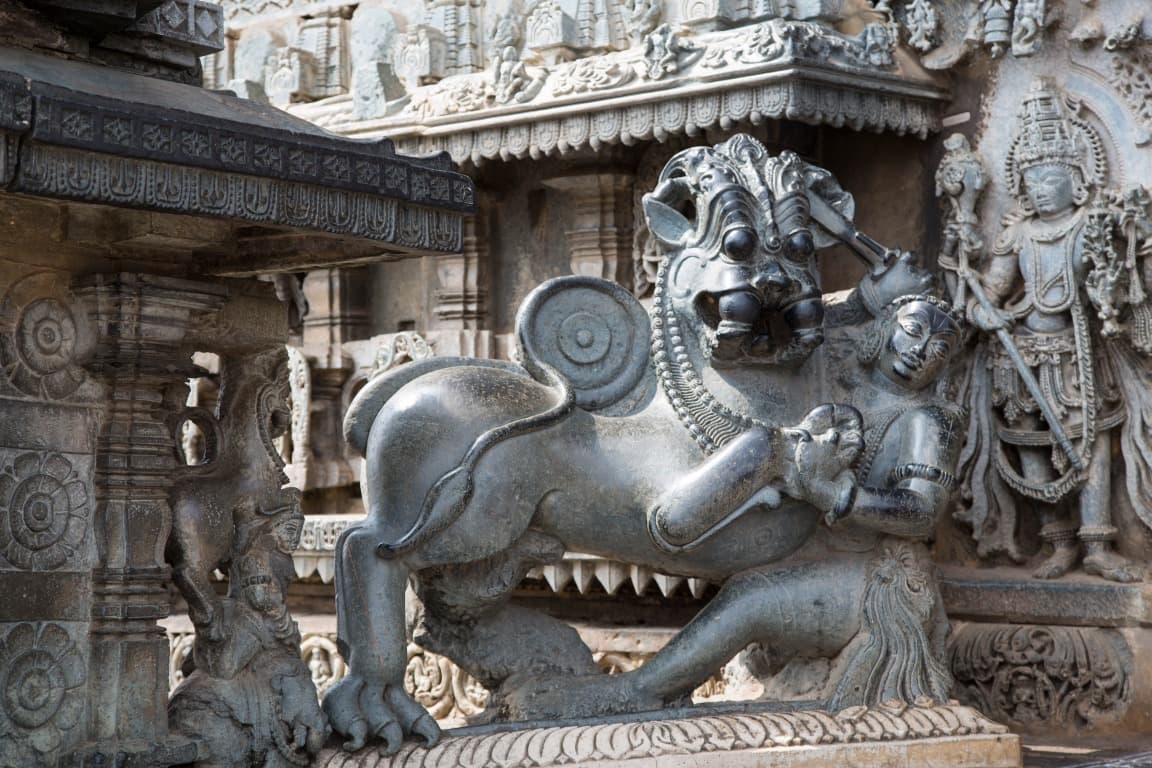
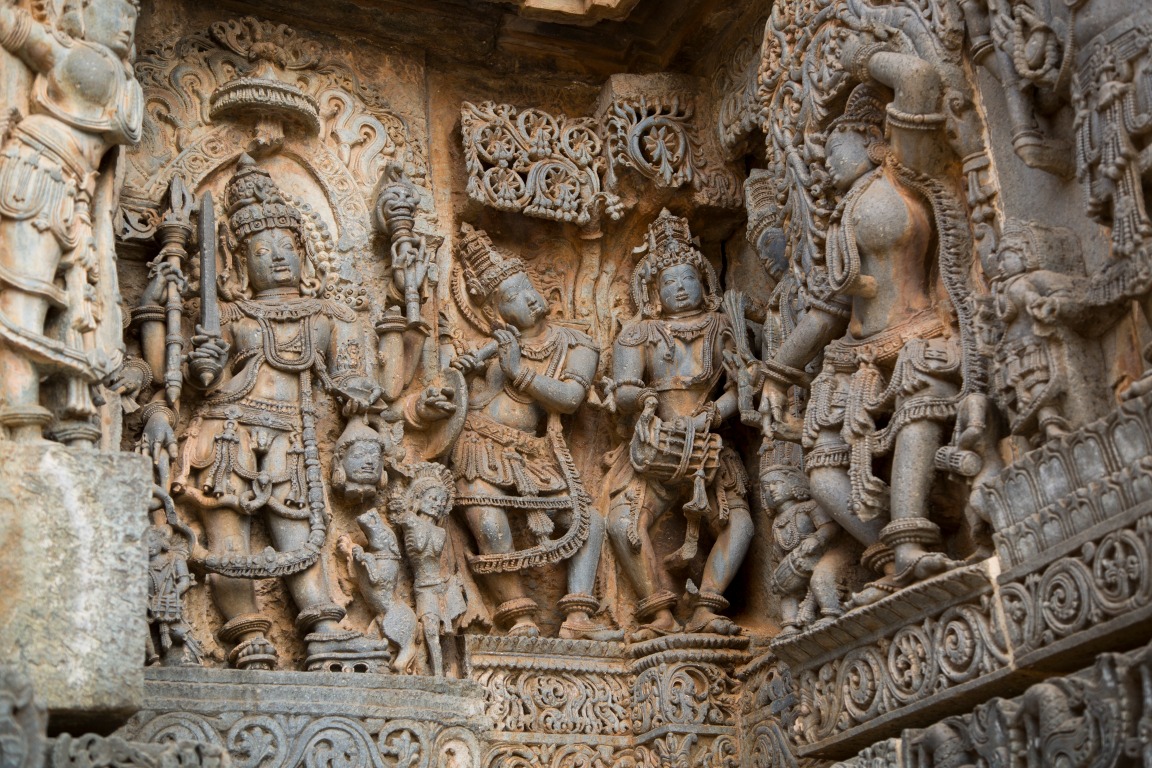
The complex comprises two twin sanctuaries dedicated to Shiva — the Hoysaleswara and Shanthaleswara — flanked by two monumental Nandi (sacred bulls). The exterior walls feature a continuous frieze several meters high: elephants, lions, horses, scenes from the Mahabharata and Ramayana, deities, and floral motifs succeed one another in layered tiers. An archaeological museum on-site preserves sculptures recovered during excavations.
History and Context
Halebidu — meaning "old capital" in Kannada — served as the political and religious heart of the Hoysala dynasty between the 10th and 14th centuries. Hoysaleswara Temple was commissioned by King Vishnuvardhana around 1121 and enlarged by his successors. Invasions by the Delhi Sultanate in the 14th century ended the city's prominence; the site subsequently lay abandoned for centuries until excavated by the ASI. Its UNESCO inscription in 2023, alongside Belur and Somnathpur, elevated the Hoysala ensemble onto the international stage.
Highlights of Your Visit
The Sculpted Friezes
Allow at least an hour to walk along the exterior walls. Each horizontal register tells a different story: the lower frieze depicts elephants symbolizing stability, followed by lions, horses, scrolling vegetation, epic scenes, and finally high-relief deities at the top. The precision of details — jewels, expressions, drapery — is remarkable to the naked eye.
The Monumental Nandi
Two massive Nandi bulls carved from polished black schist stone preside before the sanctuaries. Their smooth surfaces contrast strikingly with the ornamental density of the walls. They rank among the largest Nandi sculptures from the Hoysala period.
The Archaeological Museum
The small ASI-managed museum displays isolated sculptures, inscriptions, and architectural elements. It offers valuable context for understanding the iconography before or after visiting the sanctuaries.
Etiquette and Visit Guidelines
- Remove your shoes before entering the active sanctuaries.
- Dress modestly with shoulders and knees covered.
- Avoid visits during puja ceremonies if you wish to observe the sculptures without interruption.
- Do not touch the sculptures; some have been weakened by centuries of exposure.
Photography Tips
Early morning light (before 9 a.m.) raking across the friezes brings out the relief of the dark schist stone sculptures. Midday direct sunlight flattens the details. A macro lens or short telephoto allows you to frame epic scenes without distortion. Photography is permitted within the grounds; check for any restrictions inside active sanctuaries.
Location and Access
Halebidu is located in Hassan district, Karnataka. The town of Hassan is the most convenient gateway: it has a railway station on the Bengaluru–Mangaluru line. Buses and taxis connect Hassan to Halebidu. The site of Belur, another Hoysala masterpiece, lies about 16 km away; both sites can easily be visited in a single day. The Chennakeshava Temple at Belur is the other cornerstone of any Hoysala circuit.
Nearby Attractions
- Chennakeshava Temple, Belur — 12th-century Hoysala sanctuary approximately 16 km away, renowned for its celestial dancer sculptures (shalabanjikas).
- Keshava Temple, Somnathpur — the third major Hoysala site, approximately 140 km via Mysuru, better preserved in its original star-shaped plan.
- Hassan — convenient waypoint town with accommodations and rail connections to Mysuru and Bengaluru.
Frequently asked questions
The dry season from October to March offers pleasant temperatures and clear skies ideal for photography. Avoid the monsoon (June–September) if you plan to spend time outdoors examining the friezes.
Yes. The two sites are about 16 km apart. Starting early from Hassan, you have sufficient time to dedicate 1.5 to 2 hours to each temple. Local taxis or buses provide connections.
An ASI-accredited guide greatly enhances your experience: Hoysala iconography is complex and epic scenes are difficult to identify without interpretive keys. Guides are available at the site entrance.
Photography is generally allowed in the outer grounds. Inside active sanctuaries, check the notices or ask the guardian before using your camera.
Allow 1.5 to 2 hours to explore both sanctuaries, the Nandi, and the archaeological museum. Architecture and sculpture enthusiasts can easily spend 3 hours here.
Take a train to Hassan (approximately 3 hours from Bengaluru), then a bus or taxi to Halebidu (approximately 30 km). Direct buses from Bengaluru to Hassan are also available.
Photos
Interested in this visit?
We can include it in your personalised itinerary.