Rewalsar
Rewalsar (Tso Pema) is a sacred lake in Himachal Pradesh where Buddhist monasteries, Hindu temples and a Sikh gurdwara coexist. Linked to Padmasambhava, this unique pilgrimage site is visited from Mandi.
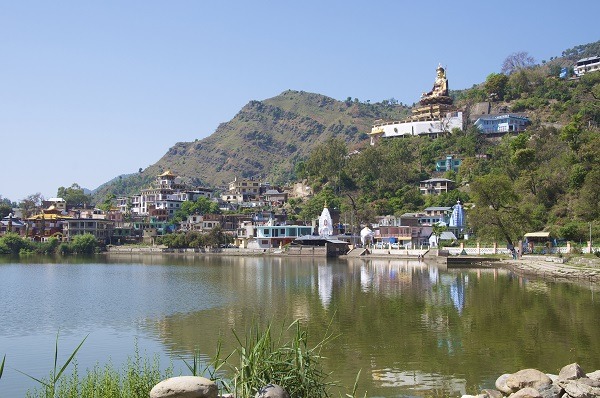
Rewalsar, known in Tibetan as Tso Pema ("Lake of the Lotus"), is a sacred lake nestled in the foothills of the Himalayas, approximately 24 km from Mandi in Himachal Pradesh. A pilgrimage site shared by three traditions—Hindu, Buddhist, and Sikh—it attracts devotees and travelers seeking a rare spiritual destination where temples, monasteries, and a gurdwara coexist along the same body of water.
Practical Information at a Glance
- Access: Regular buses from Mandi (approximately 24 km); road accessible by car or taxi
- Admission: Free access to the lake and perimeter walk; free entry to most places of worship
- Dress Code: Modest attire required in temples, monasteries, and gurdwara; cover shoulders and knees
- Recommended Duration: Half day to full day to walk around the lake and visit the main sanctuaries
- Altitude: Approximately 1,360 m — temperate climate, cool in winter
What to See
The lake itself is the heart of the site: its greenish waters harbor floating islets of reeds, said by local tradition to drift with the currents. All around, a circumambulation path (parikrama) follows the shoreline and connects the various places of worship. Sacred fish, fed by pilgrims, populate the lake in great numbers.
History and Context
Rewalsar is intimately linked to Padmasambhava (Guru Rinpoché), the tantric master who is said to have meditated here in the 8th century before bringing Buddhism to Tibet. Legend recounts that a local king, enraged to see his daughter join the master, attempted to burn him alive: the pyre transformed into a lake, and Padmasambhava appeared unharmed, seated upon a lotus. This founding narrative explains the Tibetan name Tso Pema.
For Hindus, the site is associated with the sage Lomas Rishi. Sikhs venerate the passage of Guru Gobind Singh, who is believed to have stayed here in the 17th century.
Highlights of the Visit
The Lake Walk (Parikrama)
The path circling the lake allows you to pass successively by Tibetan monasteries, the Hindu temple of Lomas Rishi, and the Sikh gurdwara. This walk of approximately 2 km illustrates concretely the coexistence of the three traditions.
The Tibetan Monasteries
Several Buddhist gompas border the lake, including the Nyingmapa Monastery and the Drukpa Kagyu Monastery. Their colorful facades, prayer wheels, and prayer flags offer a distinctly Tibetan atmosphere, rare at this altitude in Himachal Pradesh.
The Padmasambhava Statue
A large statue of Guru Rinpoché overlooks the site from the heights. It is visible from the lake and serves as a striking visual landmark for Buddhist pilgrims.
The Rewalsar Sahib Gurdwara
This Sikh gurdwara, dedicated to the memory of Guru Gobind Singh, welcomes pilgrims year-round. The langar (free communal meal) is served according to Sikh tradition.
Etiquette and Visiting Rules
- Remove your shoes before entering temples, monasteries, and gurdwaras.
- Cover your head at the entrance to the gurdwara (scarves are typically available at the entrance).
- Avoid feeding fish with inappropriate food; respect local practices.
- Buddhist circumambulation is done in a clockwise direction.
- Adopt calm and respectful behavior in all places of worship.
Photography Tips
Morning light is ideal for photographing the lake and reflections of the monasteries on the water. Prayer flags and prayer wheels offer beautiful backlit compositions. Always ask permission before photographing ceremonies or devotees in prayer.
Location and Access
Rewalsar is located in Mandi district, Himachal Pradesh. The town of Mandi is the natural starting point, accessible by bus from Manali, Shimla, or Chandigarh. From Mandi, local buses and taxis serve Rewalsar regularly. The road is winding but passable. Wheelchair access around the entire lake may be difficult on certain sections of the path.
Nearby Attractions
- Mandi — bustling market town with numerous ancient Shaivite temples, approximately 24 km away.
- Prashar Lake — high-altitude lake with a medieval floating temple, accessible from Mandi via a mountain road.
- Manali — mountain resort and departure point for Spiti and Lahaul, a few hours' drive away.
Frequently asked questions
Spring (March-May) and autumn (September-November) offer pleasant weather. Winter is cold but peaceful. Summer (June-August) coincides with the monsoon, bringing rain and slippery roads.
Yes. Covered shoulders and knees are required in all places of worship. At the gurdwara, your head must be covered—scarves are typically available at the entrance.
Yes, this is the most common combination. Explore Mandi's temples in the morning, then visit Rewalsar in the afternoon, or vice versa. Plan a full day for both.
Rules vary by monastery. Outside, photography is generally permitted. Inside prayer halls, always ask permission before taking out your camera.
A few guesthouses and dharamsalas (pilgrim lodgings) exist around the lake. Options remain modest; Mandi offers more hotel choices for those preferring a more comfortable base.
Half a day is enough for the lake walk and a quick visit to the main sanctuaries. Plan a full day if you wish to attend ceremonies or explore the monasteries in detail.
Interested in this visit?
We can include it in your personalised itinerary.