Rewalsar Lake
Rewalsar Lake
Rewalsar Lake is a sacred lake in Himachal Pradesh where Buddhist monasteries, a Sikh gurudwara and Hindu temples coexist. A rare pilgrimage site linked to Padmasambhava and Guru Gobind Singh.
Rewalsar Lake is a small sacred lake nestled in the foothills of the Himalayas, in Mandi district (Himachal Pradesh). A pilgrimage destination shared by three religions—Hinduism, Buddhism and Sikhism—it attracts devotees and travelers seeking a rare spiritual site. According to Buddhist tradition, Padmasambhava (Guru Rinpoche) is said to have ascended to Tibet from here in the 8th century. Three monasteries, one Sikh temple and several Hindu temples coexist on its shores.
Quick facts and essentials
- Access: Rewalsar is located about 24 km from Mandi, accessible by local bus or taxi from Mandi's main bus station.
- Entry: The lake and its shores are free to access; monasteries and temples are generally free to enter.
- Dress code: Covered clothing is recommended for entering places of worship; remove shoes in temples and monasteries.
- Suggested duration: Half a day is enough to walk around the lake and visit the main sanctuaries.
What you'll see
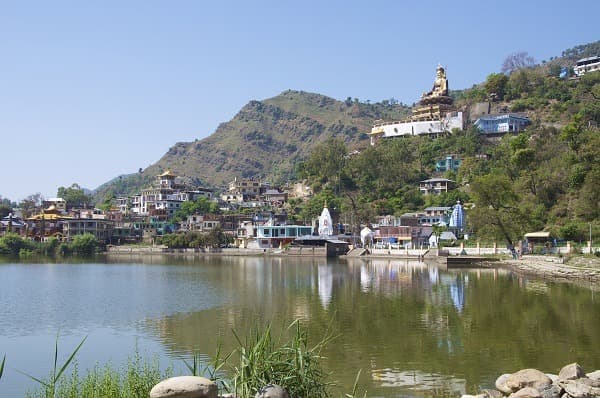
The lake is surrounded by wooded hills and floating reeds—a local particularity: reed islands drift on the surface, considered a sacred sign. On the shores stand three Tibetan monasteries with colorful facades, the Gurudwara Sri Rewalsar Sahib (a Sikh holy site linked to Guru Gobind Singh), and several Hindu temples dedicated to Lomas Rishi and Shiva. A large statue of Padmasambhava dominates the site from a hilltop.
History and context
The site is associated with Padmasambhava, an 8th-century tantric master who is said to have meditated here before bringing Buddhism to Tibet. For Sikhs, Guru Gobind Singh stayed here in the early 18th century and held negotiations with the hill rajas. Hindus revere the sage Lomas Rishi, believed to have lived here. This triple sanctity makes Rewalsar a unique case in the Himalayan region.
Highlights of your visit
The Tibetan monasteries
Three Buddhist gompas face each other on the shore. Their prayer halls house thangkas, Buddha statues and prayer wheels. The atmosphere is calm and conducive to meditation. Monks in maroon robes move freely about.
The Padmasambhava statue
Visible from the lake, this large colorful statue sits on a hilltop accessible by foot trail. It offers a sweeping view of the lake and surrounding hills.
The Sikh Gurudwara
Active and well-visited, this gurudwara offers langar (free communal meals) to visitors of all faiths. A moment of genuine, accessible sharing.
The walk around the lake
A path circles the entire lake in less than an hour. You'll encounter pilgrims, monks, Indian families and sacred fish that devotees feed—killing these fish is strictly forbidden.
Etiquette and visiting rules
- Remove your shoes before entering any temple, monastery or gurudwara.
- Cover shoulders and legs in places of worship.
- In the gurudwara, cover your head (a scarf or handkerchief is acceptable).
- Do not feed the fish with inappropriate food; respect the ban on fishing.
- Speak softly inside monasteries during services.
- Ask permission before photographing monks or devotees in prayer.
Photography tips
Morning light is ideal for photographing the lake with reflections of the wooded hills. The Padmasambhava statue stands out best in late afternoon, facing the setting sun. The colorful monastery facades are well-lit mid-morning. Avoid using flash inside prayer halls.
Location and access
Rewalsar is located in Mandi district, Himachal Pradesh. The town of Mandi is the natural logistical base: it has regular buses to Rewalsar and a wider range of accommodation. Shared and private taxis connect the two towns. The road is paved and passable by standard vehicle. Wheelchair accessibility around the lake is limited due to narrow paths and stairs leading to the monasteries.
Nearby attractions
- Mandi — a bustling market town with many ancient temples, about 24 km away.
- Prashar Lake — a high-altitude lake with a medieval floating temple, accessible from Mandi via a mountain road.
Frequently asked questions
October to June offer the most pleasant conditions. Summer (July-August) corresponds to the monsoon: roads can be slippery and visibility reduced. Winter is cool but passable.
Yes. Wear clothing covering shoulders and knees. In the Sikh gurudwara, cover your head. Bring shoes that are easy to remove for the many places of worship.
Yes. Mandi, about 24 km away, has many ancient temples and makes a good base. Prashar Lake, at higher elevation, can be visited the same day from Mandi with an early start.
Rules vary by monastery. Outside, photography is generally free. Inside prayer halls, always ask permission before bringing out your camera.
Half a day is sufficient to walk around the lake, visit the three monasteries, the gurudwara and the main temples. Allow a full day if you wish to attend services or take time to meditate on site.
A few guesthouses and dharamsalas (pilgrim accommodations) exist in Rewalsar, but options are limited. Mandi offers a wider choice of hotels for all budgets.
Photos
Nearby
Interested in this visit?
We can include it in your personalised itinerary.