Rangeen Mahal
Rangeen Mahal, the 'Palace of Colours', is a jewel of Bahmani architecture nestled within Bidar Fort (Karnataka). Its mother-of-pearl inlaid panels and Persian faience tiles make it one of the most singular medieval interiors in the Deccan.
Rangeen Mahal — literally 'Palace of Colours' — stands within Bidar Fort in northern Karnataka. Built under the Bahmani sultans and later remodelled under the Baridis, this intimate palace distinguishes itself through its inlaid mother-of-pearl décor, Persian faience tiles, and painted plasterwork. It remains one of the few legible medieval civilian interiors in the Deccan region.
Practical Information at a Glance
- Access: inside Bidar Fort; a single ticket grants access to the entire fort.
- Suggested duration: 30 to 45 minutes for the palace alone; 2 to 3 hours for the entire fort.
- Dress code: no religious obligation, though modest dress is recommended as a sign of respect for the site.
What You'll See
The palace centres on a main hall whose walls preserve mother-of-pearl panels (shell) inlaid into black plaster — a rare technique in Deccan architecture. Friezes of blue and turquoise tiles of Persian inspiration run along door and niche frames. The partially restored carved wooden ceiling testifies to the craftsmanship lavished on Bahmani royal residences.
History and Context
Bidar became the capital of the Bahmani Sultanate from 1424, then of the Baridi Sultanate after the empire's fragmentation. Rangeen Mahal likely dates to the 15th or early 16th century. Its décor blends Persian, Turkish, and local influences — reflecting the cosmopolitan courts of the medieval Deccan. The Archaeological Survey of India (ASI) protects the fort and its monuments.
Highlights of Your Visit
The Mother-of-Pearl Inlays
The black plaster wall panels inlaid with mother-of-pearl are the palace's signature. This technique, sometimes called local chini-kari, is virtually unique to the Deccan and deserves close observation.
The Persian Faience Tiles
The door and niche frames originally displayed cobalt blue and turquoise glazed tiles. Some panels remain in place; they illustrate the artistic exchanges between Safavid Iran and the courts of the Deccan.
Views of the Fort
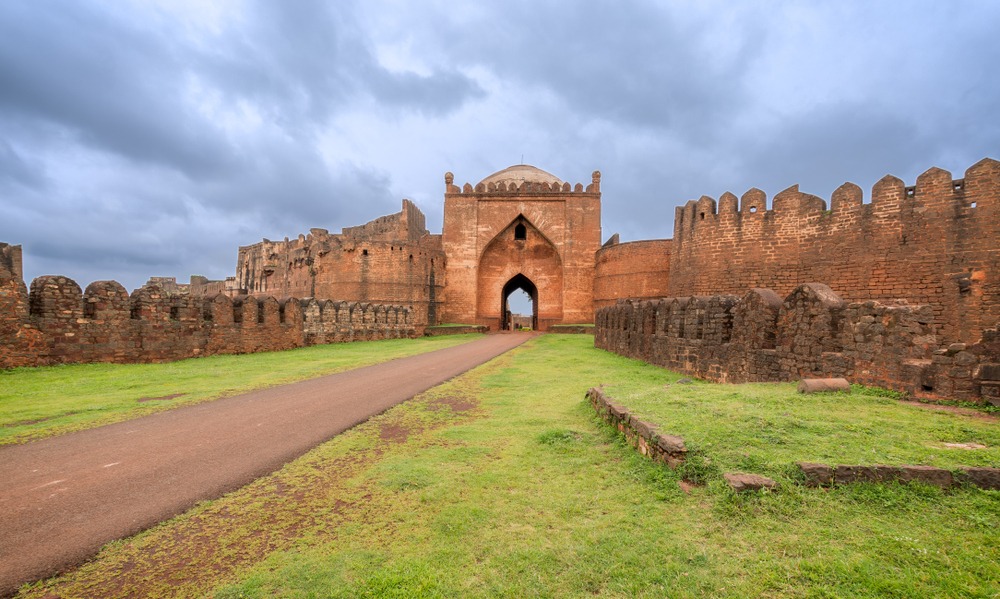
From the palace's surroundings, you can grasp the scale of Bidar Fort: moats carved into basalt, laterite ramparts, and watchtowers extending for several kilometres.
Photography Tips
Morning light, entering through east-facing openings, brings out the pearlescent reflections on the panels. Avoid flash, which flattens stucco relief. A macro lens or portrait mode captures the detail of the inlays. The ASI may restrict photography in certain restored rooms; check on site.
Location and Access
Bidar lies in the far north of Karnataka, on the border with Telangana. The fort is accessible on foot from Bidar city centre. Bidar railway station connects the city to Hyderabad and other major Deccan cities. Regular buses link Bidar to Hyderabad (approximately 140 km southeast).
Access to Rangeen Mahal involves crossing part of the fort on uneven basalt and laterite ground; accessibility for those with reduced mobility is limited.
Nearby
- Bidar Fort — the medieval enclosure that houses Rangeen Mahal, with its mosques, royal stables, and cisterns.
- Madrasa Mahmud Gawan — 15th-century madrasa in the heart of the city, with its partially preserved Persian faience minarets.
- Bahmani Tombs of Ashtur — royal necropolis a few kilometres from Bidar, with grand laterite domes.
Frequently asked questions
No. Rangeen Mahal is included in the general entrance ticket for Bidar Fort, managed by the Archaeological Survey of India.
October to February offers pleasant temperatures and clear skies. Avoid May–June, when temperatures regularly exceed 40°C.
Yes. The madrasa stands in the lower town, a few minutes by auto-rickshaw from the fort. Half a day suffices for both sites.
Generally yes for personal use, but some restored rooms may have restrictions. Check with the site attendant before photographing.
Access is challenging: the fort's ground is uneven basalt and laterite with no wheelchair facilities. Assistance is necessary for visitors using wheelchairs.
Interested in this visit?
We can include it in your personalised itinerary.