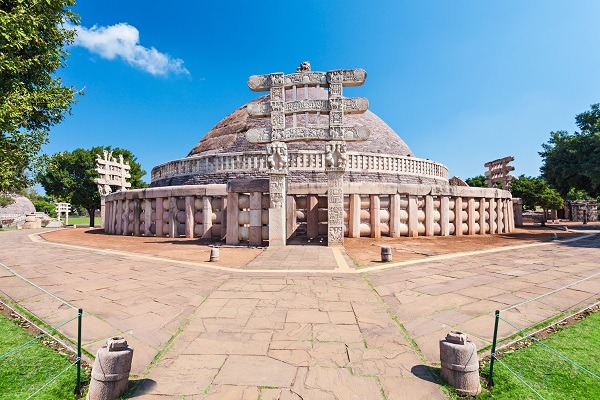
Qutb Minar
Qutb Minar
In Mehrauli, south of Delhi, the Qutb Minar has risen 72 meters of red sandstone since the 13<sup>th</sup> century. A mosque, tombs, and an ancient iron column make up a UNESCO-listed complex, witness to the meeting of Indian and Islamic civilizations.
The Qutb Minar rises over 72 meters south of Delhi, in the Mehrauli district. This red sandstone tower, built at the turn of the 13th century, marks the entry of Islam into the Indian subcontinent. Listed as a UNESCO World Heritage site, the complex surrounding it brings together a mosque, tombs, and a mysterious iron column over 1,600 years old. It is one of the best-preserved medieval monuments in South Asia.
Practical information at a glance
- Entrance: paid; differentiated rates for Indian residents / foreign visitors
- Access: Qutb Minar metro station (Yellow Line), then a few minutes' walk
- Recommended duration: 1.5 to 2 hours for the entire complex
- Closure: the site is open daily from sunrise to sunset
- Dress code: no strict obligation, but attire covering shoulders and knees is recommended out of respect
- Accessibility: main pathways are wheelchair accessible; the interior of the tower is not open to the public
What to see
The Qutb Minar complex groups several remarkable structures on the same archaeological site. The tower itself consists of five storeys with corbelled projections, decorated with Quranic calligraphy and geometric relief patterns. At its base, the Quwwat-ul-Islam ("The Might of Islam") is the first mosque built in India following the Ghurid conquest.
- The main tower: five storeys of red sandstone and white marble, projecting balconies, inscriptions in Arabic
- Ashoka's Iron Column: 4th-century pillar, virtually intact despite fifteen centuries of exposure; its resistance to rust still intrigues metallurgists
- Tomb of Iltutmish: mausoleum of the sultan who completed the tower, featuring remarkably fine interior sculptures
- Alai Darwaza: white marble and red sandstone gateway, the first true ogival arch example in India
- Alai Minar: unfinished tower that was to double the height of Qutb Minar; only the first storey was erected
History and context
Construction began around 1193 under Qutb ud-Din Aibak, founder of the Delhi Sultanate, shortly after the defeat of the last Rajput king in the region. The tower was completed and enlarged by his successors, notably Iltutmish and Firuz Shah Tughluq. Materials partly came from dismantled Hindu and Jain temples, visible in the reused columns of the mosque. The site thus illustrates the superimposition of two architectural civilizations.
Highlights of the visit
The tower up close
From the base, the sculpted bands alternating Quranic verses and floral patterns reveal work of remarkable precision. Access to the interior has been closed since 1981 for safety reasons, but external contemplation alone is enough to grasp the ambition of the project.
The iron column
This seven-meter pillar, dedicated to the god Vishnu, was erected under the Gupta dynasty. Its composition in high-purity wrought iron gives it exceptional resistance to corrosion. A local legend once held that whoever managed to embrace it with arms around the back would have their wish granted — the protective barrier installed around it ended the practice.
The Alai Darwaza
This gateway from 1311, commissioned by Alauddin Khalji, is often overlooked in favor of the tower. Its jalis (marble lattice screens) and horseshoe arches nonetheless constitute a major milestone in the history of Indo-Islamic architecture.
Photography tips
Morning light (before 9 a.m.) is ideal: low-angle sunlight brings out the carved reliefs on the red sandstone. In late afternoon, the tower takes on warm orange tones. Avoid midday, which flattens textures. The iron column photographs well from a slightly offset angle to avoid the protective barrier. Drones are prohibited on the site.
Location and access
The complex is located in the Mehrauli district, south of Delhi, about 15 km from the historic center (Old Delhi). The Qutb Minar metro station (Yellow Line) is the simplest solution from downtown. Auto-rickshaws and taxis are available at the metro exit. The site is about 5 km from the Humayun's Tomb, accessible by taxi or rickshaw.
Nearby attractions
- Humayun's Tomb — 16th-century Mughal masterpiece, precursor to the Taj Mahal, a few kilometers to the northeast.
- Lodi Garden — landscaped park dotted with tombs of the Lodi and Sayyid dynasties, ideal for a morning stroll.
- Hauz Khas Village — medieval reservoir surrounded by ruins, now a trendy district with galleries and restaurants.
- Mehrauli Archaeological Park — vast area of medieval ruins adjacent to the Qutb Minar complex, often deserted and conducive to exploration.
Frequently asked questions
October to March offers pleasant temperatures in Delhi. Summer (April-June) is very hot and humidity rises during the monsoon (July-September). Winter (December-January) can be hazy in the morning, which softens light for photography.
No. Access to the interior of the tower has been closed to the public since 1981, following an accident. The visit takes place entirely outside, around the tower and throughout the complex.
Allow between 1.5 and 2 hours to explore the entire complex at your own pace: the tower, mosque, iron column, Alai Darwaza, and Iltutmish's tomb each merit a stop.
Yes. Humayun's Tomb and Lodi Garden are accessible within the same half-day by taxi or rickshaw. Plan to start at Qutb Minar in the morning to take advantage of the best light.
Drones are prohibited on the site. Tripods generally require special permission from the Archaeological Survey of India; for typical tourist use, a handheld camera is sufficient.
Accredited guides offer their services at the site entrance. For an in-depth visit, it is preferable to book an English-speaking guide in advance through a local agency, as the on-site offering is primarily English-language.
Photos
Interested in this visit?
We can include it in your personalised itinerary.