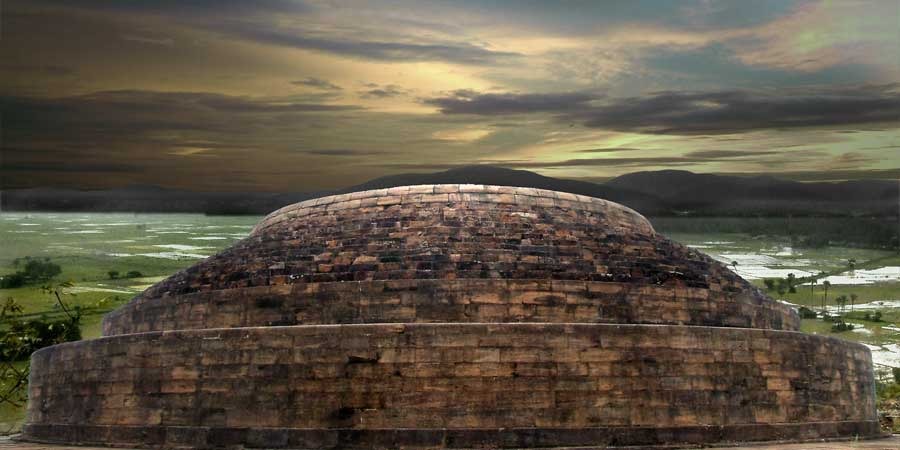
Nalanda
The ruins of Nalanda Mahavihara, in Bihar, are the remains of a Buddhist university founded in the 5th century that once hosted up to ten thousand students. Inscribed as a UNESCO World Heritage Site in 2016, this major archaeological site pairs well with visits to Rajgir and Bodh Gaya.
About a hundred kilometers southeast of Patna, in the state of Bihar, the ruins of Nalanda Mahavihara are the remains of one of the greatest monastic Buddhist universities of antiquity. Founded in the 5th century, it attracted thousands of students from across Asia for nearly seven centuries. Inscribed as a UNESCO World Heritage Site in 2016, it remains a major site of intellectual and spiritual pilgrimage.
Quick Practical Information
- Admission : paid entry (differentiated rates for Indian residents and foreigners) — verify current fees with the Archaeological Survey of India (ASI).
- Closure days : the site is closed on Fridays.
- Recommended duration : 2 to 3 hours for the archaeological site; allow half a day including the museum.
- Access : from Patna by car or bus (approximately 90 km); nearest railway stations at Rajgir or Bihar Sharif.
- Dress code : respectful attire recommended; no strict requirement, but the site is revered by Buddhist pilgrims.
- Accessibility : terrain is partially paved, though ruins feature irregular areas that may be challenging for wheelchair users.
What to See
The site spans several hectares of carefully excavated red brick structures. Distinguished features include monasteries (viharas) arranged facing temples (chaityas), notably the grand main stupa, partially restored. The monks' cells, interior courtyards, and ritual basins offer vivid insights into daily life in an institution that once accommodated up to ten thousand students.
History and Context
Nalanda was founded during the Gupta dynasty, likely in the 5th century CE. It flourished under the Palas and became a premier center for Buddhist scholarship, logic, grammar, and medicine. The Chinese monk Xuanzang stayed there in the 7th century and left a detailed account. The university was destroyed by forces under Bakhtiyar Khilji around 1193, ending over seven centuries of intellectual activity.
Highlights of Your Visit
The Great Stupa (Stupa No. 3)
This is the most imposing structure on the site. Its multiple superimposed construction phases are clearly visible. Niches still shelter some Buddhist sculptures in brick and stucco, bearing witness to Gupta and post-Gupta artistry.
Aligned Monasteries
Eleven numbered monasteries have been excavated. Their cells, courtyards, and wells reveal meticulous organization. Monastery No. 1, the best preserved, provides the clearest understanding of the period's monastic architecture.
Nalanda Archaeological Museum
Located at the site entrance and managed by the ASI, this museum houses sculptures, Buddhist bronzes, seals, and coins unearthed during excavations. It is an essential complement to exploring the ruins themselves.
The Legendary Library (Dharmaganja)
Ancient texts describe a library housed in three buildings, one said to have burned for weeks during the site's destruction. No structure can be identified with certainty, but the presumed location is marked on the site.
Photography Tips
Morning light (before 9 AM) is ideal: the low angle illuminates the red brick surfaces, bringing out relief details of stupas and walls. Late afternoon golden light suits sweeping views of the aligned monasteries. Avoid midday, which creates harsh contrasts. No photography restrictions are known at the open archaeological site; check museum rules inside.
Location and Access
Nalanda is located in the district of the same name, approximately 90 km southeast of Patna and about fifteen kilometers from Rajgir. The road from Patna is passable for standard tourist vehicles. Regular buses connect Bihar Sharif (the district capital) to Nalanda. Rajgir, reachable in 20–30 minutes, has a railway station on the Patna–Gaya line and makes an excellent base for accommodation.
Nearby Attractions
- Rajgir — ancient capital of the Magadha kingdom, featuring rolling hills, natural hot springs, and a cable car ascending to the Peace Stupa, a gift from Japan.
- Bodh Gaya — the site of Buddha's enlightenment, approximately 100 km to the south, home to the UNESCO-listed Mahabodhi Temple.
- Patna — capital of Bihar and the main gateway, featuring the Patna Museum and ghats along the Ganges River.
- Pawapuri — a sacred Jain site where Mahavira attained nirvana, about twenty kilometers from Nalanda.
Interested in this visit?
We can include it in your personalised itinerary.