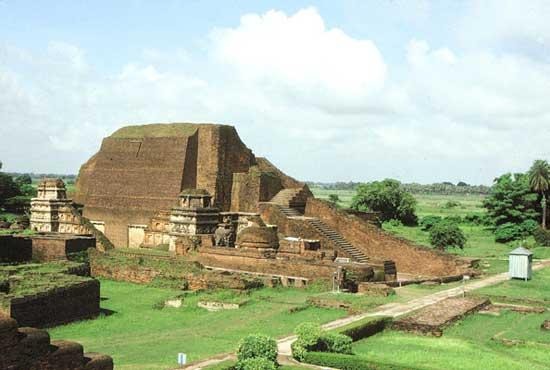
Nagarajuna Konda
An archaeological island at the heart of Nagarjunasagar Lake, Nagarjunakonda brings together the remains of a 3rd-century Ikshvaku Buddhist city: reconstructed stupas, limestone sculptures and a remarkable archaeological museum.
Nagarjunakonda is a museum island at the heart of Nagarjunasagar Lake, in Andhra Pradesh. This major Buddhist archaeological site preserves the remains of a thriving 3rd-century city, rescued from the waters when the Nagarjunasagar Dam was built in the 1960s. Sculptures, stupas and reconstructed monasteries stand alongside an exceptional open-air museum.
Quick Practical Information
- Access: the site is accessible only by boat from Vijayapuri (left bank) or Hill Colony (right bank) — crossing takes approximately 30 minutes.
- Closure: the museum is closed on Fridays.
- Recommended duration: 2 to 3 hours on the island.
- Dress code: no strict dress requirements, but respectful attire is recommended at Buddhist sites.
What You'll See
The island houses an archaeological museum managed by the Archaeological Survey of India. The collections bring together white limestone Buddhist sculptures, narrative slabs illustrating scenes from the life of Buddha, inscriptions and everyday objects from the Ikshvaku era (3rd–4th century). Outside, several structures have been reconstructed stone by stone: stupas, commemorative pillars, monastic assembly halls (chaityas) and ritual baths.
History and Context
The original city, named Vijayapuri, was the capital of the Ikshvaku kingdom. It became a radiating Buddhist center, frequented by monks from Ceylon, Central Asia and Southeast Asia. The philosopher-monk Nagarjuna, founder of the Madhyamaka school, is believed to have stayed in the region — hence the site's name. When the Nagarjunasagar Dam was built (inaugurated in 1967), archaeologists conducted urgent excavations and transferred the most significant structures to a neighboring hill, now an island.
Highlights of Your Visit
The Archaeological Museum
Four galleries present the site's discoveries in chronological order. The limestone panels, of remarkable finesse, illustrate scenes from the Jataka and episodes from the life of Buddha. Some pieces rank among the finest Buddhist sculptures in South India.
Reconstructed Stupas and Monasteries
Around ten structures have been rebuilt on the island. The large circular stupa and the chaityas allow you to visualize the layout of an Ikshvaku monastic complex. Pillars inscribed with Prakrit text offer direct insight into the religious life of the period.
Nagarjunasagar Lake
The boat crossing offers a perspective on one of India's largest reservoirs. The landscape of wooded hills and calm water contrasts with the surrounding aridity and sets the stage well for your island visit.
Photography Tips
Morning light, just after the first boat arrives, is gentlest for photographing white limestone sculptures without overexposure. The museum galleries are dimly lit — a camera with strong low-light performance is useful. Exterior stupas photograph well late in the morning, before the sun gets too high.
Location and Access
Nagarjunakonda lies in Palnadu district, about 160 km from Hyderabad and roughly a hundred kilometers from Vijayawada. The nearest town is Macherla. Boats depart from both shores of the lake; check locally for schedules, which vary by season and water level. No accommodation is available on the island itself.
In the Area
- Nagarjunasagar Dam — one of the world's largest masonry dams, visible from the shore.
- Ethipothala Falls — a three-armed cascade on the Chandravanka River, about forty kilometers from the lake.
Frequently asked questions
The dry season, from October to March, is most pleasant. Summer months (April–June) are very hot in this Andhra Pradesh region. Monsoon rains can disrupt lake navigation.
No. The archaeological museum is closed on Fridays. Plan your visit accordingly, especially if you're coming from afar.
Allow 2 to 3 hours to visit the museum and exterior structures at a leisurely pace. The boat crossing adds to this time.
Yes. Nagarjunasagar Dam and Ethipothala Falls are accessible in the same day from Macherla or Hyderabad if you start early.
Rules may vary by gallery. Check at the museum entrance; photography is generally permitted without flash in outdoor spaces.
Interested in this visit?
We can include it in your personalised itinerary.