Golconda Fort
Golconda Fort
Once the capital of the Qutb Shahi sultanate and the world's premier diamond trading hub, Golconda Fort dominates Hyderabad from a granite outcrop. Its ramparts, ruined palaces and remarkable acoustics make it one of the Deccan's most significant historical sites.
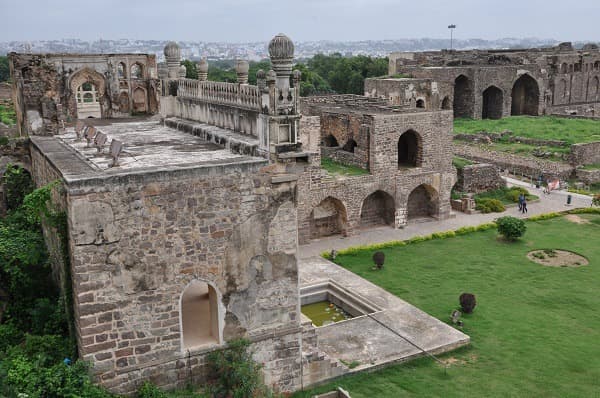
About twelve kilometres west of Hyderabad, Golconda Fort rises from a granite spur nearly 120 metres high. Once the capital of the Qutb Shahi sultanate in the sixteenth and seventeenth centuries, it was also the world's leading centre for diamond commerce — the famous Koh-i-Noor and Hope stones originated here. Its ramparts, ruined palaces and unique acoustic system make it one of the best-preserved historical sites of the Deccan.
Practical Information at a Glance
- Admission: paid (differentiated rates for Indian residents and foreign visitors)
- Closing: the site closes in the evening; a sound and light show is offered after sunset
- Recommended duration: 2 to 3 hours to explore the entire site
- What to wear: comfortable shoes essential — the climb to the summit is long and paved
- Accessibility for persons with disabilities: limited; pathways are steep and not adapted for wheelchairs
What to See
The complex spans several concentric fortifications. The Fateh Darwaza gate (Gate of Victory) marks the main entrance. Inside, the ruins of royal palaces, mosques, baths and stables bear witness to the sophisticated organisation of the Qutb Shahi court. At the summit, the Bala Hisar (upper fortress) offers a panoramic view over Hyderabad and the nearby Qutb Shahi tombs.
History and Context
Golconda was initially an earthen fort built by the Kakatiyas in the fourteenth century. The Qutb Shahi sultans transformed it into a granite citadel between 1518 and 1687. The fortress withstood numerous sieges before falling to Aurangzeb's army after an eight-month siege. It then controlled the diamond mines of the Krishna-Godavari region, a source of considerable wealth.
Highlights of Your Visit
The Acoustic System of the Fateh Darwaza Gate
A single handclap beneath the dome of the main entrance reverberates to the summit of the fort, several hundred metres away. This alert device, intentionally engineered, remains perfectly functional after four centuries. Local guides regularly demonstrate this remarkable feat.
The Climb to Bala Hisar
The ascent along paved pathways passes through multiple levels of fortification. Each level reveals new ruins — pavilions, water reservoirs, terraced gardens. The panorama from the summit embraces the entire Deccan plateau.
The Sound and Light Show
In the evening, a narrated spectacle traces the history of the Qutb Shahi sultanate through light projections on the ramparts. It is offered in Hindi and English on alternating evenings.
Photography Tips
Morning light is ideal for photographing the ramparts without backlighting. From the summit, the golden hour at late afternoon illuminates the Qutb Shahi tombs to the northwest. The interior arches and domes offer interesting geometric framing at midday. No known photography restrictions for visitors.
Location and Access
Golconda lies approximately 11 km west of central Hyderabad, in the Golconda district. It is accessible by auto-rickshaw, taxi or via TSRTC buses from the old city. The site is close to the Qutb Shahi Tombs complex, accessible on foot from the main entrance. Parking is available outside the ramparts.
Nearby Attractions
- Qutb Shahi Tombs — necropolis of the sultans of Golconda, a few minutes' walk away, recently restored by the Aga Khan Trust.
- Charminar — an iconic monument in Hyderabad's old city, about fifteen kilometres to the east.
- Salar Jung Museum — one of the world's largest private art collections, on the banks of the Musi River.
- Laad Bazaar — a traditional market specialising in lacquered bangles, near the Charminar.
Frequently asked questions
October to February offers pleasant temperatures on the Deccan plateau. Avoid April to June when heat makes the climb challenging.
Plan 2 to 3 hours to explore the entire site, including the climb to Bala Hisar. Add 1 hour if you attend the sound and light show in the evening.
Yes, the two sites are adjacent. Visit Golconda in the morning, then the tombs in early afternoon before the midday heat.
It is generally offered nightly, with sessions in Hindi and English. Check the schedule with the Archaeological Survey of India or your local agency before visiting.
The site suits children in good physical condition. The climb is long and pathways uneven; bring water and closed shoes for the whole family.
Strongly recommended. Without a guide, the acoustic demonstration and the history of the various palaces may be overlooked. Accredited guides are available at the site entrance.
Photos
Interested in this visit?
We can include it in your personalised itinerary.