Royal Cenotaphs of Bikaner (Devi Kund Sagar)
Royal Cenotaphs of Bikaner (Devi Kund Sagar)
East of Bikaner, Devi Kund Sagar brings together the cenotaphs of the maharajas of the Rathore dynasty. Red sandstone sculpture, marble cupolas and peaceful atmosphere: a little-known royal site, best combined with Junagarh Fort.
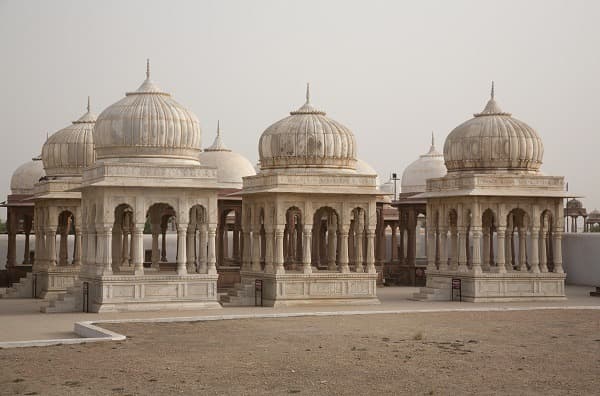
A few kilometres from Bikaner's city centre, the Devi Kund Sagar complex houses the cenotaphs (chattris) of the maharajas and members of Bikaner's royal family. These funerary monuments in red sandstone and white marble, erected from the 16th to the 20th century, form a cohesive and little-visited architectural ensemble, far removed from the bustle of Junagarh Fort.
Essential information at a glance
- Admission: usually free or symbolic for foreign visitors — check on arrival
- Duration: 45 minutes to 1 hour 30 minutes
- Dress code: modest clothing recommended (the site holds sacred significance for the royal family)
- Access: by auto-rickshaw or taxi from Bikaner's city centre; no direct public transport
What to see
The site comprises dozens of chattris of varying sizes and styles. The most imposing belong to maharajas Rai Singh, Surat Singh and Ganga Singh. The structures blend sculpted columns, marble cupolas and finely carved red sandstone friezes, characteristic of Bikaner's Rajput architecture.
- Chattri of Maharaja Surat Singh: one of the most elaborate, with worked capitals on its columns
- Chattri of Maharaja Ganga Singh: early 20th-century construction, blending Rajput and colonial influences
- Small cenotaphs of court women, more discreet but finely adorned
History and context
Bikaner was founded in 1488 by Rao Bika, son of the founder of Jodhpur. The Rathore dynasty of Bikaner erected these cenotaphs over the centuries to honour its sovereigns. Devi Kund Sagar — the adjoining artificial lake — gave the site a ritual setting: water was associated with Hindu funeral rites. The complex bears witness to Bikaner's dynastic continuity over more than four centuries.
Highlights of the visit
The Chattri of Maharaja Ganga Singh
Ganga Singh (r. 1887-1943) is one of Bikaner's most celebrated sovereigns, a reformer and representative of India at the Paris Peace Conference (1919). His cenotaph, more recent, reflects a hybrid aesthetic between Rajput tradition and modernity.
The red sandstone sculpture ensemble
Bikaner's sandstone, with its characteristic ochre-red hue, is worked here with remarkable precision: jalis (pierced lattice screens), floral motifs and friezes of figures animate the facades of the oldest chattris.
The atmosphere of the site
The place remains little visited. You can wander between the monuments in an unusual calm for a royal site in Rajasthan, making it a welcome respite after the crowds at Junagarh Fort.
Etiquette and visiting rules
- Wear clothing that covers shoulders and knees.
- Avoid loud behaviour: the site retains a sacred dimension for Bikaner's royal family.
- Ask permission before photographing any gardeners or residents who may be present.
Photography tips
Morning light (before 9 am) and late afternoon light enhance the red sandstone and avoid harsh shadows. The jalis offer interesting graphic compositions. No known photography restrictions apply at the site itself.
Location and access
Devi Kund Sagar is located east of Bikaner, approximately 8 km from the city centre. The journey by auto-rickshaw from Junagarh Fort takes about twenty minutes. No regular buses serve the site directly. Wheelchair access is limited due to the uneven ground between the monuments.
Nearby attractions
- Junagarh Fort — 16th-century royal fortress, Bikaner's main monument, with museums and interior palaces.
- Karni Mata Temple (Deshnok) — temple famous for its sacred rats, approximately 30 km south of Bikaner.
- Lalgarh Palace — early 20th-century palace in red sandstone, partially converted into a hotel and museum.
Frequently asked questions
A guide is not essential, but it helps to identify the cenotaphs of each sovereign and understand their history. Local guides in Bikaner often offer this site as a complement to Junagarh Fort.
From October to February, temperatures in Bikaner are pleasant. Avoid the summer months (April-June) when temperatures regularly exceed 40°C.
Yes, this is the most common combination. Allow for the fort in the morning (2 to 3 hours) and Devi Kund Sagar in late morning or early afternoon.
The site is open and peaceful, suitable for children. The ground between the cenotaphs can be uneven; closed shoes are recommended.
No photography restrictions are noted at the site. Remain respectful if ceremonies or members of the royal family are present.
Photos
Interested in this visit?
We can include it in your personalised itinerary.