Sumda Chenmo
Sumda Chenmo
An isolated monastery village in Ladakh, Sumda Chenmo preserves rare-quality medieval Buddhist frescoes from the 12th–13th centuries, accessible after a trek through gorges.
Sumda Chenmo is a remote village in Ladakh, nestled in the Indus Valley, well away from mainstream tourist circuits. It houses an ancient Buddhist monastery whose 12th–13th-century murals rank among the best preserved in the region. For those willing to undertake the approach trek, the site offers direct contact with medieval Ladakh Buddhist art, far from Leh's crowds.
What You'll See
The Sumda Chenmo monastery preserves frescoes in Indo-Tibetan style attributed to the period of the western Ladakh kingdoms. Depictions of Buddhas, bodhisattvas, and mandalas cover the interior walls of the main temple. The state of preservation is remarkable given the site's isolation. The village itself, composed of a few stone and adobe houses, exemplifies traditional Ladakh vernacular architecture.
History and Context
The paintings are dated approximately to the 12th–13th century, a period of artistic flourishing linked to the Guge kingdom and exchanges with Kashmir. Sumda Chenmo is part of a cluster of monastery villages in central Ladakh—alongside Sumda Chun and Wanla—that bear witness to an era of Buddhist royal patronage. The site is less studied compared to Alchi, lending it an almost insider quality.
Highlights of the Visit
The Main Temple Murals
The interior frescoes are the heart of the experience. The pigments—ochres, lapis lazuli blues, reds—have retained remarkable intensity. The compositions follow precise Mahayana Buddhist iconography, stylistically comparable to Alchi's paintings, though far less known.
The Approach Trek
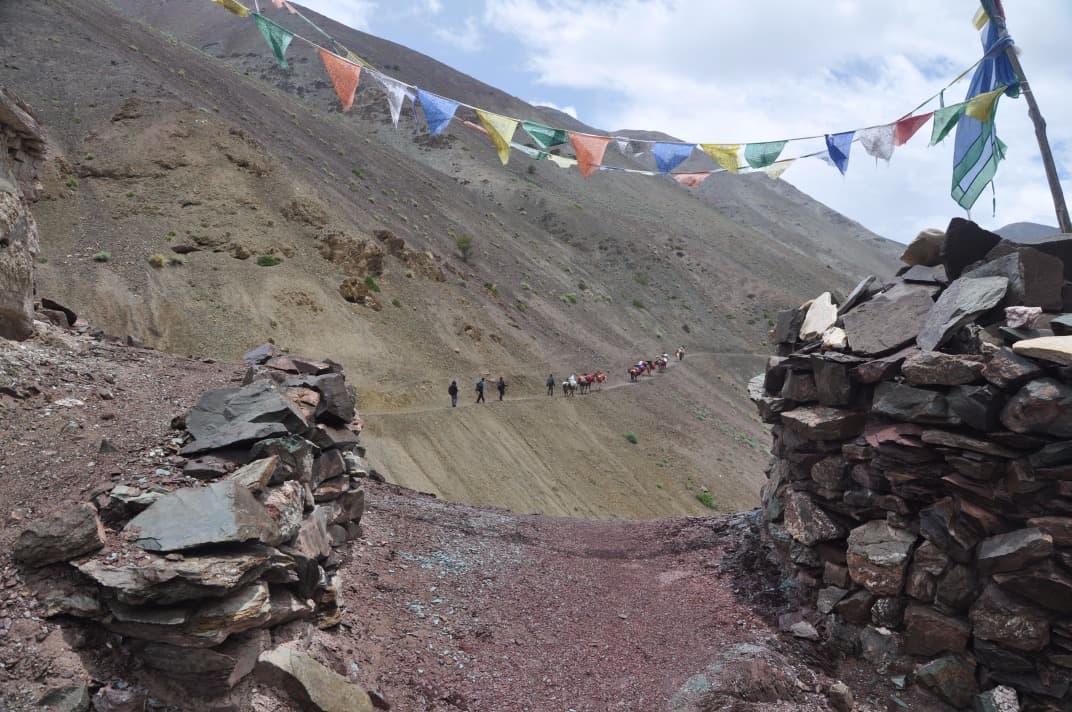
Reaching the village involves a hike from the main road. The trail traverses a landscape of gorges and irrigated terraced fields. This pedestrian approach is integral to the experience: it naturally filters visitors and preserves the site's atmosphere.
Etiquette and Visitor Rules
- Covered clothing required inside the temple (shoulders and knees covered).
- Remove shoes before entering the sanctuary.
- Request permission from the local monk or guardian before photographing the frescoes.
- Speak in hushed tones inside the temple.
- Do not touch the murals.
Photography Tips
Natural light inside the temple is dim. A tripod or high ISO sensitivity is necessary to photograph the frescoes without flash—flash is discouraged as it degrades ancient pigments. Outside, morning light illuminates the village facades and agricultural terraces. The gorge landscape photographs well late in the morning.
Location and Access
Sumda Chenmo lies in the Indus Valley, southeast of Leh. The paved road ends before the village; the final stretch is completed on foot via a mountain trail. A 4×4 vehicle with driver from Leh is the most practical solution to reach the trailhead. The village is accessible in summer (June to October); the road may be impassable in winter. No regular public transport serves the site directly.
Wheelchair accessibility is severely limited due to the unimproved trail.
Nearby
- Alchi Monastery — the most celebrated site of medieval murals in Ladakh, offering a direct stylistic comparison point with Sumda Chenmo.
- Wanla Monastery — another monastery from the same period, in an adjacent gorge, featuring a distinctive temple tower.
- Leh — Ladakh's capital and essential logistical base for organizing the excursion.
- Lamayuru Monastery — one of Ladakh's oldest monasteries, accessible on the route from Leh to Kargil.
Frequently asked questions
The ideal window runs from June to October, when Ladakh's roads are passable. In July–August, days are long and the approach trail is dry. Avoid winter: snow and cold make access very difficult.
A local guide or driver familiar with the region is strongly recommended. Trail markings are minimal and English signage on the ground is virtually nonexistent.
The combination is possible from Leh in a long day, provided you start early. Alchi is more accessible and can serve as a first stop before heading to Sumda Chenmo.
It's generally permitted with the guardian's or resident monk's consent. Flash should be avoided to preserve the fresco pigments. Ask on site before bringing out your camera.
Wear clothing covering shoulders and knees for entry into the temple. Proper hiking shoes are essential for the approach trail. Also pack a warm layer: Ladakh's altitude means cool mornings even in summer.
Want to discover this destination?
Our local advisors design your tailor-made trip.