Ravangla
Ravangla
Perched above 2,100 meters in South Sikkim, Ravangla brings together Buddhist monasteries, rhododendron forest hikes, and panoramic views of Kangchenjunga—far from the bustle of Gangtok.
Ravangla is a small mountain town in South Sikkim, perched between 2,100 and 2,200 meters elevation on a forested plateau. It offers direct views of Kangchenjunga and surrounding peaks, and serves as a base for several Buddhist monasteries and natural sites in the district. Less crowded than Gangtok, it attracts travelers seeking tranquility, Himalayan landscapes, and Tibetan culture without the crowds.
Quick Reference Guide
- Access: Ravangla is accessible from Gangtok (approximately 65 km) and Namchi by road; shared jeeps are the usual local transport.
- Permit: Foreign nationals must possess an Inner Line Permit (ILP) or Restricted Area Permit (RAP) for Sikkim, obtained on arrival or online.
- Recommended Duration: 1 to 2 nights to visit main sites at a leisurely pace.
- Best Season: October–November and March–May for clear views of peaks; avoid monsoon (June–September).
What to See
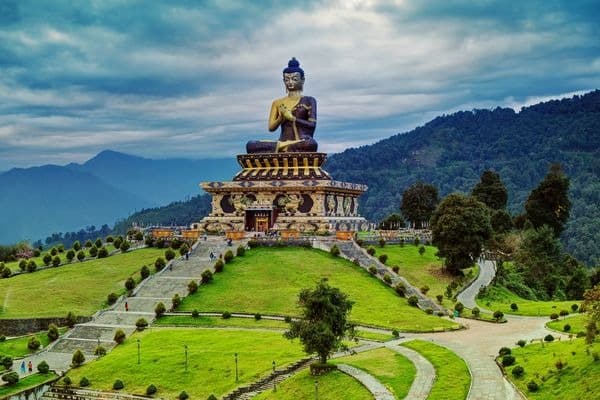
The most prominent site is the Tathagata Buddha Tsal statue, an imposing seated Buddha statue inaugurated in 2013, surrounded by a landscaped park with prayer wheels and prayer flags. The Ralang monastery (Palchen Chöling), founded in the 18th century, is one of South Sikkim's most important monasteries and houses monks of the Kagyu school. The Maenam Wildlife Sanctuary borders the town and offers hiking trails through rhododendron forests.
History and Context
Ravangla belongs to South Sikkim district, integrated into India in 1975. The region is historically linked to Tibetan Buddhism: several Kagyu and Nyingma monasteries were founded here between the 17th and 19th centuries. The Tathagata Buddha Tsal statue was built to commemorate the 2,550th anniversary of Buddha's enlightenment, on initiative of the Sikkim government.
Highlights of Your Visit
Tathagata Buddha Tsal Statue
The statue, approximately thirty meters high, dominates a well-maintained park. The site is open to visitors of all faiths. On clear days, Kangchenjunga appears in the background—a rare photographic frame.
Ralang Monastery
A few kilometers from Ravangla, this active monastery hosts regular ceremonies. The interior frescoes and thangkas deserve attention. The Pang Lhabsol festival, celebrated in August–September, is particularly lively here.
Maenam Wildlife Sanctuary
This forest sanctuary is home to red pandas, langurs, and diverse alpine flora. The trail to the Maenam summit (3,235 m) offers panoramic views of the Himalayas and Teesta Valley. The round-trip hike takes half a day.
Local Market and Sikkim Tea
Ravangla's small market allows you to taste momos, thukpa, and butter tea. South Sikkim's tea gardens produce acclaimed organic teas, available in local shops.
Etiquette and Visiting Rules
- At Ralang monastery: remove your shoes before entering the prayer hall.
- Covering clothing (shoulders and knees) required in worship spaces.
- Circumambulate stupas and prayer mills clockwise.
- Ask permission before photographing monks or ceremonies.
Photography Tips
Morning light (before 9 a.m.) is ideal for photographing the Buddha statue with Kangchenjunga in the background, before clouds obscure the peaks. At Ralang monastery, natural light filters well mid-morning. The colorful prayer flags in the park offer striking foregrounds in light breeze.
Location and Access
Ravangla lies in South Sikkim district, approximately 65 km from Gangtok and about forty kilometers from Namchi. The nearest airport is Bagdogra (Siliguri, West Bengal), approximately 3–4 hours away by road. Shared jeeps connect Ravangla to major Sikkim towns from early morning. The road is winding; prepare for motion sickness if needed.
Nearby
- Namchi — South Sikkim's district capital, known for its massive Shiva statue and the Samdruptse complex.
- Pelling — Mountain town offering views of Kangchenjunga and access to Pemayangtse monastery.
- Gangtok — Sikkim's capital, the logistical starting point for the entire territory.
- Temi Tea Gardens — Sikkim's only certified organic tea garden, on the route between Ravangla and Namchi.
Frequently asked questions
October–November and March–May offer the best conditions: clear skies, Kangchenjunga views, and pleasant temperatures. Monsoon (June–September) makes roads slippery and obscures peaks.
Yes. All foreign nationals must obtain an Inner Line Permit (ILP) to enter Sikkim. It can be obtained online or at official entry points (Rangpo, Melli, Jorethang). Check current procedures with your agency before departure.
One to two nights are sufficient to visit the Buddha statue, Ralang monastery, and hike Maenam. Ravangla fits well into a Gangtok–Pelling circuit.
The trail is moderate to challenging depending on fitness level. It passes through dense forest and climbs above 3,200 m. Plan for good hiking boots and start early to avoid afternoon clouds.
Photography is generally tolerated in outdoor spaces. Inside the prayer hall, always ask monks present for permission before taking out your camera.
Ravangla fits naturally between Gangtok and Pelling on a loop circuit. Temi tea gardens and Namchi are accessible in half a day from town.
Photos
Want to discover this destination?
Our local advisors design your tailor-made trip.