Lhalung Lakhang
Lhalung Lakhang is an ancient Buddhist temple in the village of Lhalung, nestled in Spiti Valley. Period murals, rammed-earth architecture, and remote Himalayan isolation make it a true off-the-beaten-path site.
Lhalung Lakhang is a Tibetan Buddhist temple perched in the village of Lhalung, in Spiti Valley (Himachal Pradesh). Built according to tradition, it ranks among the region's oldest places of worship, contemporary with Spiti's great monasteries. Its isolated location, above 4,000 metres in altitude, and the quality of its interior murals make it a rare site, largely untouched by mainstream tourist circuits.
What to see
The temple's interior preserves period murals depicting Buddhist deities and mandalas. The pictorial style echoes that of Tabo and Nako temples, bearing influences from Western Kashmir art. A principal statue presides in the main prayer hall. The exterior architecture, constructed of rammed earth and stone, harmonises with the arid landscape of the upper valley.
History and context
Lhalung Lakhang is linked to the period of Buddhism's spread through Spiti, around the 10th–11th centuries, connected to the translator Rinchen Zangpo's activities. This erudite monk founded numerous temples across the trans-Himalayan region. The village of Lhalung itself ranks among Spiti district's most remote settlements, accessible only in summer season.
Highlights of the visit
The interior murals
The wall paintings represent the temple's main draw. Though partially faded, their preservation speaks to ancient Buddhist art specific to this region. Natural light is dim inside: a torch proves invaluable.
The village of Lhalung
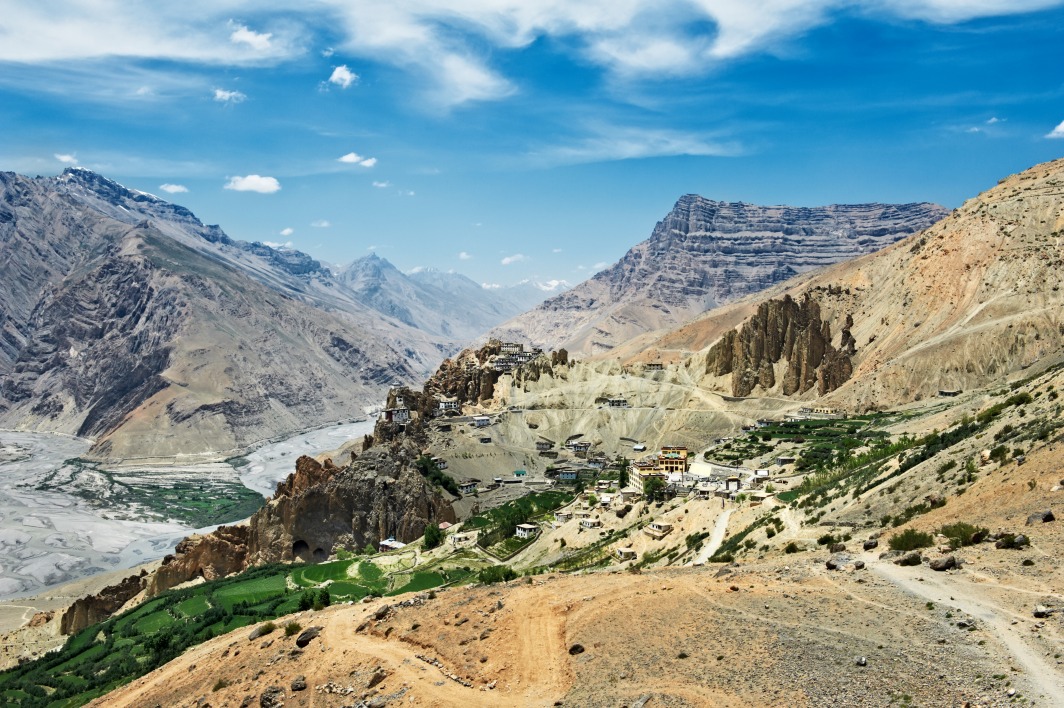
The village itself, with its earth-built houses and terraced barley fields, deserves attention. Views across the surrounding mountains and Spiti Valley spread out from the temple's surroundings.
Etiquette and visiting rules
- Covered clothing required inside the temple (shoulders and knees covered).
- Shoes must be removed before entering the prayer hall.
- Request permission before photographing murals and statues.
- Maintain quiet, respectful behaviour inside.
- A local monk or villager typically holds the key; arrive early to locate them.
Photography tips
Exterior light is optimal mid-morning, when the sun illuminates the temple façade. Inside, photographing murals requires permission; avoid flash, which damages ancient pigments. Framing from the approach path, with the village and mountains as backdrop, yields strong results.
Location and access
Lhalung is an isolated village in Spiti Valley, reachable from Kaza via a mountain track. The road is passable in summer (roughly June through October); snow cuts it off for the remainder of the year. A 4×4 vehicle or all-terrain motorcycle is recommended. The village lies away from Spiti's main route, requiring a deliberate detour.
Nearby attractions
- Tabo Monastery — one of India's oldest Buddhist monasteries, UNESCO-listed, featuring 10th-century murals.
- Kaza — Spiti district's administrative hub and logistical base for exploring the valley.
- Ki Monastery — a grand cliffside monastery overlooking the valley, active and open to visitors.
- Dhankar — an ancient monastery-fortress dominating the confluence of the Spiti and Pin rivers.
Want to discover this destination?
Our local advisors design your tailor-made trip.