Kedarnath
Kedarnath
Perched at 3,583 meters in the Himalayas, Kedarnath is one of India's most sacred Shaivite sanctuaries. An ancient temple, glacial landscapes and a demanding pilgrimage at the heart of the Char Dham.
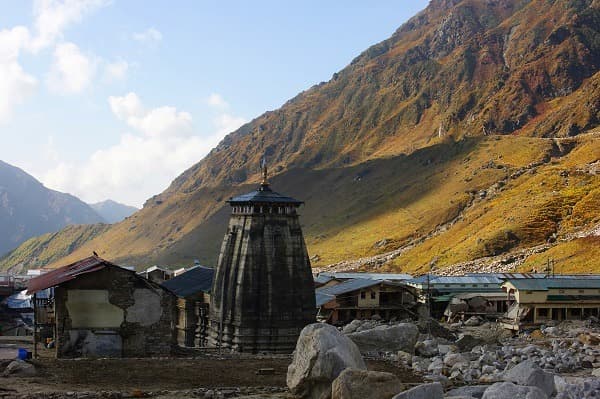
Kedarnath is one of the twelve jyotirlinga of Shiva, nestled at approximately 3,583 meters altitude in the Uttarakhand Himalayas. The main temple, built of massive grey stone, overlooks a glacial valley framed by the snow-capped peaks of Kedarnath and Kedar Dome. Each year, hundreds of thousands of pilgrims undertake the climb to reach this sanctuary, among Hinduism's most sacred places.
Quick reference guide
- Access: From Gaurikund (last road point), trek approximately 16 km on foot or by helicopter from Phata, Guptkashi or Sersi.
- Opening season: The temple opens each year at Akshaya Tritiya (April-May) and closes at Diwali (October-November); it remains closed in winter.
- Recommended duration: Plan for at least one night on site to avoid climbing and descending on the same day.
- Dress code: Modest dress is mandatory; shoulders and legs must be covered.
- Registration: Registration with the Char Dham Devasthanam Board is mandatory before departure.
- Altitude: Real risk of altitude sickness — gradual ascent recommended.
What to see
The Kedarnath Temple dates, in its present form, to the 8th century according to tradition, attributed to Adi Shankaracharya. The garbhagriha (inner sanctum) houses a natural lingam of pyramidal shape in dark stone. Behind the temple, the Chorabari glacier (Gandhi Lake) offers a striking panorama of rock walls. The village of Kedarnath, rebuilt after the devastating 2013 floods, features several dharamshalas and pilgrimage shops.
History and context
Kedarnath is part of the Char Dham, the circuit of four Himalayan sanctuaries in Uttarakhand, along with Badrinath, Gangotri and Yamunotri. Hindu tradition places here the retreat of the Pandavas after the Mahabharata war. Adi Shankaracharya reportedly revitalized the site in the 8th century and is said to have died at Kedarnath itself — a samadhi is dedicated to him behind the temple. In June 2013, exceptional rains and the breach of the Chorabari lake caused floods that destroyed much of the village, miraculously sparing the main temple.
Highlights of the visit
Darshan at the main temple
Access to the inner sanctum allows you to touch or glimpse Shiva's lingam. Queues can be long in peak season; a VIP ticket (special darshan) reduces waiting time. The atmosphere at sunrise, with chanting and bells, is particularly intense.
The trek from Gaurikund
The 16 km trail passes through rhododendron forests, alpine meadows and waterfalls. Ponies and palanquins (dolis) are available for those unable to walk. The trek typically takes five to seven hours on foot.
Chorabari Lake (Gandhi Lake)
Approximately 3 km beyond the temple, this glacial lake at over 3,900 meters offers a stunning mineral landscape. Access may be restricted depending on weather conditions and local authorities' decisions.
The samadhi of Adi Shankaracharya
This small memorial behind the main temple commemorates the philosopher who reportedly unified Shaivite traditions across India. It was damaged in 2013 and partially restored since.
Etiquette and visiting rules
- Remove your shoes before entering the temple grounds.
- Photography inside the sanctum is forbidden.
- Dress modestly: shoulders and legs covered.
- Avoid leather (belts, bags) within the sacred grounds.
- Respect silence and queues during darshan.
- Alcohol and meat consumption are prohibited throughout the Kedarnath area.
Photography tips
The golden morning light, just after temple opening, is ideal for photographing the stone façade with snow-capped peaks in the background. In late afternoon, Himalayan clouds create dramatic atmospheres. No photography is allowed inside the temple. The climbing trail offers fine framing of valleys and glaciers.
Location and access
Kedarnath is located in Rudraprayag district, Uttarakhand. The land starting point is Gaurikund, accessible by bus or taxi from Rishikesh (approximately 220 km) or Haridwar. Helicopter connections depart from Phata, Guptkashi and Sersi — tickets should be booked in advance, especially in peak season. The nearest airport is Jolly Grant in Dehradun. The site is not accessible to people with reduced mobility due to mountainous terrain.
Nearby attractions
- Badrinath — another major Char Dham sanctuary, dedicated to Vishnu, accessible via the Himalayan highway.
- Gangotri — sacred source of the Ganges, third stage of the Char Dham.
- Rishikesh — yoga and Ganges city, main departure point for the Char Dham.
- Haridwar — holy city on the Ganges, gateway to Himalayan pilgrimages.
- Tungnath — world's highest Shiva temple, in the Kedarnath range, accessible from Chopta.
Frequently asked questions
The temple is open from May to November. May-June and September-October offer the best conditions: more stable weather, clear trails. July-August corresponds to the monsoon, with risks of landslides.
Yes. Registration with the Char Dham Devasthanam Board is mandatory. It can be done online or at official registration points in Rishikesh, Haridwar or Gaurikund.
Yes. The complete Char Dham circuit (Yamunotri, Gangotri, Kedarnath, Badrinath) is typically done in ten to fifteen days. Kedarnath is often visited as the third stage.
Helicopter flights are frequent and reduce the journey to a few minutes. They are subject to weather conditions and may be cancelled without notice. Book in advance and allow extra time in case of cancellation.
Photography is permitted outside the temple. Inside the sanctum, it is strictly forbidden. Follow the temple guardians' directions.
Spend at least one night at an intermediate altitude (Guptkashi or Gaurikund) before the climb. Stay well hydrated, ascend slowly and consult a doctor if you experience severe headaches, nausea or breathlessness at rest.
Photos
Want to discover this destination?
Our local advisors design your tailor-made trip.