Daulatabad
Daulatabad
Located 20 km from Aurangabad, Daulatabad Fort dominates the Deccan with its concentric ramparts, Chand Minar, and a millennium of Indo-Islamic history.
Situated a short distance from Aurangabad in Maharashtra State, Daulatabad is a historic city renowned for its imposing fort and central role in Deccan history. Once known as Devagiri, it served in turn as capital of the Yadavas, the Delhi Sultanate, and a secondary capital of the Ahmadnagar Sultanate. Thanks to its remarkable monuments and unique fortified site, Daulatabad today attracts history enthusiasts, architecture lovers, and those passionate about Indian culture.
History
Originally known as Devagiri, this city had established itself as early as the 6th century as a strategic crossroads on caravan routes linking western and southern India. In 1187, Bhillama V, the first Yadava ruler, erected a triangular fortress on the conical hill that dominated the region. The city became the seat of Yadava power, which reigned there until the 14th century.
In 1308, Devagiri was conquered by Alauddin Khalji, integrating it into the Delhi Sultanate. A few years later, in 1327, Muhammad bin Tughluq decided to transfer his capital here from Delhi and renamed the city Daulatabad. The experiment proved short-lived. By 1334, the capital had returned to Delhi. However, the city retained considerable political and military prestige.
From 1499 onwards, Daulatabad was incorporated into the Ahmadnagar Sultanate, which made it a secondary capital. The minister Malik Ambar, an Ethiopian-born figure of great significance in the Deccan, strengthened the fortifications and founded the new city of Khadki in 1610, which would become Aurangabad. Most of Daulatabad's current ramparts date from this period.
Today: An Archaeological Jewel of Maharashtra
Today, Daulatabad stands as a major archaeological and tourist site in Maharashtra. The fort, its walls, and monuments bear witness to a millennium of architecture and power. The site holds particular appeal for visitors who often explore Daulatabad alongside the UNESCO World Heritage caves of Ellora and Ajanta. A veritable open-air museum, the city captivates both history buffs and travelers seeking spectacular vistas.
What to See in Daulatabad?
Daulatabad Fort
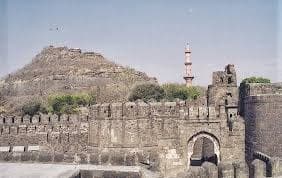
Daulatabad Fort is the city's main attraction and one of India's most impressive fortresses. It comprises three fortified zones: Balakot, at the summit; Kataka, in an intermediate position; and Ambarkot, on the periphery. The Yadavas shaped the rocky slopes into sheer cliffs, reinforced by a deep water-filled moat.
Notable monuments within the fortress include the Chini Mahal, a palace adorned with blue and white tiles, later converted into a prison by the Mughals. The fort also houses another palace built under Shah Jahan, hammams and mosques, and massive ramparts erected by Malik Ambar. The ingenious defensive design of this place, its system of concentric walls, and its exceptional panoramas will captivate you.
Chand Minar
Rising to nearly 30 metres, Chand Minar is India's second-highest minaret, after Qutb Minar in Delhi. It was erected in 1435 by Ala-ud-din Bahmani to celebrate his conquest of Daulatabad. With its four storeys, 24 chambers, and adjoining small mosque, this tower combined religious function with military surveillance roles. It remains one of the fort's emblematic monuments and a striking testament to Indo-Islamic architecture in the Deccan.
Bharat Mata Mandir
The Bharat Mata Mandir is a temple dedicated to the goddess "Mother India," the symbolic incarnation of the nation. Located within Daulatabad Fort, it occupies the former Jami Masjid mosque. This sanctuary is today a place of devotion and patriotic pride. It stands near the Chand Minar and a stepped well.
Bibi Ka Maqbara
Surnamed the "Taj Mahal of the Deccan," Bibi Ka Maqbara is a mausoleum built in the 17th century by Azam Shah in memory of his mother, Rabia-Durrani, wife of Aurangzeb. With its charbagh gardens, slender minarets, and Persian architecture, it echoes the Taj Mahal while asserting its own identity. White marble and stucco blend to create a refined composition, offering a majestic setting for visitors.
Ajanta Caves
The famous Ajanta Caves comprise 29 Buddhist sanctuaries carved into rock between the 2nd century BCE and the 6th century. They shelter frescoes, sculptures, and statues depicting the life of Buddha and the Bodhisattvas. It is one of India's richest artistic ensembles.
Panchakki
Panchakki is an ancient water mill dating from the 17th century. Water channelled from an upstream source powered the millstones that ground grain for pilgrims and soldiers. It stands as impressive testimony to the technical ingenuity of its era. The site is part of a religious complex dedicated to the Sufi saint Baba Shah Musafir, which includes a mosque, a madrasa, and peaceful gardens.
Pitalkhora
The Pitalkhora Caves, over 2,000 years old, also merit a visit. They rank among Maharashtra's oldest Buddhist excavations. Within them are 14 sanctuaries, including viharas and chaityas, adorned with sculptures of elephants, icons, and an ingenious rainwater collection system. Though some sections are damaged, these caves represent an important stage in the evolution of Indian rock-cut architecture.
Grishneshwar Temple
The Grishneshwar Temple, located near Ellora Caves, is one of the twelve Jyotirlinga of Shiva, a major Hindu pilgrimage site. Destroyed and rebuilt multiple times between the 13th and 18th centuries, it was restored to its current form in 1729 thanks to Queen Ahilyabai Holkar. The shrine continues to draw crowds of devotees and impresses with its intricately carved stone architecture.
Practical Information
Daulatabad is easily accessible from Aurangabad (20 km away). Buses and taxis regularly connect the two cities, making a visit straightforward to organize. The small Daulatabad railway station sits on the Manmad-Purna line, but Aurangabad remains the primary access point thanks to its rail connections and trains such as the Devagiri Express from Mumbai or Hyderabad.
When to Visit?
The best time to visit Daulatabad extends from October to March, when temperatures are mild and pleasant. Summer brings intense heat, while monsoon rains make visits less comfortable.
Want to discover this destination?
Our local advisors design your tailor-made trip.