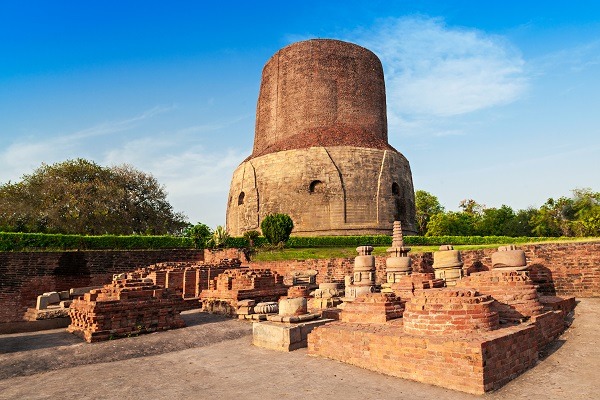
Uperkot Fort
Perched on a rocky plateau in the heart of Junagadh, Uperkot Fort encompasses over 2,000 years of history: Mauryan ramparts, Buddhist caves, vertiginous step wells and sultanate mosques coexist on a single site.
Perched on a rocky plateau in the heart of Junagadh, Uperkot Fort is one of the best-preserved citadels in Gujarat. Founded, according to tradition, in the Mauryan era, it was occupied almost without interruption for more than two millennia. Its cyclopean ramparts, medieval mosques, step wells and Buddhist caves carved into the rock make it a rare concentration of history in western India.
Practical information at a glance
- Admission: paid (differentiated rates for Indian residents and foreign visitors)
- Recommended duration: 2 to 3 hours to explore the entire site
- Access: on foot from central Junagadh, or by rickshaw from the bus or railway station
- Dress code: modest attire recommended; closed shoes advised for well and cave staircases
- Accessibility: limited — numerous staircases and uneven terrain
What to see
The site comprises several distinct ensembles. Stone ramparts, several metres high, encircle a plateau where structures from very different periods coexist. Two medieval mosques — the Jama Masjid and the Rani ki Vav — testify to the sultanate period. The two-tiered Buddhist caves, carved between the 2nd and 4th centuries, preserve carved pillars and monastic cells.
History and context
The fort's foundation is attributed to the Mauryan empire (4th–3rd century BCE), then it was enlarged under the Kshatrapas, the Guptas, the sultans of Gujarat and finally the Mughals. Its elevated position meant it was besieged several times without ever being taken by force. The British used it as a garrison before independence. This stratification of civilisations explains the site's architectural diversity.
Highlights of the visit
The step wells (vav)
The fort is home to two remarkable step wells: the Adi Chadi Vav and the Navghan Kuvo. The latter, excavated to a depth of more than 50 metres, features a helical staircase carved into the rock. The descent is striking and the natural coolness contrasts with the heat of the plateau.
The Buddhist caves
Two levels of caves are accessible via an external staircase. The octagonal pillars and carved capitals recall the architecture of Ajanta on a smaller scale. The place is lightly visited on weekdays, allowing for a peaceful visit.
The cannons and ramparts
Several ancient cannons are displayed on the ramparts, including the famous Nilam cannon, several metres long, cast in the 15th century. A walk along the walls offers clear views over the city of Junagadh and, on clear days, of Mount Girnar.
The Jama Masjid
Built from materials of earlier Hindu temples, the mosque features reused columns with carved capitals. This involuntary architectural syncretism is characteristic of Gujarati sultanate construction.
Etiquette and visiting rules
- Remove your shoes before entering prayer spaces in the mosque.
- Avoid short or transparent clothing in religious areas.
- Do not touch the sculptures in the Buddhist caves.
- Stay on marked paths near the step wells — steps can be slippery.
Photography tips
Morning light is ideal for photographing the east-facing ramparts and Buddhist caves, whose entrance faces the rising sun. For the step wells, a wide-angle lens best captures the depth. The cannons on the ramparts photograph well in late afternoon with Girnar as a backdrop. Photography is permitted throughout the site.
Location and access
The fort is located in the old part of Junagadh, a few hundred metres from the main bazaar. Junagadh railway station is about 2 km away. Rickshaws serve the main entrance. The site is near the Mahabat Maqbara mausoleum and the Junagadh museum, accessible on foot or by rickshaw. Accessibility is challenging due to elevation changes and staircases.
Nearby attractions
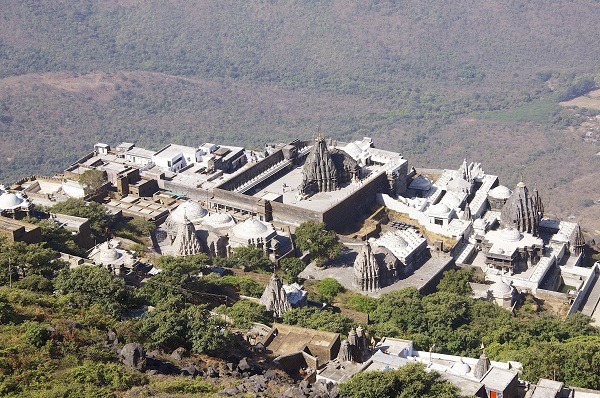
- Mount Girnar — Jain and Hindu pilgrimage site dominating Junagadh, with 12th-century temples at the summit.
- Mahabat Maqbara Mausoleum — neo-Gothic and Indo-Islamic tomb of the Junagadh nawabs, with strikingly hybrid architecture.
- Gir National Park — the last refuge of the Asian lion, about 60 km from Junagadh.
- Ashoka Rock Edicts — 3rd-century BCE Mauryan inscriptions carved on a rock at the base of Mount Girnar.
Interested in this visit?
We can include it in your personalised itinerary.