Thiruvalluvar Statue
Thiruvalluvar Statue
Standing 41 meters high on a rocky islet, the Thiruvalluvar Statue dominates the southern tip of India where three seas converge. A powerful symbol of Tamil culture, accessible by ferry from Kanyakumari.
Rising from a rocky islet at the southern tip of India, the Thiruvalluvar Statue overlooks the confluence of the Indian Ocean, the Arabian Sea, and the Bay of Bengal. Standing 41 meters tall (including its base), it represents the Tamil poet-philosopher who authored the Tirukkural, a collection of wisdom composed over two thousand years ago. Visible from the Kanyakumari shoreline, it stands as an inseparable part of the cultural and spiritual pilgrimage that visiting the cape represents.
Quick reference information
- Access: ferry from Kanyakumari's main landing—round-trip ticket available for purchase on-site.
- What's included: the ferry also serves the Vivekananda Memorial on the neighboring islet; a combined ticket is typically available.
- Recommended duration: 1 to 2 hours for both islets combined.
- Dress code: neat attire is recommended; no strict dress code is imposed at the statue itself.
- Closures: ferries do not operate in poor weather or rough sea conditions.
What you'll see
The statue depicts Thiruvalluvar standing upright, clad in a dhoti, holding a stylus—the emblem of the poet-sage. Its total height of 41 meters symbolizes the 41 chapters dedicated to virtue in the Tirukkural; the 38-meter base represents the 38 chapters devoted to wealth and love. The gray granite sculpture contrasts beautifully against the blue waters that surround it on all sides.
History and context
Thiruvalluvar authored the Tirukkural, a foundational text of Tamil literature likely composed between the 2nd century BCE and the 5th century CE. The statue was inaugurated on January 1, 2000, as a project championed by the Tamil Nadu government. Its design is attributed to sculptor V. Ganapati Sthapati, a major figure in traditional Tamil architecture and sculpture.
Highlights of the visit
The ferry crossing
A few minutes of crossing are all it takes, yet they offer an unobstructed view of the three bodies of water meeting. On clear days, the Kanyakumari coastline and the Amman Temple are visible from the boat's deck.
The panorama from the base
Interior staircases allow you to ascend into the base. The 360° panorama embraces the maritime horizon, the nearby Vivekananda Memorial, and on clear days, the Western Ghats hills to the north.
Light at sunrise and sunset
Kanyakumari is renowned for its sea sunrises. The statue, facing east, captures the golden morning light in a particularly striking way when viewed from the shore.
Photography tips
From the shore, a telephoto lens lets you frame the statue with the Vivekananda Memorial in the background. On the islet itself, the best views of the entire statue are obtained from water level, just after landing. Sunrise offers warm, raking light; midday light is harsh and backlighting is challenging. A telephoto lens from shore allows you to capture the statue with the Vivekananda Memorial in the background.
Location and access
The islet lies a few hundred meters off the Kanyakumari shore, at the extreme southern tip of Tamil Nadu. The landing is situated near the Kumari Amman Temple. Kanyakumari is accessible by train from Chennai, Madurai, or Trivandrum; the station is within walking distance of the waterfront. Buses also connect the town to major cities in Tamil Nadu and Kerala.
In the vicinity
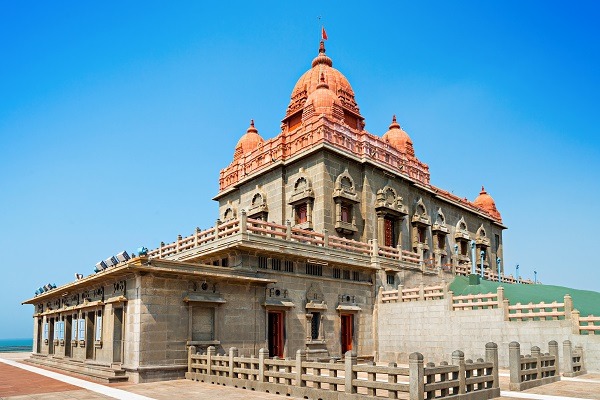
- Vivekananda Memorial — on the neighboring islet, this memorial marks the rock where Swami Vivekananda meditated in 1892 before his journey to the West.
- Kumari Amman Temple — a coastal temple dedicated to the virgin goddess, one of the cape's most visited pilgrimage sites.
- Gandhi Memorial — a structure designed so that sunlight illuminates the urn containing the Mahatma's ashes on the anniversary of his birth.
- Sunset Viewpoint — a scenic overlook on the waterfront, ideal for watching the sun descend over the Arabian Sea.
Frequently asked questions
A paid ferry departs from Kanyakumari's main landing, near the Kumari Amman Temple. The crossing takes a few minutes. Tickets are purchased on-site; a combined ticket with the Vivekananda Memorial is typically available.
Yes, interior staircases allow access to the base, where you can enjoy a 360° panorama of the three seas and the coastline.
The dry season, from October to February, offers the best conditions: calm seas, regular ferry service, and clear skies for photography. During the monsoon (June–September), ferries may be suspended due to rough waves.
No strict dress code is imposed at the statue itself. Neat, covered attire is recommended, especially if you plan to visit the adjacent Kumari Amman Temple, which requires shoulders and knees to be covered.
Yes, both sites are on adjacent islets and served by the same ferry. Allow 1 to 2 hours to comfortably visit both.
Yes, at 41 meters tall it is clearly visible from the Kanyakumari waterfront, particularly from the sunset viewpoint and the temple grounds.
Photos
Interested in this visit?
We can include it in your personalised itinerary.