Pinjore Gardens
Pinjore Gardens
Seven Mughal terraces from the 17th century at the foot of the Himalayas: pavilions, pools and festivals 22 km from Chandigarh, on the road from Ambala to Shimla.
At the foot of the Himalayan foothills, in the Indian state of Haryana, the Pinjore Gardens — also known as the Yadavindra Gardens — unfold seven Mughal terraces across the natural slope of Panchkula district. Designed in the 17th century as an imperial summer residence, they combine pavilions, pools and orchards some twenty kilometres from Chandigarh, on the route linking Ambala to Shimla.
Why visit Pinjore Gardens
The site offers a well-preserved example of Mughal terrace garden design (charbagh adapted to the slope), with a clear reading of the original composition. It is also a useful cultural stop from Chandigarh: a complex restored in the 20th century, several identified pavilions, an on-site museum and three annual festivals (spring, mangoes, heritage). The moderate altitude of the Himalayan foothills makes a visit pleasant outside the monsoon season.
History
The gardens were built in the 17th century under the reign of Mughal emperor Aurangzeb. They were designed by Nawab Fidai Khan Koka, Aurangzeb's foster brother and architect of the Badshahi Mosque in Lahore. Conceived as a summer residence, they offered the court the coolness of the foothills.
A legend recounted by British author C.M. Villiers-Stuart tells how local Brahmans, hostile to the Mughal settlement, convinced Fidai Khan's wives that the water at Pinjore caused goitre. Frightened, they begged to leave the place, and the site was gradually abandoned.
In the 18th century, the maharaja Amar Singh of Patiala bought the gardens from the king of Sirmur. Under British rule, they were converted into a rose garden for the production of attar, a fragrance made from roses. In the 20th century, maharaja Yadavindra Singh undertook a complete restoration: the gardens now bear his name.
What to see
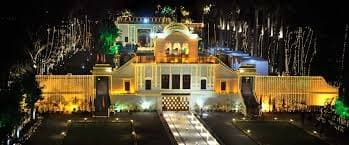
The structure of seven terraces is explored by descending from the monumental gateway. Each level features a pavilion, a pool or a parterre.
The pavilions
- Shish Mahal (Palace of Mirrors), on the first terrace, blending Rajasthani and Mughal styles.
- Hawa Mahal (Palace of Air), designed to capture the breeze during the hot season.
- Rang Mahal (Palace of Colours), on the second terrace, whose arcades open onto the parterres.
- Jal Mahal (Palace of Water), surrounded by pools and water jets.
Orchards and theatre
The intermediate levels host orchards and rows of cypress trees. The lower terraces, more serene, house an open-air theatre. An on-site museum traces the history of Pinjore and the nearby Bhima Devi temple.
The festivals
- Pinjore Baisakhi Festival (April): Haryana's spring festival, two days of music, folk dances, crafts and regional gastronomy.
- Pinjore Mango Festival (July): created in 1992, it brings together more than 4,000 varieties of mangoes and derived products. Competitions, artisan village and concerts animate the event, which has been open to international participants since 2018.
- Pinjore Heritage Festival (December): a winter edition dedicated to dances, classical music, artisan exhibitions and culinary demonstrations from Haryana.
When to visit
The most comfortable period extends from October to March: cool temperatures, clear skies, well-maintained vegetation. The months from April to June are warm but coincide with the Baisakhi Festival and then the Mango Festival; plan an early morning visit. The monsoon (July-September) greatly greens the terraces but can disrupt travel from Chandigarh. December coincides with the Heritage Festival, which is interesting for its cultural focus.
Practical information
- Visit duration: allow 1.5 to 2.5 hours to explore the seven terraces at a leisurely pace, longer if you include the museum and festivals.
- Tickets: paid entry at moderate rates, possible surcharge for cameras. Rates and evening opening hours may vary; check current information before your visit.
- What to bring: comfortable shoes (sloped terrain), water, hat in warm season.
- Accessibility: the natural slope and stairs between terraces limit access for people with reduced mobility.
How to get there
The gardens are located approximately 22 km from Chandigarh, on the Ambala-Shimla road, in Panchkula district. From Chandigarh, allow about three-quarters of an hour by taxi or bus, depending on traffic. Kalka railway station, the terminus of the main railway line and the departure point of the famous narrow-gauge train to Shimla, is located 5 km from the site.
Nearby
- Chandigarh: capital designed by Le Corbusier, ideal logistical base for visiting Pinjore.
- Kalka: departure station for the Kalka-Shimla Railway, a UNESCO World Heritage site.
- Bhima Devi Temple: ruins adjacent to the gardens, presented in the on-site museum.
- Shimla: former British summer capital, accessible via the historic railway from Kalka.
Frequently asked questions
Frequently asked questions
Allow 1.5 to 2.5 hours to explore the seven terraces, pavilions and on-site museum. A half-day is recommended if your visit coincides with a festival.
The site is located approximately 22 km from Chandigarh on the Ambala-Shimla road. Taxis and buses provide connections. Kalka railway station, 5 km away, offers an alternative by train.
The dry season, from October to March, offers the most pleasant conditions. For the Mango Festival, plan a visit in July; for the Heritage Festival, in December.
Continue your journey
Pinjore Gardens fit naturally into an itinerary combining Chandigarh, Kalka and the Himalayan foothills. To plan the next leg of your trip, explore our trips to India.
Interested in this visit?
We can include it in your personalised itinerary.