The ancient Ekambareswarar Hindu temple
The ancient Ekambareswarar Hindu temple
Dedicated to Shiva as the earth element, the Ekambareswarar temple in Kanchipuram spans 16 hectares of sanctuaries, a 53 m Raja Gopuram and a rich ritual calendar.
The Ekambareswarar temple, sanctuary of the earth in Kanchipuram
The Ekambareswarar temple, also called Ekambaranathar, is a major Hindu sanctuary dedicated to Shiva, located in Kanchipuram, in the state of Tamil Nadu. It belongs to the group of five temples associated with primordial elements and represents "Prithvi", the earth element. This singular quality makes it one of the major sites of Shaivism in South India, visited year-round by pilgrims.
Why visit the Ekambareswarar temple
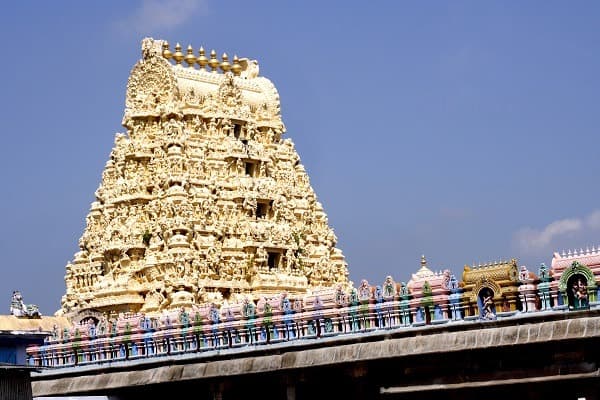
The complex spans 16 hectares, dominated by a Raja Gopuram (entrance tower) of 53 meters in height visible from the city entrance. Beyond its dimensions, the site stands out for the richness of its iconography, its anchoring in Shaivite mythology (the legend of Tazhuvakkuzhainthaar) and the continuity of its six daily worship services. For those interested in Dravidian architecture and living traditions in Tamil Nadu, the temple offers a complete panorama in a single visit.
History of the temple
The temple was renovated and enlarged by several successive dynasties: first the Pallavas, then the Cholas, and finally Krishna Deva Raya, ruler of the Vijayanagar dynasty, who undertook major works between 1509 and 1529. This layering explains the diversity of styles visible today within the enclosure.
The legend of Parvati and the mango tree
According to tradition, the goddess Parvati worshipped a Lingam of Shiva beneath a sacred mango tree. During her penance, the nearby Vegavati river overflowed and threatened to submerge the stone. To protect it, Parvati embraced the Lingam with her arms. Moved by this gesture, Shiva decided to marry her. In Tamil, this act is designated by the word "Tazhuvakkuzhainthaar". The mango tree that is said to have sheltered the scene remains part of the venerated elements within the complex.
What to see on site
The enclosure groups several distinct ensembles that can be explored in a logical order:
- The Raja Gopuram of 53 m, which serves as the main entrance and is one of the tallest in Tamil Nadu.
- The pillared hall, a vast covered space where sculptures and capitals illustrate the craftsmanship of successive builders.
- The main sanctuary dedicated to Shiva, the ritual heart of the temple, as well as a sanctuary dedicated to Vishnu, rare in a Shaivite temple.
- Two sacred reservoirs, the Kampa Nadi and the Shivaganga, used for ritual ablutions.
- Statues of the 63 Nayanmars, saint poets of Tamil Shaivism, and a collection of vahanams (ritual mounts) in silver and gold plating, brought out during processions.
The six worship services
Each day, the temple observes six successive pujas: Ushad Kalam, Kaalasanthi, UchiKaalam, Pradosham, Sayaratchai and Ardhajamam. Attending one of these ceremonies, particularly those in the morning or evening, allows you to observe the rituals in their living context.
When to go
The temple can be visited year-round, but the ritual calendar brings relief to certain periods. The main annual festivals are:
- Ani Tirumanjanam (June-July)
- Adi Kritikai (July-August)
- Avani Moolam (August-September)
- Navarati (September-October)
- Kartikai Deepam (November-December)
- Thai Poosam (January-February)
- Panguni Uthiram (March-April)
- Chitra Pournami (April-May)
- Vaikashi Vishakam (May-June)
The Panguni Uthiram, which lasts 13 days, is arguably the most striking moment: it commemorates the wedding of Shiva and Parvati and attracts thousands of devotees. If you're looking for a quieter time, choose ordinary days outside festivals, avoiding major Hindu calendar celebrations where crowds become very dense.
Practical information
The temple is open daily, with a break at midday like most major sanctuaries in Tamil Nadu: plan your visit for early morning or late afternoon to coincide with the pujas. Temple admission is generally free, but fees may apply for photography or access to certain inner sanctuaries: inquire upon arrival.
Allow 1h30 to 2h30 to explore the complex without rushing. Dress should be appropriate (shoulders and knees covered) and shoes are left at the entrance. As in most active temples in South India, access to the innermost sanctuary may be reserved for Hindus.
How to get there
Kanchipuram is well connected to major cities in Tamil Nadu and neighbouring states:
- By air: Chennai international airport is about 75 km away. From there, buses and taxis provide connections to Kanchipuram.
- By train: the city is served by the South Indian railway network. From the station, taxis or rickshaws allow you to reach the temple in a few minutes.
- By bus or car: regular service connects Chennai to Kanchipuram, and roads are in good condition from major cities in the region.
What to see nearby
Kanchipuram is one of the seven sacred cities of India and has other major sanctuaries (Kailasanathar, Varadharaja Perumal, Kamakshi Amman) that combine easily with a visit to Ekambareswarar. To extend an itinerary in India, you might also consider other cultural sites such as the Alchi monastery in Ladakh, the State Museum of Bhopal or Anjengo Fort in Kerala.
Frequently asked questions
Frequently asked questions
The temple is dedicated to Shiva, venerated here as the earth element (Prithvi). It belongs to the group of five temples associated with primordial elements in the Tamil Shaivite tradition.
Allow approximately 1h30 to 2h30 to explore the 16-hectare complex, observe the sanctuaries, the pillared hall and the two reservoirs. Plan for more time if you wish to attend a puja.
The most striking period is the Panguni Uthiram festival (March-April), which lasts 13 days and commemorates the wedding of Shiva and Parvati. For a quieter visit, choose an ordinary day outside major Hindu celebrations.
Temple admission is generally free, but fees may apply for photography or access to certain sanctuaries. It's best to inquire on site on the day of your visit.
Kanchipuram is about 75 km from Chennai international airport. Public buses, taxis and trains provide connections several times a day.
Prepare your trip
The Ekambareswarar temple naturally fits into a circuit dedicated to Tamil Nadu temples and Dravidian heritage. To build a complete itinerary, explore our trips to India and adapt the Kanchipuram stop to your interests.
Interested in this visit?
We can include it in your personalised itinerary.