Meenakshi Amman Temple
Meenakshi Amman Temple
In the heart of Madurai, Meenakshi Amman temple impresses with its fourteen gopurams adorned with polychrome sculptures and its sacred tank. A vibrant, active and monumental Hindu complex.
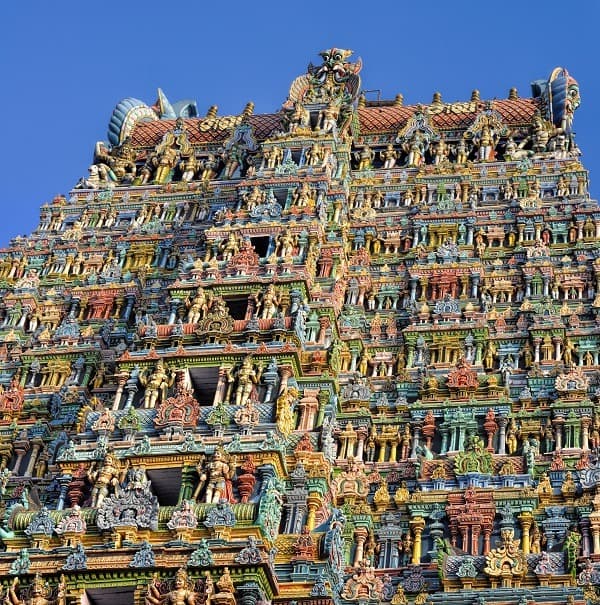
In the heart of Madurai, Meenakshi Amman temple stands as one of South India's great Hindu complexes. Dedicated to the goddess Meenakshi—a local form of Parvati—and her consort Shiva, known here as Sundareswarar, it has structured the city's life for centuries. Its fourteen gopurams, adorned with polychrome sculptures, dominate the skyline and draw thousands of pilgrims and visitors daily.
Essential Information at a Glance
- Entry: temple access is free for devotees; certain interior areas (museum, hall of a thousand pillars) require a fee.
- Access: central Madurai, a few minutes' walk from the main bus station and reachable by rickshaw from the railway station.
- Dress code: shoulders and legs must be covered; a dhoti can be rented on-site for men in shorts.
- Footwear: must be removed before entering; shoe storage available at the entrance.
- Non-Hindus: welcome throughout most of the complex; the inner sanctum (garbhagriha) is reserved for Hindus.
- Recommended duration: 1.5 to 2 hours for a complete visit.
- Crowds: quieter early in the morning; very busy in the evening during ceremonies.
What to See
The complex spans approximately 15 acres. Its fourteen gopurams (gateway towers) reach up to 171 feet at their highest. Each tower is covered with thousands of stucco sculptures painted in bright colours, depicting gods, demons and mythological scenes. Inside, the Hall of a Thousand Pillars (actually 985 columns) now houses a sculpture museum. The sacred tank Porthamarai Kulam, surrounded by gilded colonnades, occupies the heart of the complex.
History and Context
The site is mentioned in ancient Tamil texts dating back more than two thousand years. The current temple was largely rebuilt and expanded under the Nayak kings of Madurai in the sixteenth and seventeenth centuries. The goddess Meenakshi—meaning "fish-eyed"—is Madurai's tutelary deity; her mythical marriage to Shiva is celebrated annually during the Chithirai festival, one of Tamil Nadu's largest religious gatherings.
Highlights of Your Visit
The Gopurams and Their Sculptures
Each gateway tower is an inventory of Hindu mythology rendered in coloured stucco. The sculptures are repainted every twelve years during a ritual ceremony. Close observation reveals complex narrative scenes: cosmic battles, divine processions, mythical creatures.
The Porthamarai Kulam Tank
This rectangular tank bordered by colonnades is used for ritual ablutions. A gilded mandapa at its centre catches the light in late afternoon. The atmosphere here is more serene than in the interior galleries.
The Hall of a Thousand Pillars
This hypostyle hall from the twelfth century ranks among Dravidian architecture's major achievements. Each pillar is uniquely carved. The museum installed here brings together bronzes and stone sculptures from the site.
Evening Ceremonies
Each evening, a procession carries Shiva's image to Meenakshi's sanctuary to the accompaniment of ritual music. Witnessing this aarti ceremony offers insight into the temple as a living place of worship, not merely a monument.
Etiquette and Visiting Rules
- Cover shoulders and knees; inappropriately light clothing will be turned away at entry.
- Remove your footwear before crossing the threshold; paid shoe storage is available.
- The main sanctuary is reserved for Hindus; respect ropes and prohibition signs.
- Avoid turning your back to altars during ceremonies.
- Photography is prohibited in certain interior areas; check signs on-site.
- Speak quietly in areas of active worship.
Photography Tips
Golden morning light illuminates the southern and eastern gopurams without backlighting. In the evening, the towers are artificially lit—effective but less nuanced. For detailed sculptures, a macro lens or short telephoto works well. The interior of the Hall of a Thousand Pillars is dim: a camera with strong low-light performance is useful. Always check prohibition signs before photographing.
Location and Access
The temple stands at Madurai's geographic centre, a few hundred metres from Madurai railway station. Rickshaws and taxis are available continuously. The city is connected by rail to Chennai, Coimbatore and Trichy. Madurai airport serves several Indian cities. The complex is walkable from most central hotels. Accessibility for people with mobility challenges is limited due to thresholds and the gopurams' steps.
Nearby Attractions
- Thirumalai Nayak Palace — a few minutes' walk away, this seventeenth-century palace blends Dravidian and Italian architecture.
- Gandhi Memorial Museum — museum dedicated to India's independence movement, housed in a former palace.
- Madurai Central Markets — surrounding the temple, the lanes offer ritual flowers, silks and spices.
Photos
Interested in this visit?
We can include it in your personalised itinerary.