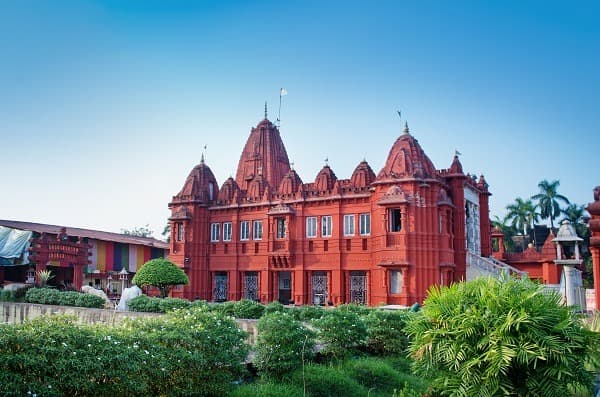
Shree Digambar Jain Mandir (Pareshnath Temple)
Shree Digambar Jain Mandir (Pareshnath Temple)
In the Belgachia neighborhood, the Pareshnath Jain temple astounds with interiors entirely covered in colorful mirrors and meticulously maintained gardens. A 19th-century place of worship, funded by Kolkata's Jain merchant community.
In the heart of Belgachia, north Kolkata, the Shree Digambar Jain Mandir — often called the Pareshnath Temple — ranks among the city's most lavishly adorned places of worship. Dedicated to the tenth tirthankara Sheetalnathji according to some sources, it strikes visitors with its profusion of mirrors, mosaics, and surrounding gardens. Construction dates to the 19th century, funded by the Jain merchant community that thrived in Bengal at the time.
Practical Information at a Glance
- Entry: free for visitors
- Dress code: covered clothing required; shoes must be removed before entering sanctuaries
- Recommended duration: 45 minutes to 1.5 hours depending on interest in the gardens
- Access: Metro Line 1, Shyambazar or Belgachia station, then rickshaw or walking
What to See
The complex comprises several distinct sanctuaries, each dedicated to a different tirthankara. The interiors are entirely covered with colorful mirrors, Belgian faience tiles, and stained glass—a distinctive style of 19th-century Jain temples funded by prosperous merchants. Landscaped gardens with pools and statues offer a striking contrast to the bustling energy of north Kolkata.
History and Context
The Digambara Jain community settled in Kolkata in the 18th century, drawn by trade under the East India Company. The main temple was constructed in 1867. Jain merchants, often jewelers or bankers, invested substantially in richly decorated places of worship as expressions of faith and social standing. The site was enlarged and restored multiple times throughout the 20th century.
Highlights of Your Visit
Mirror-Mosaic Interiors
The walls and ceilings of the sanctuaries are covered with thousands of mirror shards and colored glass. Natural light multiplies within them, creating a striking visual effect. Each panel depicts scenes from Jain cosmology or floral motifs.
Gardens and Pools
The complex spans several parcels of carefully tended gardens, with paths lined by statues of meditating tirthankaras. Pools with water lilies bring an atmosphere of contemplation rare in this dense quarter of the city.
Sanctuary Diversity
Several small temples succeed one another within the grounds, each with its own decorative style. Some display marked European influence in imported tiles, while others remain closer to Mughal aesthetics.
Etiquette and Visiting Rules
- Remove your shoes before entering each sanctuary.
- Dress conservatively: shoulders and knees covered for everyone.
- Avoid bringing leather items (belts, bags) into the sanctuaries—Jain tradition discourages this.
- Speak in low voices; some areas are reserved for prayer.
- Photography is generally tolerated in the gardens; check with caretakers before photographing inside the sanctuaries.
Photography Tips
Morning light, between 8 and 10 a.m., is ideal for photographing facades without backlighting. Inside, mirrors create complex reflections: a wide-angle lens and high ISO sensitivity yield better results than flash. The gardens are photogenic year-round, but especially striking during Jain festivals when luminous garlands decorate the pathways.
Location and Access
The temple sits in the Belgachia neighborhood, north Kolkata, a few kilometers from the historic center near Marble Palace and the Shyambazar area. The Belgachia Metro station (Line 1) is closest. Rickshaws and taxis are available from the station. The site is accessible on foot from the main street, but the entrance can be hard to spot: look for the ornate gateway on Badridas Temple Street.
Nearby Attractions
- Marble Palace — a 19th-century neoclassical mansion a few minutes by rickshaw, home to a remarkable collection of art and sculpture.
- College Street — the city's bookseller hub and literary café district, intellectual heart of Kolkata.
- Kumartuli — neighborhood of idol-carving artisans nearby, where Durga statues for major festivals are crafted.
Frequently asked questions
The temple comes alive during Jain festivals such as Paryushana (August-September) and Mahavir Jayanti (March-April). Outside these times, visits are quieter. Avoid peak summer heat (April-June).
Yes, the temple welcomes all visitors regardless of religion, provided they respect the dress code and behavioral guidelines.
Plan for 45 minutes to 1.5 hours to explore all the sanctuaries and gardens at your own pace.
Gardens and exterior facades are generally open to photographers. For sanctuary interiors, seek permission from the caretakers on site, as rules may vary.
The temple pairs naturally with Marble Palace and the Kumartuli neighborhood, all reachable by rickshaw from Belgachia. Half a day suffices for all three sites.
Photos
Interested in this visit?
We can include it in your personalised itinerary.