Sankar Gompa
Sankar Gompa
Gelugpa monastery 3 km from Leh, official residence of Kushok Bakula Rinpoché. Dukhang adorned with mandalas and annual festival in October-November.
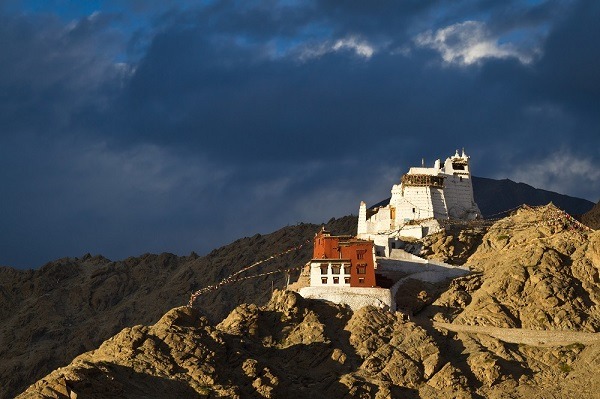
Three kilometers north of Leh, the Sankar monastery rises amid barley fields and poplar groves in the valley. This gompa of the Gelugpa lineage, more modest than its perched neighbors, serves as the official residence of Kushok Bakula, one of Ladakh's major spiritual figures. Its proximity to Leh makes it one of the most accessible monasteries to reach on foot from the center.
Why visit Sankar Gompa
Sankar offers a striking contrast with Ladakh's great monastic fortresses such as Hemis or Thiksey. More understated, more intimate, it can be visited in an hour and offers glimpses into the daily life of a small Gelugpa monastic community. Three compelling reasons to stop by:
- Its role as the official residence of Kushok Bakula Rinpoché, leading figure of the Gelugpa order in Ladakh.
- Its Dukhang adorned with murals of mandalas and a well-preserved Tibetan calendar.
- Its accessibility from Leh on foot or by rickshaw, ideal for a half-day acclimatization to the altitude.
History
Sankar Gompa is an auxiliary monastery of Spituk monastery, located slightly further south in the Indus valley. According to local tradition, the site was originally founded by the Red Hat institution (the ancient schools of Tibetan Buddhism), before being taken over by the Yellow Hat sect—that is, the Gelugpa—in the 15th century, during the era of this reformist order's expansion throughout the western Himalayas.
Today, the monastery's residents belong to the Gelugpa order and are considered spiritual incarnations linked to the lineage of Kushok Bakula Rinpoché, a major figure in 20th-century Ladakhi Buddhism, who was also a diplomat and founder of several monastic institutions.
What to see on site
The complex presents itself as a cluster of two-story buildings surrounded by trees, marked from a distance by prayer flags. The architecture remains understated, lacking the spectacular verticality of Thiksey, but it well illustrates the contemporary Ladakhi monastic style.
The Dukhang
The assembly hall, or Dukhang, is the heart of the monastery. It is accessed via a double-door entrance. To the right of the entrance, three green drums are placed against the wall. To the left, a passage leads to a representation of the Wheel of Life (Bhavachakra) held by Yama, the lord of death—a classic iconography in Tibetan monasteries that illustrates the six realms of existence and the cycle of rebirth.
Murals and Tibetan calendar
The walls are covered with paintings of mandalas and representations of the Tibetan calendar, useful for understanding Buddhist cosmology and astrological systems. The works are not ancient, but they faithfully follow traditional iconographic canons.
Library and guest rooms
The monastery also houses a library containing religious texts as well as a few guest rooms for pilgrims and visitors.
Practical information
- Duration of visit: plan for 45 minutes to 1 hour.
- Fee: symbolic entry fee (a few rupees), to be paid on-site in cash.
- Hours: open during the day; the Dukhang doors may be closed outside prayer times—ask a monk to open them for you.
- Dress code: shoulders and knees covered, remove shoes at the entrance to halls, no photography inside without permission.
When to visit
The peak season for visiting Ladakh runs from June to September, when roads are passable and the climate is mild. Sankar remains accessible year-round since it lies in the Leh valley, but winter (November to March) brings very low temperatures.
The highlight is the monastery's annual festival, held between October and November. Monks perform masked dances (cham) and ritual ceremonies. Verify exact dates with local sources: they vary according to the Tibetan lunar calendar.
How to get there
Sankar Gompa is located approximately 3 km north of Leh's center. Several options are available:
- On foot: 30 to 45 minutes from Leh's bazaar, a pleasant way to gradually acclimatize to the altitude (3,500 m).
- By taxi or rickshaw: a short journey from the center.
To reach Leh itself:
- By air: daily flights from Delhi and connections from Srinagar to Kushok Bakula Rimpochee airport.
- By bus from Manali: approximately 453 km, road open only from June to September depending on snow at the passes. Check road conditions before departing.
- By train: the nearest railway station is Jammu, about 734 km away, to be completed by bus or shared taxi.
What to see nearby
- Leh: the bazaar, royal palace, and Shanti Stupa, to be explored on foot.
- Spituk monastery, of which Sankar is the auxiliary, located about ten kilometers away.
- The Beas River, on the road between Manali and Leh, for travelers arriving by land.
Frequently asked questions
Frequently asked questions
Plan your trip
Sankar Gompa fits naturally into a Ladakh itinerary, whether you arrive via the legendary Manali road or by plane from Delhi. To build a tailor-made journey including monasteries in the Indus valley, explore our India travel experiences.
Interested in this visit?
We can include it in your personalised itinerary.