Salim Singh Ki Haveli
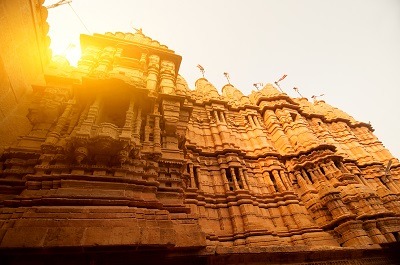
An 18th-century merchant's residence in the heart of Jaisalmer, Salim Singh Ki Haveli impresses with its finely carved yellow sandstone façade and corbelled upper storey, a hallmark of Rajasthani architecture.
At the heart of Jaisalmer, Salim Singh Ki Haveli is one of the grand merchant mansions (havelis) of the golden city. Built in the 18th century, it stands out for its intricately carved yellow sandstone façade and distinctive corbelled upper storey. It bears witness to the economic and political power of the great families who controlled the caravan routes of Rajasthan.
Practical information at a glance
- Admission : paid entry (rates to be confirmed on-site)
- Recommended duration : 30 to 45 minutes
- Access : on foot from Jaisalmer Fort, in the town centre
- Dress code : no special requirements (non-religious site)
What to see
The haveli comprises several storeys, with the uppermost one projecting outward and adorned with beautifully carved semicircular balconies and latticed screens. The exterior façades concentrate most of the decoration: floral friezes, geometric patterns and figures carved from local sandstone. The interior, partially inhabited by descendants of the original family, is only partially accessible to visitors.
History and context
The haveli takes its name from Salim Singh, Chief Minister (diwan) of Jaisalmer in the early 19th century, renowned for his absolute authority over the city. The residence is believed to have been originally constructed in the 18th century, then enlarged during his reign. According to local tradition, Salim Singh wished to connect his rooftop to that of the adjoining royal palace—a project the maharaja refused. The peacock-shaped upper storey is the most celebrated architectural feature.
Highlights of your visit
The carved façade
The exterior face showcases the most spectacular craftsmanship: each panel of yellow sandstone is carved with different motifs. Late afternoon light brings out the reliefs with remarkable clarity.
The corbelled storey
The topmost level projects over the street in a distinctive curved form. Its balconies, screened with carved stone lattice, allowed the women of the household to observe the street without being seen—a typical feature of Rajasthani architecture.
Views of the neighbourhood
From the accessible upper levels, you can glimpse the winding lanes of old Jaisalmer and, on clear days, the silhouette of the fort. The contrast between flat roofs and turrets of neighbouring havelis offers a clear picture of the medieval urban fabric.
Photography tips
The main façade faces west: morning light is low and ideal for capturing carved reliefs. By late afternoon, the sandstone glows golden. Step back into the opposite alley to frame the entire façade—space is tight in the lane. Interior photography may require permission; check at the entrance.
Location and access
Salim Singh Ki Haveli is situated in Jaisalmer's historic centre, just a few minutes' walk from Jaisalmer Fort. It is accessible from the main square (Gopa Chowk) via the bazaar lanes. No specific transport is needed from the town centre. Wheelchair access is limited due to interior staircases.
Nearby attractions
- Jaisalmer Fort — UNESCO-listed medieval yellow sandstone fortress, just a few minutes' walk away.
- Patwon Ki Haveli — a complex of five adjoining havelis, considered Jaisalmer's largest such ensemble.
- Nathmal Ki Haveli — another impressive 19th-century merchant residence, renowned for the carved elephants adorning its façade.
- Gadisar Lake — an artificial lake on the outskirts, surrounded by temples and ghats, particularly pleasant in early morning.
Frequently asked questions
The dry season, from October to March, is most comfortable. Temperatures remain moderate and winter light is ideal for photographing the yellow sandstone. Avoid May and June when temperatures regularly exceed 40°C.
Plan for 30 to 45 minutes to explore the accessible levels and observe the sculptures in detail. If combining with neighbouring havelis, allow half a day for the haveli quarter.
Yes, both sites are just a few minutes' walk apart. A typical itinerary involves visiting the fort in the morning, followed by the havelis (Salim Singh, Patwon Ki, Nathmal Ki) in the afternoon.
Part of the residence is still occupied by members of the original family. Only certain sections are open to visitors; please respect areas marked as private.
Exterior photography is free. Inside, rules may vary by section; check directly at the entrance before bringing out your camera.

Nearby

Interested in this visit?
We can include it in your personalised itinerary.