Pench National Park
Pench National Park
Straddling Madhya Pradesh and Maharashtra, Pench National Park is one of India's premier sites for observing the Bengal tiger, set in forests that inspired Rudyard Kipling's The Jungle Book.
Pench National Park straddles Madhya Pradesh and Maharashtra in central India. Traversed by the Pench River, this territory of teak forests and open grasslands is home to one of the country's most observable Bengal tiger populations. It's also the landscape that inspired Rudyard Kipling for The Jungle Book. Wildlife is abundant, safaris are accessible, and the atmosphere is far less saturated with tourists than Ranthambore or Kanha.
Practical information at a glance
- Best season: October to April; the park typically closes from July to mid-October (monsoon).
- Access: main entrance on the MP side at Turia Gate, near Seoni. On the Maharashtra side, Khursapar Gate near Nagpur.
- Transport: Nagpur is the nearest city with an international airport (approximately 90 km from Turia Gate). Jabalpur is accessible by train from several major cities.
- Safari: two daily slots — dawn and afternoon. Online booking is mandatory via the official Indian Forest portal.
- Recommended duration: 2 to 3 nights to maximise outings and increase observation chances.
- Attire: neutral colours (khaki, green, beige); avoid white and strong perfumes.
- Accessibility: forest tracks are unpaved; wheelchair access is very limited.
What you'll see
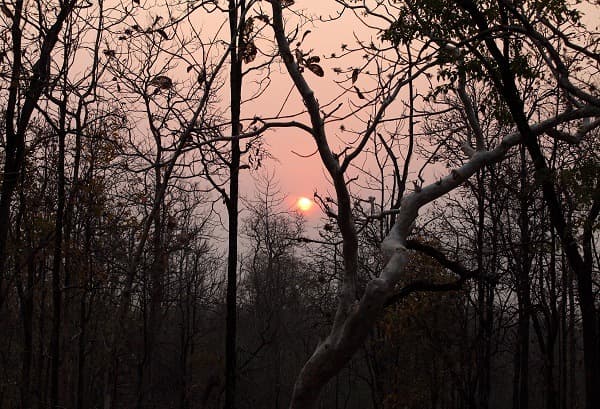
The dry deciduous forest — teak, bamboo, mahua — alternates with grasslands called maidans, ideal for spotting large mammals. The Bengal tiger is the star attraction, but leopards, dholes (Asian wild dogs), gaur (Indian bison) and sambar also roam the park. Bird life is abundant: brown-capped kingfisher, Indian hornbill, Indian peafowl.
History and context
The region was a hunting reserve of the Gond princes before British colonisation. It was declared a tiger reserve in 1992 as part of Project Tiger, then made a national park. The Pench River, which gives the park its name, forms the heart of the ecological corridor linking Pench to Kanha to the north. Kipling never visited these forests, but his descriptions closely match this landscape.
Highlights of a visit
Dawn jeep safari
The low morning light reveals animals before the heat of the day. Tigers often move along tracks and the banks of the Pench River. Local guides read alarm calls from deer and langur monkeys to locate predators.
Turia Lake
This artificial water body attracts marsh crocodiles, painted storks and wintering ducks. It's a fixed observation point, accessible even without venturing deep into the forest.
Buffer zone
Less regulated than the park's core, the buffer zone allows guided walking safaris and nights in tent camps. The experience is more immersive and far less crowded.
Night-time observation in the buffer zone
Some lodges offer legal night-time outings in the buffer zone. Civets, striped hyenas and jungle cats are regularly spotted after sunset.
Photography tips
Prioritise dawn outings: the light is golden and animals are active. A telephoto lens (400 mm minimum) is essential for tigers at the required viewing distance. Flash is forbidden in the park. In the dry season (March–April), sparse vegetation offers better sightlines, though midday light is harsher.
Location and access
The park is situated approximately 90 km north of Nagpur (Maharashtra) and around 100 km south of Jabalpur (Madhya Pradesh). Most visitors arrive via Nagpur, which has an airport well served from Mumbai, Delhi and Hyderabad. Taxis and organised transfers connect the airport to lodges on the park's edge. On the MP side, Seoni railway station is closest to Turia Gate.
Lodges and resorts are concentrated around Turia Gate on the Madhya Pradesh side, and Khursapar on the Maharashtra side.
Nearby
- Kanha National Park — approximately 180 km to the north, another major tiger reserve in Madhya Pradesh, larger and more frequented.
- Nagpur — the orange capital and convenient transit city, home to the Deekshabhoomi temple, an important Buddhist site.
- Ramtek — approximately 50 km from Nagpur, a Hindu temple perched on a hilltop, associated with the Ramayana.
- Tadoba National Park — approximately 150 km to the south-east, in Maharashtra, renowned for its highly visible tigers.
Frequently asked questions
March to June offers the best chances: vegetation is dry, and scarce water sources concentrate animals. October to February is more pleasant climatically, but denser vegetation makes observation more challenging.
Yes, online booking via the official Indian Forest portal is mandatory. During peak season (November–March), slots fill quickly; book several weeks ahead.
Yes. A classic itinerary links Pench to Kanha (approximately 3–4 hours by road) or to Tadoba (approximately 3 hours). Allow at least 2 nights in each park for meaningful safaris.
Neutral colours — khaki, olive green, beige. Avoid white, bright red and perfumes. A lightweight windbreaker is useful on winter mornings; a hat and sunscreen in summer.
No. The park's core typically closes from July to mid-October during the monsoon. The buffer zone may remain partially accessible depending on the year; check with your lodge before booking.
Yes, photography is permitted. Flash is strictly forbidden. Drones are prohibited throughout the park.
Photos
Want to discover this destination?
Our local advisors design your tailor-made trip.