Eravikulam National Park
Eravikulam National Park
Misty highlands, wild Nilgiri tahrs roaming free, and the highest peak of peninsular India: Eravikulam National Park, 15 km from Munnar, stands as one of the Western Ghats' most remarkable natural sites.
Eravikulam National Park sprawls across the Rajamalai highlands, roughly fifteen kilometers from Munnar, in Kerala's Western Ghats. Designated a biosphere reserve, it protects one of the world's largest populations of the Nilgiri tahr, a wild caprine species endemic to the region. Shola grasslands intersperse with misty forests and summits exceeding 2,600 meters, including Anamudi, the highest peak of peninsular India.
Quick facts at a glance
- Entrance: paid admission (rates differ for Indian residents and foreign visitors)
- Annual closure: the park typically closes February through March during tahr calving season — verify exact dates before your visit
- Suggested duration: 2 to 3 hours in the public-access zone
- Access: road from Munnar to the Rajamalai entry gate; shared jeeps or taxis provide connections
- Attire: closed-toe shoes recommended, warm clothing (cool temperatures at altitude)
- Accessibility: mountainous terrain with limited access for people with reduced mobility
What to see
The visitor-accessible zone follows a marked trail through Rajamalai's grasslands. Nilgiri tahrs, accustomed to human presence, often approach within meters. The shola vegetation—dense, humid forest confined to terrain hollows—contrasts strikingly with wind-swept open meadows. On clear days, vistas across the Western Ghats ridgeline are breathtaking.
History and context
The park was established in 1978 to protect the Nilgiri tahr (Nilgiritragus hylocrius), then critically endangered. Conservation programs launched in the 1980s have restored the population to several hundred individuals. Anamudi (2,695 m), encompassed within the park, ranks as the highest summit south of the Himalayas.
Highlights of your visit
The Nilgiri tahrs
These sturdy caprines with curved horns graze in herds across herbaceous slopes. Their relative indifference to visitors allows close observation, a rarity for a protected wild species.
The Neelakurinji bloom
Every twelve years, hillsides blanket in purple flowers of Strobilanthes kunthiana, the Neelakurinji. The next bloom is anticipated around 2030. Outside this window, grasslands remain spectacular yet without this distinctive hue.
Views of Anamudi
The summit remains inaccessible to tourists (protected core zone), yet it rises clearly along the trail on clear days, framing a remarkable photograph.
Photography tips
Morning light, before mist ascends, offers ideal conditions for capturing tahrs and ridgelines. Avoid flash near animals. Cloudy afternoons lend an atmospheric, misty quality to grassland shots. No specific photography restrictions apply in the public zone.
Location and access
The Rajamalai entry gate stands approximately 15 km from Munnar via road. Taxis and shared jeeps depart regularly from Munnar's center. The road winds narrowly; an early morning departure avoids crowds and ensures optimal visibility. No regular public transport directly serves the park.
Nearby attractions
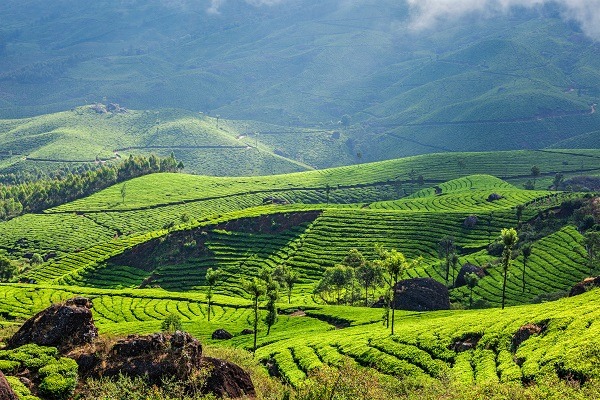
- Munnar tea plantations — terraced gardens surround the town and may be explored on foot or by jeep.
- Mattupetty Dam — reservoir lake with boat cruises, about ten kilometers from Munnar.
- Top Station — viewpoint at the Kerala-Tamil Nadu border, commanding panoramic vistas of the Ghats.
- Munnar Tea Museum — traces the region's tea cultivation history since the British colonial era.
Frequently asked questions
The optimal period spans October through January, following the monsoon. The park typically closes in February-March during tahr calving season. Avoid the monsoon months (June-September) for comfortable visiting conditions.
No. Anamudi lies within the park's protected core zone, closed to the public. Only authorized researchers may access it. The summit remains visible from the tourist trail.
Plan 2 to 3 hours on-site, including travel from Munnar. The public-access trail is relatively short, though tahr observation and photo stops naturally extend the experience.
Yes, throughout the park's open periods. Tahrs inhabit the Rajamalai zone permanently and readily approach visitors along the marked trail.
During peak season (October-January) and weekends, online reservation via the Kerala Forest Department's official portal is advisable to avoid queues at the ticketing counter.
Yes. A single day suffices to pair Eravikulam in the morning (optimal light, fewer crowds) with tea plantations or Mattupetty Dam in the afternoon.
Photos
Interested in this visit?
We can include it in your personalised itinerary.